IoT SIM for GPS Tracker Fleet Procurement and Multi-Country Device Operations
By jietion, Business Development (BD) at Quanqiu IoT · Published · Updated
Definition: Procuring IoT SIMs for a multi-country GPS tracker fleet means choosing connectivity that keeps trackers reporting across borders, fits their data and power budget, and can be managed centrally for years.
The short answer: buy for the routes and the tracker hardware, not for a headline price per megabyte. Check four things before ordering at volume. First, which radio technologies the trackers support on each route, because 2G and 3G are being switched off. Second, whether the SIM may stay on foreign networks long term. Third, how much data the reporting settings really use. Fourth, who will configure, suspend and replace SIMs once trackers are installed in other companies’ vehicles.
Start from the tracker, not the SIM
Many trackers still in service were built around 2G modules. Research prototypes from a few years ago show the pattern: a drone locator used an internal 2G card and reported once every 10 seconds during flight tests (Jiang et al., 2019), and a probe-vehicle tracker paired a quad-band GSM/GPRS module with GPS, reaching a first fix within 20 seconds and accuracy under 5 m outdoors (Wu et al., 2015). Hardware of that kind loses service wherever the 2G network closes, whatever SIM it holds.
For a new fleet, specify LTE-M, NB-IoT or LTE Cat 1 bis modules, with 2G fallback only where the routes still need it. List the countries on every route and check each one’s 2G and 3G status before ordering. The 2G and 3G shutdown checklist for trackers covers migration and SMS continuity.
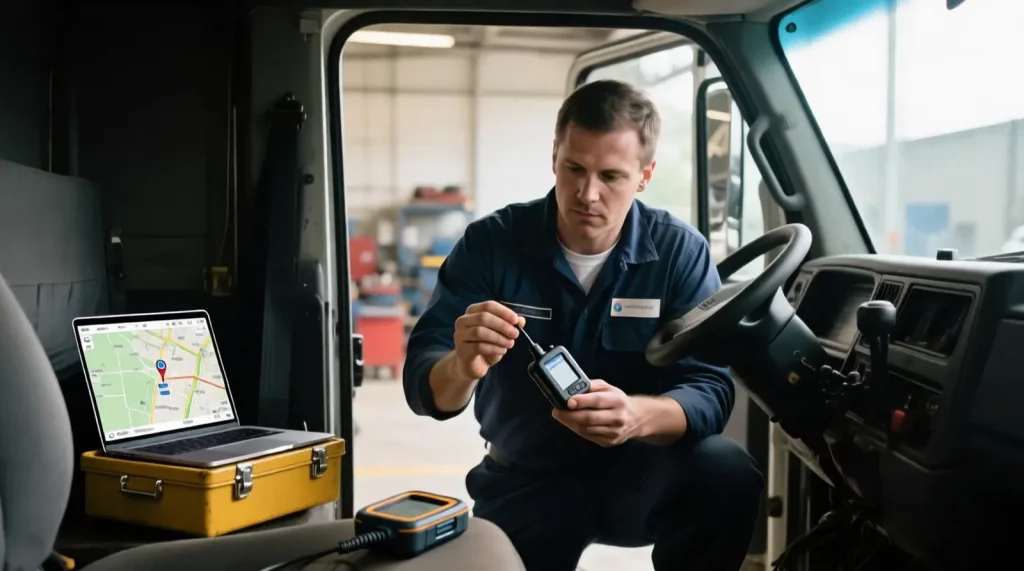
Cars and vans fitted with plug-in units need one more check before the order, the battery drain while parked. The sleep and cut-off settings are worked through in OBD GPS trackers for vehicles.
Teams working on network coverage in LTE-M GPS trackers can find the detailed checks in LTE-M GPS Trackers: Battery Life, PSM and eDRX Settings and Network Coverage.
Cross-border rules and roaming
A tracker on a truck crosses borders often; a tracker on a trailer or container may stay abroad for months. Short visits are normal roaming. Long stays raise the permanent-roaming question, because some operators and regulators restrict devices that live on a visited network. In the EU, Regulation (EU) 2022/612 provides roaming at domestic prices for periodic travel and lets operators apply fair-use policies, so long-term machine use depends on commercial agreements. Ask the provider, for each country on your routes, whether trackers may stay attached for months, and which networks they may use.
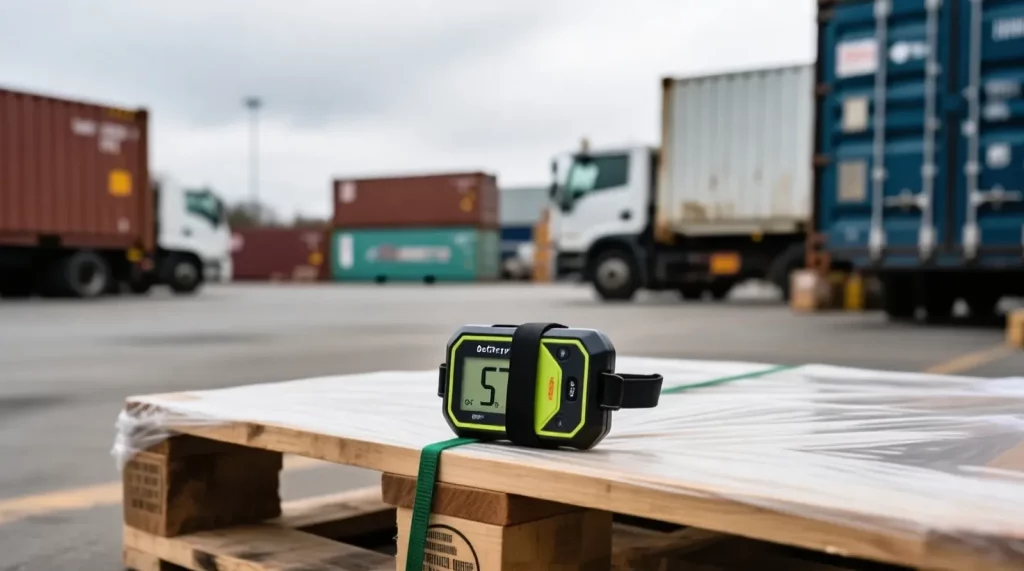
A global IoT SIM with several partner networks per country also helps in border areas and on motorways where one network is weak. The comparison of global, roaming and local SIMs explains the trade-offs, and the cold-chain truck example covers trailers that stay abroad.
Sizing data, SMS and battery
Data use follows the reporting settings. A position report is small, but each one also carries protocol overhead and, on some trackers, a new TCP connection.
| Tracker profile | Example settings | Rough monthly data per unit |
|---|---|---|
| Truck tracker, wired power | Report every 30 seconds while driving, 10 hours a day, 22 days | About 10 MB at 400 bytes per report including overhead |
| Van tracker with driver ID and CAN data | Report every 15 seconds, extra CAN fields | 20 to 50 MB |
| Battery asset tracker | 1 to 4 reports a day | Under 1 MB |
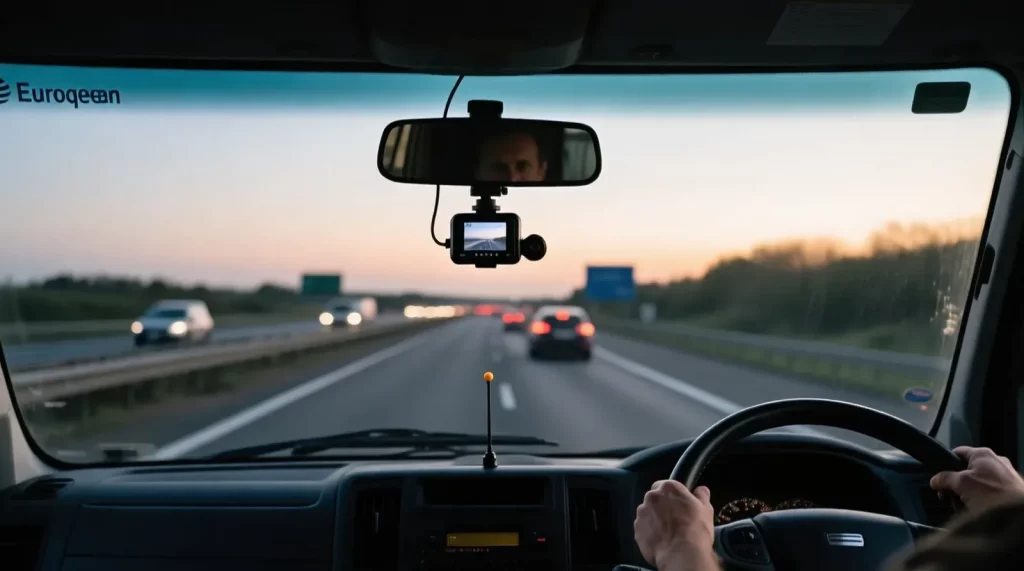
| Tracker with dash cam | Event clips or live view | Hundreds of MB or more; size separately |
These are our estimates; measure a pilot of 10 to 20 units on real routes for 30 days. Trackers with cameras are a different calculation; the 4G dash cam data guide works through event clips and live view minutes. Keep-alive timers matter as much as reporting intervals, because a tracker that reconnects after every carrier NAT timeout uses more data and battery than one tuned to the network; the guide to reporting intervals and keep-alive timers works through this. Battery trackers depend on power-saving features and sparse reporting; one design for airport ground equipment reached more than a year of standby with low-power chips and power management (Jiang et al., 2024).
SMS still matters for many trackers: installers send configuration commands by SMS, and some trackers fall back to SMS alerts when data fails. Confirm that SMS works on the roaming networks along the routes, not only at home.
Operations after installation
- Who owns the SIM. Trackers are often sold by a distributor or telematics provider to fleets. Agree whether SIMs stay on the provider’s account or move to the fleet’s, and how they are suspended when a customer leaves.
- Lifecycle states. Keep SIMs in test or inventory until installation, so stock waiting in a warehouse is not billed as active.
- Usage alerts. A tracker with a firmware fault can report every second. Set per-SIM alerts and an automatic suspend threshold.
- Theft and swaps. IMEI locking stops a removed SIM working in another device; record IMEI changes when a tracker is replaced.
- APN and configuration. Use the APN from the SIM delivery sheet; a wrong APN is the most common reason a new tracker shows as online but sends nothing.
The guide to SIMs for trackers and dash cams covers device types, and container tracking procurement shows how to run a pilot before a fleet contract.
When to ask for a project quote
- Trackers will stay for months in countries where permanent roaming may be restricted.
- The fleet mixes 2G-era and LTE-M or NB-IoT trackers.
- You resell trackers and need SIM transfer or sub-accounts for your customers.
- Dash cams or video add large, uneven data use.
Quanqiu IoT supplies Global IoT SIM cards for GPS trackers, with SMS, pooled data and a CMP for alerts and lifecycle control; operators and network technologies per country are confirmed in the quote. Route lists and tracker models can be sent through the contact page.
FAQ
How much data does a GPS tracker use?
From under 1 MB a month for battery asset trackers to tens of MB for vehicle trackers reporting every few seconds. Dash cams use far more.
Will my 2G trackers keep working abroad?
Only where the visited networks still run 2G. A roaming SIM loses 2G at the same time as local users.
Can a tracker stay on a foreign network for months?
It depends on the country and partner network. Ask the provider in writing for every country where trackers will stay long term.
Do trackers need SMS?
Many use SMS for configuration and fallback alerts. Check that SMS works on roaming networks along your routes.
How do we stop runaway data from a faulty tracker?
Set per-SIM usage alerts and an automatic suspend threshold in the connectivity platform.
Official References
- Regulation (EU) 2022/612 on roaming on public mobile communications networks within the Union
- 3GPP Release 13, which introduced LTE Cat-M1 and NB-IoT for machine-type devices
- ITU-T Recommendation E.212: The international identification plan for public networks and subscriptions
- Jiang Zhikai et al. (2019). Technical Research on a UAV Locator System with Sound, Light, and Smoke Peripherals (in Chinese). 科技创新导报, (01), 6-7.
- Wu Zhenyu, Song Xi (2015). Design of a Probe Vehicle Tracker Based on SIM908 and KL25 (in Chinese). 计算机测量与控制, 23(9), 3151-3154.
- Jiang Jian, Shi Qiyu (2024). An Intelligent Positioning Terminal for Unpowered Equipment and Its Method (in Chinese). 中国信息界, (04), 183-185.