OBD GPS Trackers for Vehicles: Plug-In Installation, Power Behaviour and SIM Data Use
By jietion, Business Development (BD) at Quanqiu IoT · Published
Definition: An OBD GPS tracker is a small location unit that plugs into a vehicle’s OBD-II diagnostic port, takes power from it, and sends position and engine data over a cellular IoT SIM.
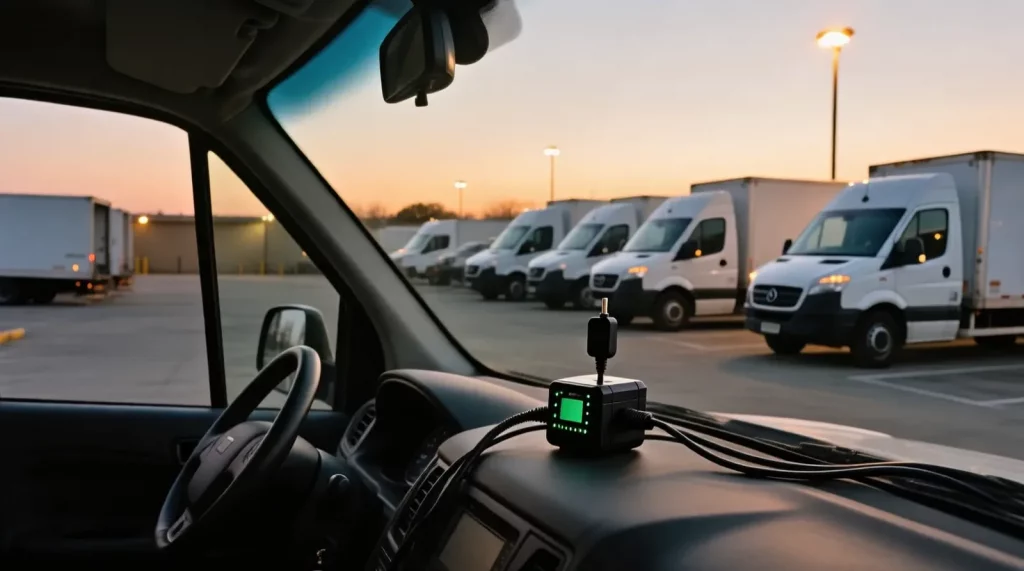
An OBD GPS tracker is the quickest tracker to fit: it plugs into the diagnostic socket under the dashboard, needs no wiring, and can read speed and fault codes as well as position. A car or van reporting every 30 seconds while driving uses about 2 MB of data a month, so a 30 MB plan leaves plenty of room. The settings that cause trouble are sleep and wake-up, because the port stays powered when the engine is off, and a tracker that never sleeps will flatten a small battery in a few weeks.
What the tracker gets from the diagnostic port
The socket is the 16-pin connector defined in SAE J1962, normally within reach of the driver’s seat. Pin 16 carries battery voltage at all times, pins 4 and 5 are ground, and on most vehicles built since the late 2000s pins 6 and 14 carry the CAN bus that the tracker uses to query the engine controller. OBD-II became mandatory on light-duty vehicles in the United States from model year 1996, and the European equivalent, EOBD, applies to petrol cars from 2001 and diesel cars from 2004. Older vehicles and most heavy trucks do not have this socket. Trucks use SAE J1939 on a separate 9-pin connector, so a “universal” OBD tracker will not fit them.
Through the port, a tracker can request standard values such as vehicle speed and engine speed, and read stored diagnostic trouble codes. A design for monitoring commercial vehicles lists speed, fuel consumption, load, braking frequency, engine condition and trouble codes as the parameters gathered through OBD and add-on sensors, and sets the collection rate at 1 Hz or faster with routes sampled at least once a minute (Liu). That paper reports positioning within 2.5 m using a receiver that also tracks BeiDou, but it describes a designed and tested system, not a large fleet in service. Manufacturer-specific values such as fuel level or odometer are not part of the standard request set on many models. Ask the device vendor for a tested list of vehicle makes before you promise those fields to a fleet manager.
Ignition detection, sleep and the parked battery
Because pin 16 is always live, the tracker has to decide by itself when the vehicle is in use. Most units watch the supply voltage, which rises above about 13 V when the alternator is charging, and combine it with an accelerometer. Voltage alone fails on vehicles with smart charging systems that let the voltage fall while driving, and motion alone wakes the tracker every time a lorry passes the car park. Test both on the actual vehicle models before rollout.
The parked current is where budgets go wrong. A tracker that sleeps at 5 mA uses about 3.6 Ah in 30 days. One that keeps its modem registered and its GNSS receiver running may draw 40 mA, which is close to 29 Ah over the same month, about half of a 60 Ah car battery. Pool cars and hire vans that stand for weeks are the vehicles that come back with flat batteries. Set three things in the configuration: a sleep mode that turns off GNSS when parked, a heartbeat interval measured in hours, and a low-voltage cut-off above the level at which the vehicle still starts reliably. The vehicle maker’s figure for that level is the one to use.
How much SIM data an OBD tracker uses
The table assumes about 250 bytes on the air for each report over TCP, including headers and acknowledgements, two hours of driving a day, a heartbeat every hour while parked, and a 30-day month. Change the payload or the driving time and the arithmetic stays the same.
| Setting | Reports per day | Data per month |
|---|---|---|
| Position every 60 s while driving | 142 | about 1.1 MB |
| Position every 30 s while driving | 262 | about 2 MB |
| Position every 10 s while driving | 742 | about 5.6 MB |
| 1 Hz positions, each sent on its own | 7,222 | about 54 MB |
| 1 Hz positions, 30 fixes sent together every 30 s | 262 uploads | about 7 MB |
| Firmware update over the air | once | file size plus retries; to be confirmed during project validation |
The fourth and fifth rows carry the same positions. Batching cuts the data by roughly eight times because the header overhead is paid once per upload. Trouble codes and engine values add little if they are sent on change. Where a fleet platform asks for 1 Hz tracking, ask whether it accepts batched uploads before you size the plan. Interval choices and keep-alive timers are covered in more detail in GPS tracker reporting intervals and keep-alive timers.
Choosing LTE Cat 1, LTE-M or NB-IoT for a plug-in tracker
An OBD tracker has vehicle power, so the low current of NB-IoT matters less than it does for a battery tag. What matters is delay and coverage while moving. In the comparison table of the commercial-vehicle study, 4G LTE showed a mean latency of 50 ms and NB-IoT 1,500 ms (Liu). Those are the authors’ figures for their own design, but the gap explains why live map tracking feels slow on NB-IoT. LTE Cat 1 and LTE-M are the usual choices for vehicles. Choose LTE-M only for countries where it is switched on and open to roaming SIMs, and keep a Cat 1 variant for the rest.
Older trackers still run on 2G. Early vehicle locators sent position and load status over GPRS to a central platform, as in a logistics tracking system tested on a Beijing to Shenyang route (Dong, 2018). Where 2G and 3G have been shut down, those units stop reporting whatever SIM is fitted; see GPS trackers after the 2G and 3G shutdown.
Installation and rollout checks for fleets
The plug-in design that makes fitting quick also makes removal quick. A driver who wants to switch tracking off can pull the unit out in a second, so configure an unplug alert that the tracker sends from its backup battery, and check that the platform raises it. A short extension cable with the tracker tucked behind a panel makes removal harder and stops the unit hitting the driver’s knee. Some vehicles also keep their diagnostic bus quiet unless the ignition is on, which is normal and not a fault.
Plan the rollout as a pilot of ten to twenty vehicles of each model, for two weeks. Check four things: that trips start and end where the drivers say they did, that the parked battery voltage holds, that fault codes match what a workshop scanner reads, and that data per SIM sits close to the estimate. For multi-country fleets, confirm the networks in each country and any limits on permanent roaming, as set out in GPS tracker fleet procurement and multi-country operations.
When a plug-in tracker is the wrong choice
An OBD unit suits cars, vans and pickups that the company owns or leases long term. It is a poor fit for heavy trucks without the socket, for trailers and containers with no engine, and for theft recovery, because the first thing a thief checks is the diagnostic port. A hard-wired tracker hidden in the loom, or a battery tracker inside the cargo, covers those cases. For vehicles that also need video, a dash cam with its own SIM is compared in IoT SIM for GPS trackers and fleet dash cams.
Quanqiu IoT supplies Global IoT SIM cards for vehicle trackers. Its standard tracker plan is 30 MB a month, and vehicle-tracker projects have used plans from 30 MB to 100 MB. The networks for each country are confirmed in the project quote; send the tracker model and the country list through the quote process.
FAQ
What is an OBD GPS tracker?
A tracker that plugs into the vehicle’s 16-pin OBD-II diagnostic socket. It takes power from the socket, finds its position by satellite, can read engine data such as speed and fault codes, and sends everything over a cellular SIM.
Does an OBD tracker drain the car battery?
It can. The socket is powered with the engine off, so the tracker must sleep when parked. A well-configured unit uses a few amp-hours a month; one that never sleeps can use about half of a small car battery in a month.
How much data does an OBD GPS tracker use?
About 1 to 6 MB a month for a vehicle driven two hours a day and reporting every 10 to 60 seconds. Unbatched 1 Hz tracking can reach about 54 MB, which is the case to check before choosing a plan.
Will an OBD tracker work in a truck?
Usually not as a plug-in. Heavy trucks use the J1939 bus on a different connector. Use a tracker made for J1939 or the truck’s FMS interface instead.
Can I read fuel level and mileage through the OBD port?
Only on models where the vehicle maker exposes them. They are not in the standard request set on many vehicles, so ask the tracker vendor for a tested list of makes and models.
Official References
- GSMA: Internet of Things
- GSMA: Mobile IoT (LTE-M and NB-IoT)
- Liu Ruixue. Research on the Design of an IoT-Based Information Supervision System for Commercial Vehicles (in Chinese). 运输经理世界, 144-146.
- Dong Xiao (2018). Analysis of the Application of GPS-Based Embedded Locators in the Internet of Things (in Chinese). 信息系统工程, 45-46.