2G and 3G Shutdowns for GPS Trackers: Migration Planning, SMS Continuity and Roaming Checks
By jietion, Business Development (BD) at Quanqiu IoT · Published · Updated
Definition: For GPS trackers facing 2G and 3G shutdowns, the IoT SIM must work on the LTE, LTE-M or NB-IoT network each replacement tracker uses, including SMS for configuration and roaming in every country.
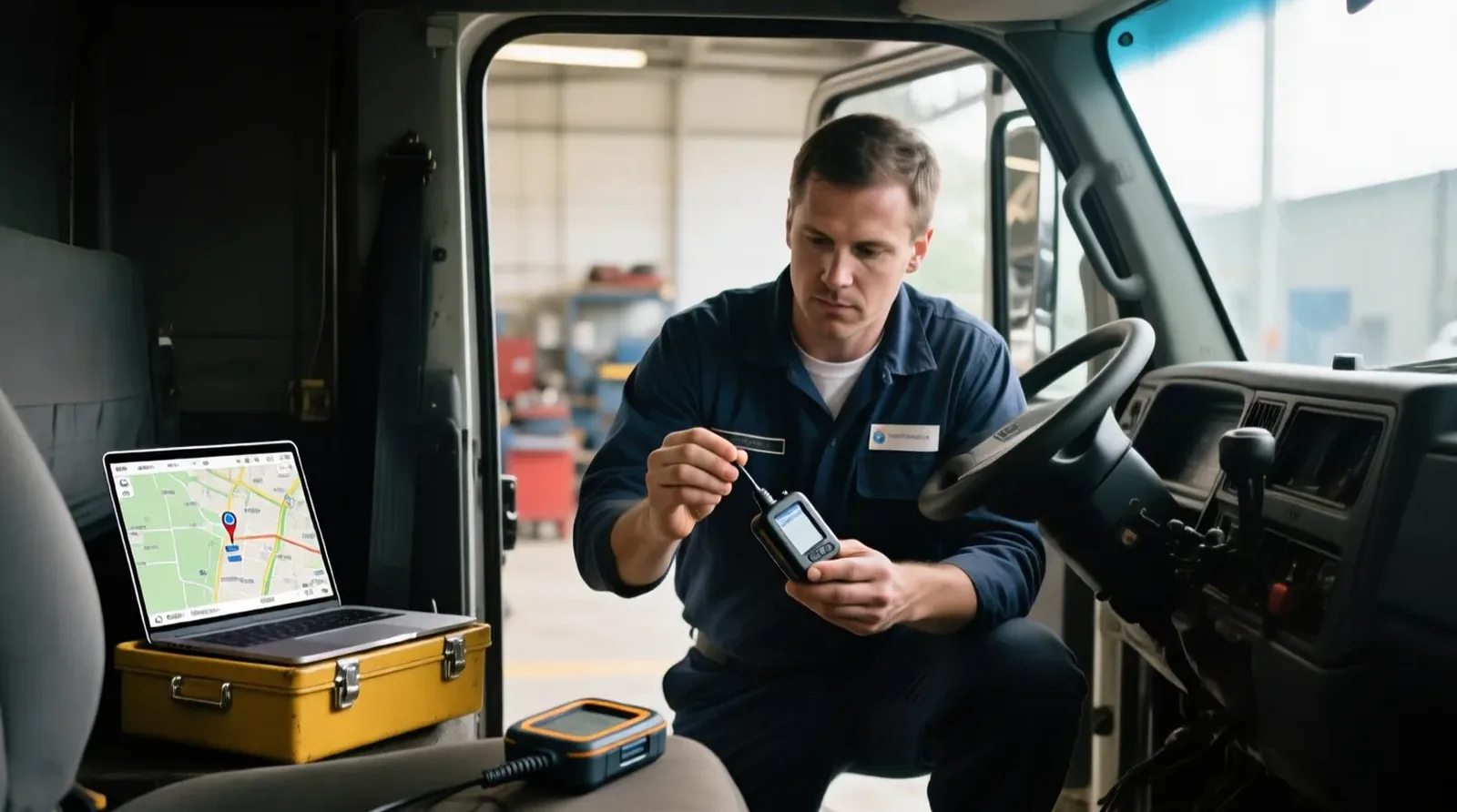
Start with an inventory, not a SIM swap. A tracker whose cellular module only speaks 2G or 3G stops reporting when the last network it can use in a country closes, and no SIM change can prevent that. The migration therefore has three parts: find every 2G- or 3G-only unit, replace it with an LTE Cat-1, LTE-M or NB-IoT model that fits the use case, and confirm in a pilot that both data and SMS work on the new networks in every country the vehicles visit. The SIM question comes last and is the easy one.
Why network closures hit trackers harder than phones
Phones are replaced every few years; trackers are installed behind dashboards and in trailers and left for a decade. Many older tracker designs were built on 2G modules, as the examples further down show. The pace of closures is now fast: GSMA notes that more than 130 networks are expected to retire their legacy technologies by 2030, and its IoT community published guidance in March 2025 because devices that rely on SMS are at risk when those networks go.
Regulators handle the transition differently, which is why dates must be checked country by country. In a contribution to BEREC, the alarm provider Verisure reports that Finland requires operators to keep the 2G band until 31 December 2029 and to give end users at least a year’s notice of changes, and that Norway’s parliament asked the regulator Nkom for an impact assessment, whose July 2025 report recognised that home alarm systems and similar devices would be affected. For other countries, rely on each operator’s own announcements and recheck them during the project.
Finding the 2G-only units in a fleet
The tracker brand rarely tells you the network generation; the module inside does. Published designs show how common 2G modules have been in trackers. Two vehicle trackers from 2015 used the SIM908, a quad-band GSM/GPRS module with integrated GPS (Wu et al., 2015; Mo et al., 2015). An ARM-based locator used the MC20, which combines quad-band GSM/GPRS with GNSS positioning (Dong, 2018). A UAV locator carried a 2G communication card, a dependency its authors list as a limitation (Jiang et al., 2019), and a review of pet trackers describes location data travelling over 2G GPRS or NB-IoT (Wu, 2021).
For each tracker model in the fleet, record the module and the network technologies it supports, either from the datasheet or by reading the module identity with an AT command during maintenance. Group the fleet into three lists: 2G or 3G only, LTE with 2G fallback, and LTE-only. Only the first list needs hardware replacement before closure; the second needs a check that it actually moves to LTE when 2G disappears.
Choosing the replacement: LTE Cat-1, LTE-M or NB-IoT
The replacement technology follows the tracker’s power source and how often it must report. Vehicle-powered trackers that report while driving are usually best served by LTE Cat-1, which keeps reasonable speed for firmware updates and photos. Battery trackers on trailers, containers and equipment benefit from LTE-M or NB-IoT power-saving modes; an airport cart terminal using NB-IoT, with carts asleep except when towed and a daily status report, reached more than a year of standby (Jiang & Shi, 2024). NB-IoT suits units that send a few small messages a day but is a poor fit for fast-moving vehicles that need frequent live positions.
| Replacement option | Fits | Watch-outs | Check per country |
|---|---|---|---|
| LTE Cat-1 | Vehicle-powered fleet trackers, trackers with photos or voice | Higher power draw than LTE-M or NB-IoT | LTE roaming for the SIM: To be confirmed during project validation |
| LTE-M | Battery trackers on trailers and assets that still move between cells | Network availability and roaming support vary by country | LTE-M roaming support: To be confirmed during project validation |
| NB-IoT | Stationary or slow assets sending a few messages a day | Not designed for frequent live tracking; roaming support is limited in places | NB-IoT availability and roaming: To be confirmed during project validation |
| LTE with 2G fallback | Transition where 2G still runs | Fallback disappears with the 2G network | Closure date per operator |
Keeping SMS configuration working on LTE
Many trackers are configured, queried or even controlled by SMS. One SIM908 vehicle tracker worked without any server: the owner sent an SMS command and received a map link with the vehicle’s position, and another command cut the fuel line and power (Mo et al., 2015). The MC20 locator could deliver positions by SMS or over TCP (Dong, 2018). Fleets that use SMS for APN changes, server addresses or remote immobilisation must confirm SMS still reaches the tracker after 2G closes.
That is not automatic. GSMA’s 2025 whitepaper states that SMS fallback for IoT is no longer guaranteed as 2G and 3G close, and its November 2025 webinar describes SMS over Diameter (SGd) as one way operators keep SMS available on LTE. For a buyer the practical rule is to test SMS delivery to the replacement tracker on the actual LTE or LTE-M network in each country during the pilot. On Quanqiu IoT SIMs, SMS is supported and switched on for a project after the requirement is confirmed, so state SMS use in the quote request.
Roaming SIM checks before the closure date
Most international fleets run trackers on a Global IoT SIM that attaches as a roaming subscriber. When a visited operator closes 2G, the roaming SIM loses that network at the same time as local SIMs, and roaming access to LTE-M or NB-IoT is agreed separately from ordinary LTE roaming. Check three things for every country on the routes: the closure dates of each operator the SIM can use, which of them allow LTE-M or NB-IoT roaming, and whether permanent roaming rules limit how long a foreign SIM may stay. The trade-offs between SIM types are compared in Global IoT SIM vs roaming SIM vs local SIM. Where a country restricts long-term roaming, an eSIM that can download a local profile avoids a second hardware visit.
A migration plan, and when to request a project quote
Plan the work in four steps: inventory modules, pilot replacement trackers on the real routes, replace units country by country in order of closure date, and retire the old SIMs. Keep the existing SIMs in replacement trackers where they already support the new network; most of our SIMs use the APN mobile, and the delivery sheet states the APN for each order. A replacement wave is also the moment to revisit data plans, since LTE trackers often carry new features; size them from the pilot or with the IoT data usage calculator, and see the GPS tracker SIM page for plan options.
Ask for a project quote when the fleet spans several countries, when you need SMS, pooled data or eSIM, or when you want network availability confirmed per country before buying replacement hardware. The wider buying process for multi-country fleets is set out in GPS tracker fleet procurement across countries.
What a SIM change cannot solve
A new SIM does not upgrade a 2G-only module, add LTE bands the module lacks, or make an old firmware use LTE power-saving modes. It also cannot guarantee that an operator keeps a network open until a given date. Treat closure dates as planning inputs to be rechecked each quarter, and keep the replacement budget tied to the hardware inventory rather than to the SIM contract.
FAQ
Will my 2G GPS tracker work with a new SIM after 2G closes?
No. If the tracker’s module supports only 2G, it cannot connect once no 2G network remains in that country, whatever SIM it uses. The tracker itself has to be replaced with an LTE Cat-1, LTE-M or NB-IoT model.
Should replacement trackers use LTE Cat-1 or LTE-M?
Vehicle-powered trackers that report while driving usually suit LTE Cat-1. Battery trackers on trailers and assets gain more from LTE-M power-saving modes, provided LTE-M roaming is available in the countries they visit.
Will SMS commands still work after the 2G shutdown?
Only if SMS is delivered over the LTE network the tracker uses. GSMA warns that SMS continuity for IoT is not guaranteed, so test SMS to the new tracker in each country during the pilot and state SMS use in the quote request.
Do Global IoT SIMs lose 2G at the same time as local SIMs?
Yes. A roaming SIM uses the visited operator’s networks, so it loses 2G when that operator closes it. Check each operator’s dates and whether it supports LTE-M or NB-IoT roaming.
Can we keep our existing SIMs in the replacement trackers?
Often yes, if the SIM’s plan covers the new network technology in each country. Confirm the APN on the delivery sheet and test the replacement tracker with the existing SIM during the pilot.
Official References
- GSMA: Ensuring SMS Continuity for IoT After 2G/3G Shutdown (March 2025)
- GSMA: Ensuring SMS service continuity for IoT on LTE, webinar (November 2025)
- Verisure contribution to the draft BEREC 2026-2030 Strategy
- Wu Zhenyu, Song Xi (2015). Design of a Probe Vehicle Tracker Based on SIM908 and KL25 (in Chinese). 计算机测量与控制, 23(9), 3151-3154.
- Mo Changjiang, Liang Qiwen (2015). Design of a Real-Time Vehicle Positioning System Based on SIM908 (in Chinese). Automotive Electronics, (1), 57-59. https://doi.org/10.3969/j.issn.1005-5517.2015.1.011
- Dong Wenchao (2018). An ARM-Based Tracking Locator (in Chinese). 科技创新与应用, (7), 27-28. https://doi.org/10.19981/j.cn23-1581/g3.2018.07.011
- Jiang Zhikai, Yang Xue, Zhang Jie et al. (2019). Technical Research on a UAV Locator System with Sound, Light, and Smoke Peripherals (in Chinese). 科技创新导报, (01), 6-7.
- Wu Shengli (2021). Current Status and Development Trends of Dog GPS Trackers (in Chinese). 中国工作犬业, (10), 64-65.
- Jiang Jian, Shi Qiyu (2024). An Intelligent Positioning Terminal for Unpowered Equipment and Its Method (in Chinese). 中国信息界, (04), 183-185.