Cold-Chain Truck Temperature Monitoring Across Countries: Roaming Rules, Local Profiles and Connectivity Choices
By jietion, Business Development (BD) at Quanqiu IoT · Published · Updated
Definition: For cold-chain trucks, an IoT SIM carries temperature readings, door and position events from the reefer telematics unit to the monitoring platform, and it must keep attaching to networks as the truck crosses borders.
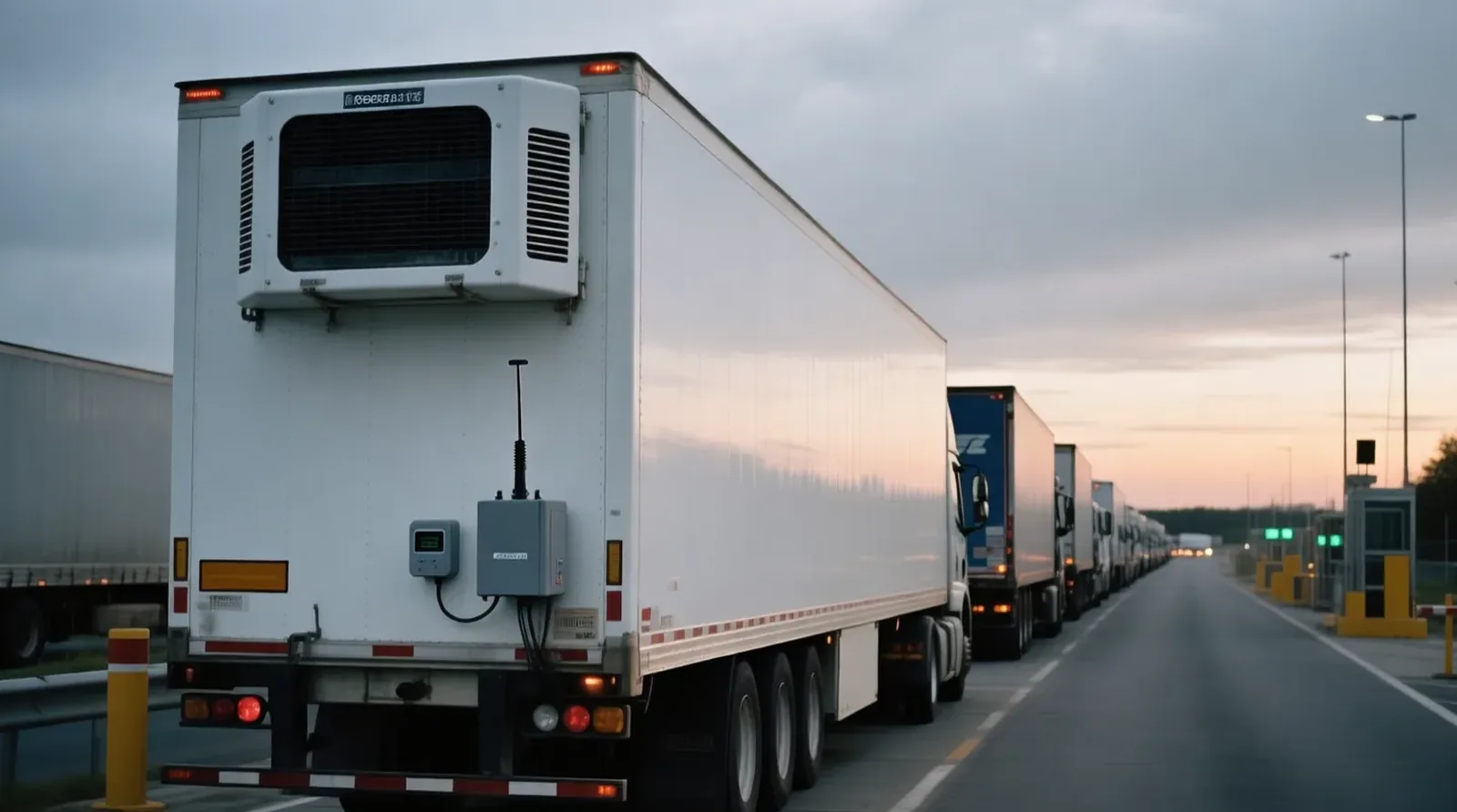
A cold-chain truck that runs between countries needs one SIM decision made before the first unit ships: either a Global IoT SIM that attaches in every country on the route, or a local SIM per market with the swap and contract work that brings. For most cross-border reefer fleets the single Global IoT SIM is simpler, because a temperature log with a gap at every border is exactly what a shipper’s audit will question. The SIM choice still has limits. Some markets restrict SIMs that stay on roaming for months, the telematics unit has to support the radio technologies used along the whole route, and the data plan has to match how often the unit reports. This article works through those three questions and what to put in a quote request.
Why a temperature record breaks at the border
Shippers of food and pharmaceuticals buy refrigerated transport partly for the record: a continuous temperature log from loading to delivery, tied to the truck’s position. A cellular gap does not by itself spoil the cargo, but it leaves a hole in the evidence. If an alarm fires while the unit has no connection, the driver and dispatcher learn about it late, and the log for that stretch can only be filled in if the device buffers its readings and uploads them after reconnecting.
The risk is concentrated where the truck stops and opens. A study of urban short-haul cold chains reports that open handling at the last mile accounts for 63% of temperature-control failures (You et al., 2026). That is a useful reminder for long-haul planning too: border crossings, depots and delivery stops are where doors open, engines stop and the reefer unit may cycle, and they are also the places where a SIM changes networks or loses coverage. Connectivity planning should treat those points as the high-risk part of the route, not the motorway in between.
What a reefer telematics unit sends over cellular
A cold-chain unit is a small data producer compared with a camera. Typical traffic is periodic temperature and humidity readings from one or more probes, GPS position, door-open and alarm events, and occasional configuration commands from the platform. The research designs show the common building blocks. One logistics system uses vehicle locators that send position and load status over GPRS to a central management platform, which tracks and dispatches goods and vehicles from one place (Dong, 2018). A short-haul cold-chain design reads battery-free passive RFID temperature tags within about 5 m of an ESP32 controller, fuses them with GPS and motion data, and uploads the result over MQTT (You et al., 2026). Bus and fleet gateways increasingly translate vendor-specific terminal data into standard formats such as JT/T 808 before sending it, so that one platform can read several device makes (Li, 2026).
The practical consequence for the SIM is that the unit sends many small messages rather than large files. Our standard plan for fleet tracking devices, including container and cold-chain monitors, is 30 MB per month. Shorter reporting intervals, frequent reconnections and over-the-air firmware updates raise that number, so measure real usage during a pilot. If the same trucks carry dash cams, treat those separately: video needs larger plans, which are quoted to the customer’s usage. The Fleet & Logistics IoT SIM page lists the device types side by side, and the IoT data usage calculator gives a first estimate per unit.
Roaming restrictions and local profiles on a multi-country route
A Global IoT SIM normally registers as a roaming subscriber in each visited country. That is what lets one SIM work across a route, and it is also where the commercial limits sit. Several markets restrict permanent roaming, meaning a SIM that stays on a foreign network for months rather than visiting; others require local registration of SIMs or devices. A truck that only passes through a country is a different case from a trailer parked there for a season. Which restrictions apply to your route, and whether a local profile is needed in a particular market, is confirmed during project validation for the specific country list.
This is where eSIM changes the procurement conversation. With an eSIM, operator profiles are stored electronically and can be configured remotely, so a unit can receive a different profile later without a physical SIM swap. That matters for long-lived reefer units installed in trailers that may be redeployed to another region. It does not remove the need to check the route: the device, the profile and the visited networks all have to support each other. The comparison in Global IoT SIM vs roaming SIM vs local SIM covers the general trade-off.
Radio technologies along the route
Reefer telematics units range from older 2G-only designs to LTE Cat-1, LTE-M and NB-IoT modules. GSMA describes LTE-M and NB-IoT as licensed low-power wide-area technologies for low-cost devices with low data rates and long battery life, which suits battery-powered trailer and container monitors. The catch for cross-border fleets is that availability differs by country and changes over time as operators switch off 2G and 3G. Our SIMs support the network technologies we provide in each country, including 2G, 4G LTE and LTE-M where the local network offers them, so the check that matters is the device: which technologies its module supports, and whether those stay available on every country of the route for the life of the trailer.
Two further device settings decide whether the truck reconnects cleanly after a border crossing. Data roaming must be enabled, and the APN must be set correctly; most of our SIMs use the APN mobile with no username or password, and the delivery sheet that comes with the SIMs is the reference. Units configured by SMS command need SMS enabled on the SIM, which is done per project after confirmation.
Choosing the connectivity model: a decision table
| Fleet pattern | Typical choice | What to check | Data starting point |
|---|---|---|---|
| Trucks stay in one country | Country plan from the catalog | Coverage on depots and routes; device radio technology | 30 MB per month standard plan |
| Regular cross-border routes | One Global IoT SIM for all countries on the route | Roaming acceptance and registration rules per country | 30 MB per month; pooled data above a minimum quantity |
| Trailers parked abroad for long periods | Global IoT SIM or eSIM with a local profile | Permanent-roaming restrictions in that market | To be confirmed during project validation |
| Battery-powered container monitors | LTE-M or NB-IoT where offered | LPWA availability in every country of the route | Reporting interval decides usage; measure in a pilot |
| Trucks with reefer unit and dash cam | Separate plans per device type | 4G LTE for video; clip upload pattern | Video plan quoted to usage |
Pooled data is often the deciding factor for mixed long-haul and regional fleets. All SIMs in a pool share one allowance, so a truck that reports more on a long route is balanced by vehicles that spent the month near the depot. The minimum quantity and pool size are agreed in the quote.
Security and access on refrigerated fleets
Remote access to a reefer unit can change setpoints or silence alarms, so it deserves the same control as any other operational system. For cold-chain buyers the questions are practical: who can send commands to the unit, whether the platform logs those commands, and whether the SIM is limited to the services the device needs. Our device cybersecurity procurement questions give a checklist to send to the telematics vendor.
When a cold-chain fleet needs a project quote
A single-country pilot with one reefer telematics model can start from a catalog plan. Move to a project quote when the routes cross several countries, when trailers stay abroad for long periods, when the fleet mixes device types, or when you want pooled data, SMS configuration, eSIM profiles or CMP visibility across the fleet. The procurement steps for multi-country tracker fleets are covered in GPS tracker fleet procurement across countries.
Send these details: the telematics unit model or its cellular module, the countries and border crossings on each route, how long trucks or trailers stay in each country, the reporting interval and alarm behaviour, the number of units for the pilot and the full fleet, and whether dash cams or other devices share the vehicles. Our answer covers the networks available per country, the plan or pool, and any market where a local profile or registration is needed.
FAQ
How much data does a cold-chain truck monitor use?
Temperature, position and door events are small messages. Our standard plan for fleet tracking and cold-chain monitors is 30 MB per month; shorter reporting intervals, reconnections and firmware updates use more, so confirm real usage in a pilot.
Can one SIM cover a truck that crosses several countries?
Yes, a Global IoT SIM attaches in each country on the route as a roaming subscriber, so the unit needs no SIM swap at the border. Data roaming must be enabled on the device.
What happens if a trailer stays in one foreign country for months?
Some markets restrict permanent roaming or require local registration. For long stays we check that market during project validation and may recommend a local profile, for example on an eSIM.
Will the temperature log have gaps when the truck loses coverage?
That depends on the telematics unit. Choose units that buffer readings while offline and upload them after reconnecting, and test this behaviour at a border crossing during the pilot.
Does the SIM support SMS configuration of reefer units?
SMS is supported and is enabled per project after confirmation. Mention SMS in the quote request if your units are configured by SMS command.
Official References
- GSMA Internet of Things
- GSMA Mobile IoT (LTE-M and NB-IoT)
- You Yuhang, Xiao Shungen, Chen Ziqi, Xue Chenxin (2026). Design of a Logistics Tracking System Based on Passive RFID (in Chinese). 机电信息, (13), 33-37,43.
- Dong Xiao (2018). Analysis of the Application of GPS-Based Embedded Locators in the Internet of Things (in Chinese). 信息系统工程, 45-46.
- Li Bo (2026). Research on the Interconnection between Vehicle Terminals and Information Systems in Smart Public Transport Scenarios (in Chinese). 智能制造研究与应用, 2(6), 13-15.