Remote Security-Camera Sites: Cellular Connectivity Design, Power and Network Selection
By jietion, Business Development (BD) at Quanqiu IoT · Published · Updated
Definition: For remote security-camera sites, an IoT SIM provides the cellular backhaul that carries alarm events, video clips and remote viewing from cameras or a site recorder to the monitoring platform where no wired line exists.
Cellular backhaul for a remote camera site works when the design keeps video local and sends only what the operator needs: alarm events, short clips and live view on demand. A site that tries to stream every camera around the clock over a mobile link will either exhaust its data plan or run into upload limits within days. The arithmetic is simple. One camera streaming continuously at 2 Mbps produces about 21.6 GB per day, which is roughly 650 GB per month; the same camera recording locally and uploading twenty 30-second event clips a day sends about 4.5 GB per month. The rest of the design follows from that choice: the radio technology, the antenna position, the power budget on solar or battery sites, and the security of a device that is reachable from the internet.
Recording on site versus streaming: the decision that sets the data plan
Data use on a camera site is roughly bitrate × time, multiplied by the number of cameras that upload. Three patterns cover most projects:
- Event upload: cameras or a site recorder store video locally and send a clip when motion analytics, a door contact or an alarm panel triggers. A 30-second clip at 2 Mbps is about 7.5 MB.
- Live view on demand: the operator opens a stream after an alarm or for a patrol check. One hour at 1 Mbps is about 450 MB, so the monthly figure depends on how often, and for how long, people actually watch.
- Continuous streaming: every camera sends video all the time. Over cellular this is rarely the right design except for a small number of critical views at reduced bitrate.
Construction sites, solar farms, pipelines and car parks usually fit the first two patterns. The plan therefore depends on how many events the site generates and how the monitoring team works, not on the camera’s maximum resolution. We have larger data plans for video and quote them to the customer’s measured usage; a short pilot with the real cameras and analytics settings is the most reliable basis. For vehicle cameras the same logic applies, see Dash Cam SIM.
Network selection: 4G LTE for video, low-power channels for alarms
Video needs 4G LTE. 2G cannot carry it in practice, and LPWA technologies such as LTE-M and NB-IoT are built for small messages. NB-IoT does reach deeper into poor coverage: its downlink in standalone mode has a power spectral density about 17 dB above LTE, and its single-tone uplink about 10.8 dB above LTE (Wang et al., 2022). That makes a low-power channel useful for alarm sensors and status messages on the same site, while the video path stays on LTE. If a project uses such a split, the availability of each technology is confirmed per country during project validation; our SIMs support the network technologies we provide in each country, including 4G LTE and LTE-M where the local network offers them.
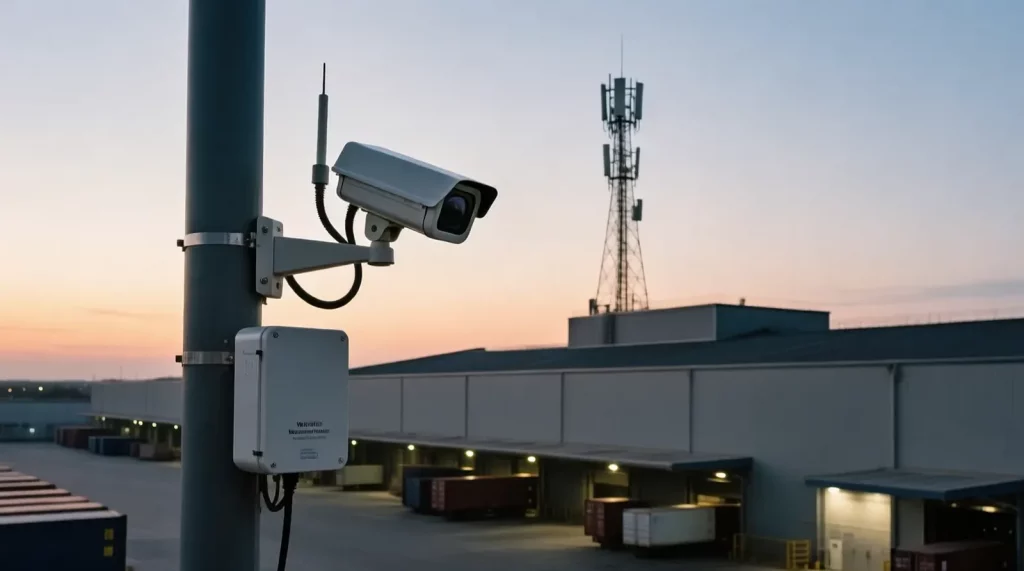
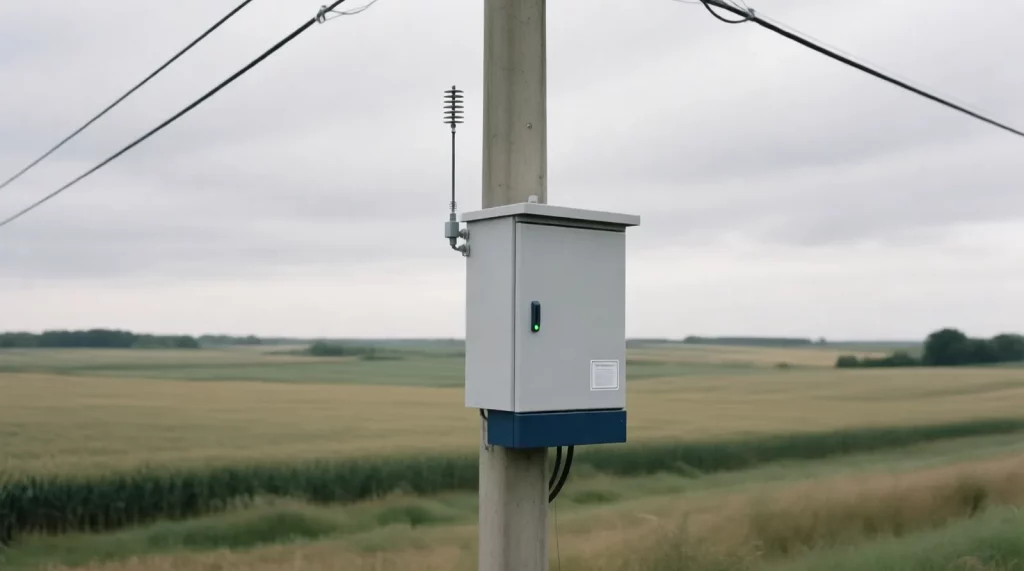
Antenna placement often matters more than the choice of operator. A router inside a steel cabinet or at the base of a pole can lose much of the signal that an external antenna at the top of the mast receives. Survey signal at the mounting height, prefer a router with an external antenna port, and keep the cable short. A camera site that fails because of a cabinet position is a truck roll, not a SIM problem.
Where power in IoT devices is also in scope, 5G RedCap vs 4G LTE for IoT Devices: Cost, Power, Field Results and SIM Checks sets out the engineering and procurement questions.
Power budget on solar and battery sites
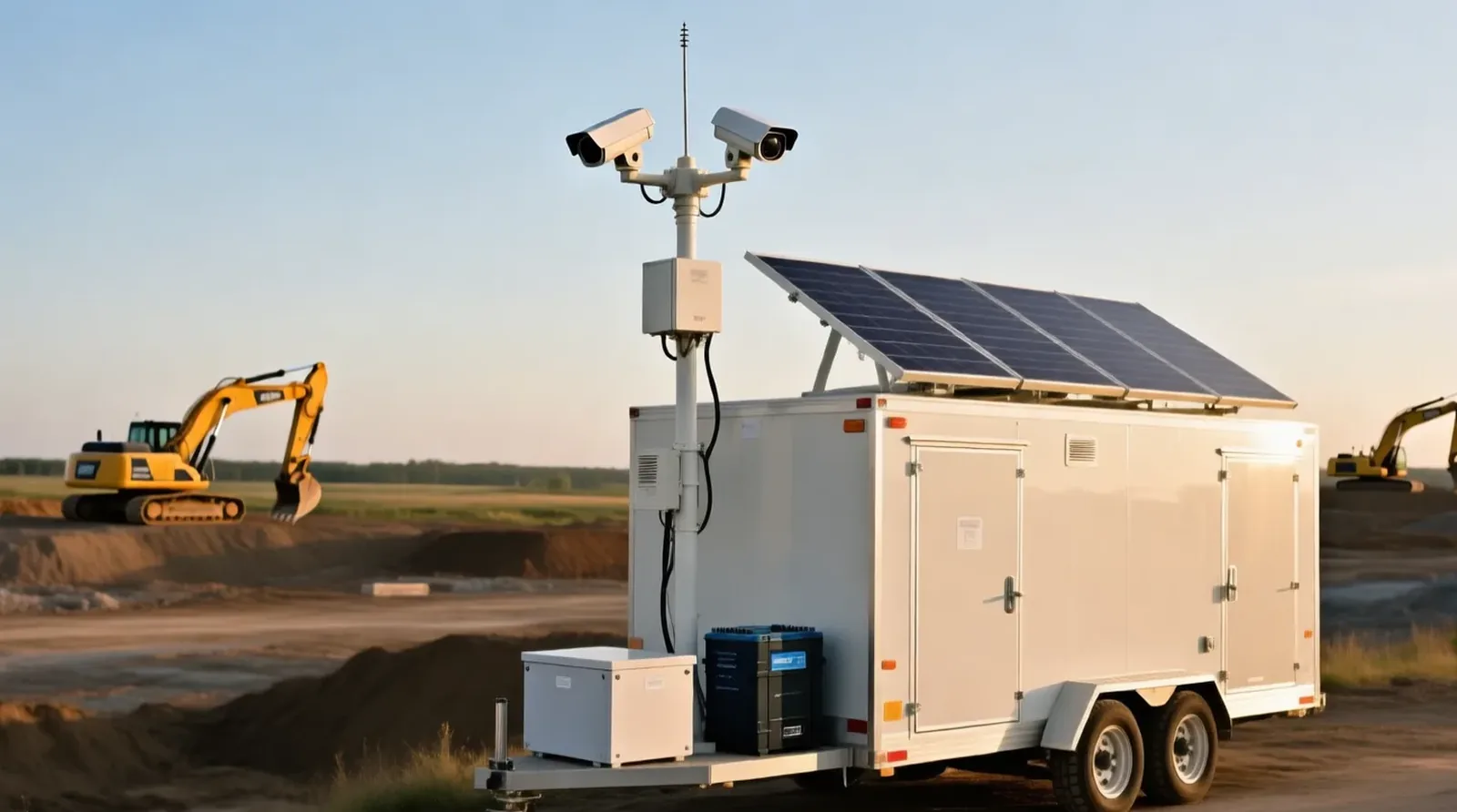
Off-grid camera trailers and pole sites usually run on solar panels and batteries, and the LTE modem is one of the larger loads after the cameras themselves. Two design choices keep the budget manageable. First, let the recorder and modem stay in a low-activity state between events, and wake the uplink when an alarm or a scheduled check needs it. Second, avoid connection patterns that keep the radio busy: frequent reconnections, very short keep-alive intervals and unnecessary cloud polling all cost energy as well as data. The exact energy figures depend on the router, the cameras and the climate, so they are measured on the chosen hardware during the pilot.
Security of a camera that is reachable from the network
Internet-connected cameras have a history that buyers should take seriously. In October 2016 a DDoS attack on the US DNS provider Dyn came largely from IoT devices such as webcams and DVRs (郭茂文, 2019). The lesson for a cellular camera site is to reduce what can be reached: no default passwords, no open management ports on the public internet, firmware that can be updated, and remote access only through the platform or a VPN.
Public guidance gives buyers a structure for these questions. NIST SP 800-213 helps organisations define the device cybersecurity requirements they expect from an IoT device and its manufacturer before acquisition. ETSI’s cybersecurity work, including its consumer IoT baseline EN 303 645, sets out provisions such as unique passwords and a vulnerability-disclosure policy. CISA’s Secure by Design guidance asks manufacturers to take ownership of customer security outcomes and to be transparent about how they do it. Ask the camera and router vendors which of these they follow.
The SIM is part of the identity chain. Authentication can work offline, with credentials stored on the device, or online against a cloud authentication server (郭茂文, 2019). With eSIM, operator profiles are provisioned remotely under the GSMA Remote SIM Provisioning framework, which relies on a PKI certificate hierarchy to authenticate the parties involved (Li et al.). For buyers this means a profile can be changed without visiting the site, but only through that controlled chain. Our eSIM guide for power distribution terminals explains remote provisioning for unattended field equipment.
Matching the site type to a connectivity design
| Site type | Video pattern | Network | Data plan basis | Main field risk |
|---|---|---|---|---|
| Construction site with mains power | Event clips and live view on demand | 4G LTE router, external antenna | Quoted to measured clip and viewing volume | Router moved or cabinet blocks signal |
| Solar camera trailer | Event clips, short live checks | 4G LTE; low-power channel for status where offered | Quoted to measured usage | Battery drain from modem activity |
| Pipeline or utility perimeter | Alarm-triggered clips | 4G LTE for video; LTE-M for sensors where offered | Sensors from small plans; video quoted | Coverage at remote poles |
| Car park or retail exterior | Frequent live view by operators | 4G LTE | Quoted; pooled data across sites helps | Viewing time higher than planned |
| Cross-border or multi-country estate | Mixed | Global IoT SIM attaching per country | To be confirmed during project validation | Local roaming or registration rules |
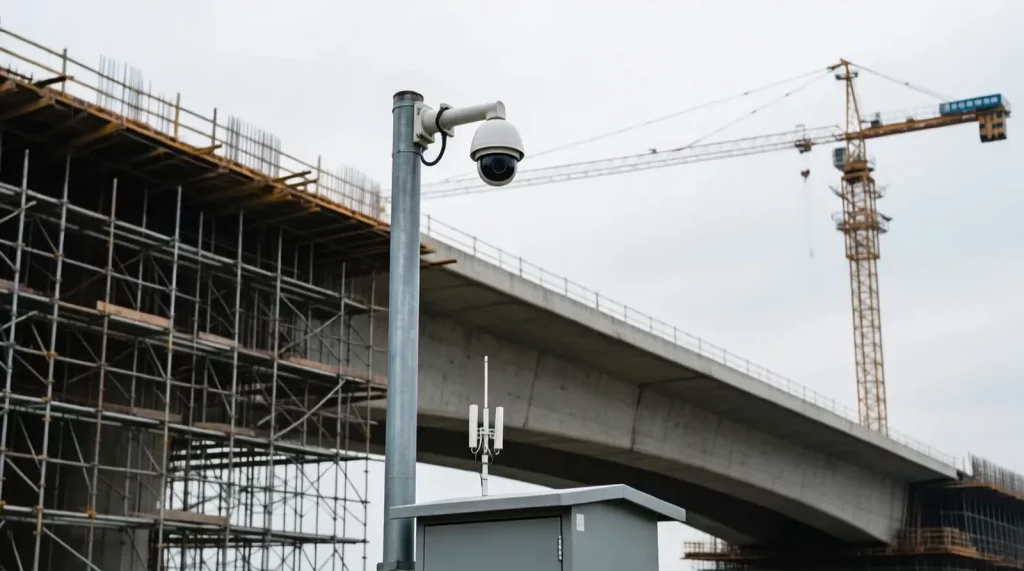
On construction sites the cameras usually share a SIM budget with crane, dust and formwork monitors. Sizing per device, and what happens to the SIMs between project phases, are covered in IoT SIM for construction site monitoring.
Many camera estates share a site network with other systems. Building and facility owners who already backhaul controllers over cellular will recognise the same questions in our guide to BACnet/SC hubs and building network backhaul: which device owns the uplink, who controls remote access, and how the site recovers after an outage.
From pilot to project quote
A single site can start with one router and a measured pilot. Move to a project quote when the estate spans many sites or several countries, when you want pooled data across sites, when SIMs need SMS for router configuration or wake-up, or when you need eSIM profiles and CMP visibility of usage per site. Pooled data is available above a minimum quantity of SIMs and suits camera estates well, because a site with a busy month is balanced by quiet ones.
Send these details: router or camera model and its cellular module, the number of sites and cameras per site, the video pattern (events per day, clip length and bitrate, expected live-view hours), power source, countries, and whether SMS is needed. On setup, most of our SIMs use the APN mobile with no username or password; use the APN on the delivery sheet and enable data roaming on the router. The security and monitoring IoT SIM page summarises the device types we cover.
FAQ
How much data does a remote security camera use per month?
It depends on the video pattern. Continuous 2 Mbps streaming is about 650 GB per month per camera; local recording with twenty 30-second event clips a day is about 4.5 GB. We quote video plans to the measured usage from a pilot.
Can a camera site run on NB-IoT or LTE-M?
Not for video. Those technologies suit alarm sensors and status messages. Use 4G LTE for clips and live view, and a low-power channel only for sensors where it is available in that country.
Is live view possible on a cellular camera site?
Yes, on 4G LTE. Plan it as on-demand viewing: one hour at 1 Mbps is about 450 MB, so the monthly plan follows how often operators actually watch.
How do we keep cellular cameras from being exposed to attacks?
Remove default passwords, close public management ports, keep firmware updatable, and route remote access through the platform or a VPN. NIST SP 800-213 and ETSI EN 303 645 give a structure for vendor questions.
Can data be shared across many camera sites?
Yes. Pooled data is available above a minimum quantity of SIMs, so busy and quiet sites share one allowance. The minimum quantity and pool size are agreed in the quote.
Official References
- NIST SP 800-213, IoT Device Cybersecurity Guidance for the Federal Government
- ETSI Cybersecurity, privacy and users (consumer IoT security)
- CISA Secure by Design
- Wang Yanfeng, Shen Yongpeng, Tang Yaohua, Zhong Jianying, Zhang Youpeng (2022). Framework and Key Technologies for NB-IoT Energy Internet of Things to Achieve Carbon Peak and Neutrality Goals (in Chinese). 电力系统保护与控制, 50(8), 179-185.
- 郭茂文 (2019). Discussion of IoT Identity Authentication Solutions (in Chinese). 广东通信技术, (02), 24-28,35. https://doi.org/10.3969/j.issn.1006-6403.2019.02.007
- Li Hongping, Meng Yuming, Zhang Lixing, Zhang Aosi, Du Linmei. Research on the Application of PKI Digital Certificates in eSIM Security (in Chinese). 研究与开发, 34-39.