EtherCAT, Sercos and Ethernet-APL over Cellular: What the Remote Link Can Carry
By jietion, Business Development (BD) at Quanqiu IoT · Published · Updated
Definition: On EtherCAT, Sercos and Ethernet-APL systems, an IoT SIM in a service gateway carries diagnostics, telemetry and engineering access, while the deterministic networks stay local.
The answer first: a mobile network adds tens of milliseconds of delay at best, while EtherCAT and Sercos motion networks often run cycles below one millisecond. No cellular technology, 5G included, replaces those networks. The useful remote design reads diagnostics, counters and process values from the controller or a gateway, sends them upstream, and opens a secured engineering path when a technician needs it. Ethernet-APL in process plants follows the same rule from a different direction: it brings Ethernet to field instruments, and the cellular link connects the plant edge, not the instrument loop.
Cycle times compared with mobile latency
| Network | Typical role | Timing scale | Over cellular? |
|---|---|---|---|
| EtherCAT | Machine I/O and motion | Cycles of 100 µs and below are common | No; diagnostics and data only |
| Safety over EtherCAT (FSoE) | Functional safety on EtherCAT | Watchdog-controlled safety frames | No; safety stays local |
| Sercos III | Synchronised motion control | Cycle times down to tens of microseconds | No; drive diagnostics only |
| Ethernet-APL | Process field instruments | 10 Mbit/s, process control loops | Edge data only |
| Cellular LTE or 5G | Remote service and telemetry | Round trips of milliseconds to hundreds of milliseconds | Yes |
Even an optimised 5G set-up shows the gap. In a test of an industrial gateway on a standalone 5G network, Modbus TCP round trips averaged 11.8 ms, and about 8 ms with uRLLC features and slicing (Chen et al., 2025). That is excellent for supervision and far too slow for a 250 µs motion cycle. Public LTE networks in the field are slower and less predictable still.
EtherCAT: reaching the machine without touching the cycle
EtherCAT, maintained by the EtherCAT Technology Group and standardised in IEC 61158, processes frames on the fly as they pass through each device. The master controls the cycle. For remote access, two routes exist. The controller can expose diagnostics and data through its own IT interface, which a gateway forwards upstream. Or Ethernet over EtherCAT (EoE) can tunnel standard IP traffic to devices that have web or configuration interfaces, scheduled by the master in the acyclic part of the frame. A remote technician reaching a drive’s configuration page through EoE is fine; anything that loads the cycle with large transfers during production is not.
Safety over EtherCAT uses the black channel principle: the safety layer does not trust the network below it and checks every safety frame itself. That is why the safety function never depends on a remote link. Remote access is for reading safety diagnostics; changes follow the machine’s safety validation process on site.
Sercos motion systems and drive diagnostics
Sercos III is a real-time Ethernet bus for synchronised drives, maintained by Sercos International. Its diagnostics are rich: drive status, error histories, temperatures and load data are available through the controller. Remote service usually needs exactly that, for example a drive fault history before a technician travels. Keep the data path read-only, collect it at the controller or gateway, and send it when it changes. Sercos also allows standard IP traffic on the same cable through a channel reserved for it, which some vendors use for configuration tools; treat any path into that channel as engineering access with approval and logging.
Ethernet-APL in process plants
Ethernet-APL is the two-wire Ethernet physical layer for process instruments, based on IEEE 802.3cg 10BASE-T1L. It runs at 10 Mbit/s, carries power and data on the same pair, and supports trunk lengths up to 1,000 metres and spurs up to 200 metres, with intrinsically safe options for hazardous areas. Instruments on APL commonly use PROFINET with PA Profile 4.0, or other Ethernet protocols. For remote sites such as wellpads, tank farms and pumping stations, APL brings instrument data to a field switch and controller; a cellular gateway then connects that controller to the central system. The gateway sees the controller, not the instruments, and the instrument loop keeps working when the mobile link drops.
Gateway design for mixed fieldbus sites
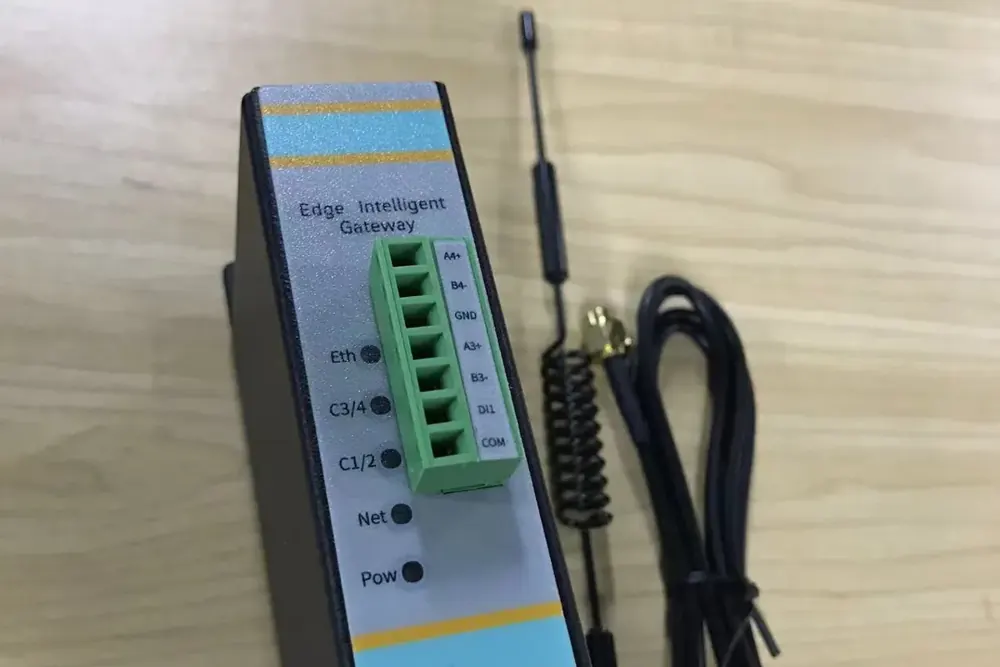
Real machines mix networks: EtherCAT inside a machine, PROFINET between machines, Modbus on legacy meters, and OPC UA toward IT. A 2025 study of an industrial data acquisition gateway lists protocol fragmentation among the main challenges and describes drivers for more than a dozen protocols with a common internal data model (He, 2025). For a cellular project, this means one gateway can collect from several networks and publish one stream upstream. Check two things before choosing it: that its drivers read from your controller without disturbing the cycle, and that it can buffer data while the mobile link is down.
Related reading: PROFINET remote access over cellular, 5G SA network slicing for PLC remote access and ISA/IEC 62443 for cellular conduits.
Quanqiu IoT supplies Global IoT SIM and eSIM connectivity for machine service gateways, with each country’s network technologies confirmed in the quote. For machine fleets in several countries, request a project quote through the contact page.
FAQ
Can 5G replace EtherCAT or Sercos inside a machine?
No. Motion networks run cycles far below mobile latencies. 5G can carry supervision, diagnostics and some non-critical control between cells, not the motion cycle.
Is Ethernet over EtherCAT safe to use for remote configuration?
It is a supported way to reach device web interfaces, but it shares the EtherCAT frame. Use it for configuration during planned windows, not for large transfers during production.
Can safety functions be monitored remotely?
Their status and diagnostics can be read remotely. Safety parameters and validation stay on site under the machine’s safety process.
What does Ethernet-APL change for remote process sites?
It gives field instruments Ethernet and power on two wires over long cable runs. The cellular link still connects the site controller, not individual instruments.
How much data does a machine diagnostics gateway use?
Mostly small diagnostic and counter messages plus occasional engineering sessions. Measure a typical month during the pilot, including any firmware transfers.
Official References
- EtherCAT Technology Group: EtherCAT technology, EoE and Safety over EtherCAT
- Sercos International: Sercos III
- Ethernet-APL: Advanced Physical Layer for process automation
- Chen Dejin et al. (2025). Research on End-to-End Low-Latency Communication for Industrial Gateway Based on 5G uRLLC (in Chinese). 邮电设计技术, (6), 30-33. doi:10.12045/j.issn.1007-3043.2025.06.006
- He Xuewen (2025). Design and Implementation of a Next-Generation Industrial Data Acquisition Gateway System Based on Management and Control Native Fusion Architecture (in Chinese). 2(11), 69-79.