PROFINET Remote Access over Cellular: Gateways, GSD Governance, Security Zones and Export Rollouts
By jietion, Business Development (BD) at Quanqiu IoT · Published · Updated
Definition: For PROFINET machines, an IoT SIM in an edge gateway or service router provides the remote path for engineering access, diagnostics and production data; the real-time PROFINET traffic itself stays on the machine network.
The direct answer: a cellular link never carries the cyclic I/O between a PROFINET controller and its devices. That traffic runs at Layer 2 on the machine network in millisecond cycles. What the SIM carries is everything around it: the engineering tool session when a technician changes a program, diagnostic alarms, energy and production data sent to a platform, and file transfers such as firmware or device description updates. Plan the cellular path for those jobs, and keep it from ever becoming a route into the real-time network.
What travels on PROFINET and what can travel on the mobile network
PROFINET, maintained by PROFIBUS & PROFINET International (PI), defines conformance classes A, B and C. Real-time (RT) and isochronous real-time (IRT) frames use their own EtherType and are not routed over IP, so they cannot cross a mobile network. Engineering, configuration and non-real-time diagnostics use standard IP traffic and can. In a teaching platform built around an S7-1200 PLC, the engineering station spoke PROFINET locally while a separate MQTT path over TLS on port 8883 fed a mobile app; the speed control loop ran on the PLC every 200 ms with no cloud dependency, and remote commands took about 320 ms round trip on a campus network (Cheng and Xu, 2026). That split, local control and remote supervision, is the pattern to keep when the remote path is cellular.
| Traffic type | Over the cellular link? | Notes for the remote design |
|---|---|---|
| Cyclic I/O (RT, IRT) | No | Layer 2, millisecond cycles; stays on the machine network |
| PROFIsafe safety telegrams | No | Safety loop must remain local; remote access is read-only diagnostics at most |
| Engineering tool session (program change, commissioning) | Yes, through a VPN | Time-limited, approved, logged; several MB per session is common |
| Diagnostics and alarms | Yes | Small messages; send on change |
| PROFIenergy and production data | Yes | Batch at the edge; often MQTT or OPC UA to a platform |
| GSDML files, firmware images | Yes, with integrity checks | Largest transfers; schedule them |
Edge gateway or service router: choosing the remote access device
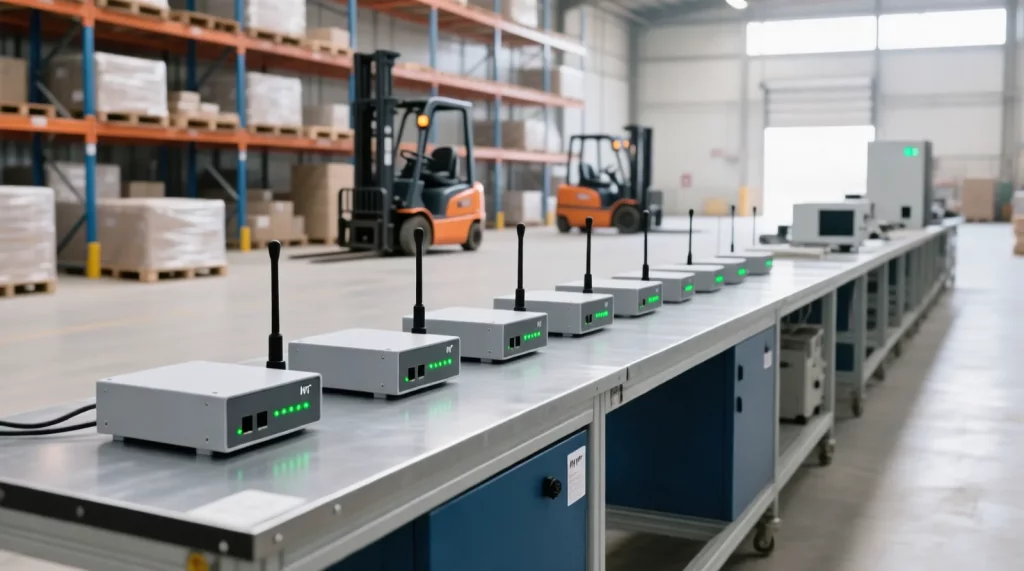
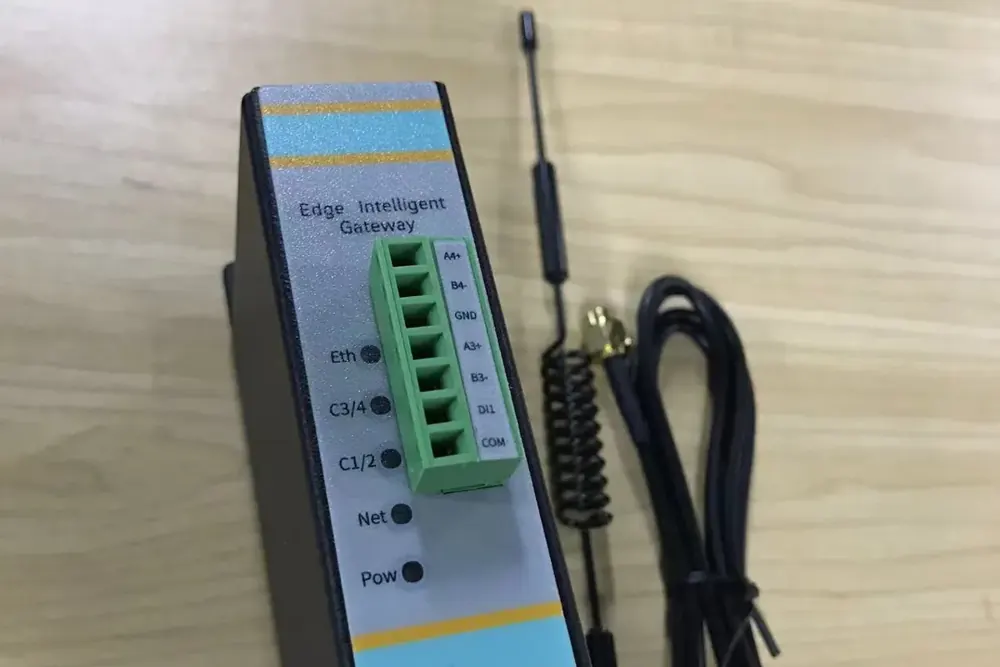
Two device types compete. A service router gives a technician a VPN into the machine network so the engineering tool behaves as if it were on site. An edge gateway reads data from the controller and publishes it upstream, without giving anyone a network-level path inside. Many OEMs fit both functions in one box but should still separate them logically: data collection runs all the time; engineering access runs only on request. A 2025 study of industrial acquisition gateways lists protocol fragmentation as a main difficulty, with a single gateway supporting S7, EtherNet/IP, Modbus, OPC UA and MQTT drivers side by side (He, 2025). On a PROFINET line, the gateway still has to be configured by someone who knows which controller data may leave the machine.
Device description (GSDML) governance across sites
Every PROFINET device is described by a GSDML file, an XML document that the engineering tool imports. Multi-site operators run into trouble when two plants use different GSDML versions for the same device, or when a replacement device arrives with newer firmware. Keep a central library with the vendor source, version, date and a checksum of each file; distribute it to sites over the remote path rather than by USB stick; and record which GSDML version each machine was commissioned with. When remote commissioning is part of the service model, the identity of the device and the file used to configure it should both be traceable later.
Security zones, hardening and PI security classes
Classic PROFINET has no authentication on the wire, so the machine network is treated as a trusted zone and protected at its edge. PI has introduced security classes: the first class hardens existing devices, for example by protecting discovery and configuration services and checking the integrity of device description files, while higher classes add authenticated and encrypted communication. In a remote service design, apply ISA/IEC 62443 thinking: the machine network is one zone, the cellular router is the conduit, and the service centre is another zone. See our ISA/IEC 62443 guide for cellular conduits for the requirements.
- Keep engineering access separate from data collection, with different credentials and logging.
- Block all inbound traffic from the cellular interface except the VPN.
- Disable remote write access to safety-related parameters; PROFIsafe settings are changed on site.
- Document the zone drawing in the machine’s export file so the end customer’s security team can approve it.
Profiles that change what you monitor remotely
PROFINET profiles add application-specific data. PROFIdrive standardises drive parameters, which helps a remote technician read fault codes consistently across vendors. PROFIenergy lets a controller put equipment into pause states and report consumption, which is useful data for an energy dashboard but should be commanded locally, not from a cloud schedule that cannot see the production state. PA Profile 4.0 standardises process instruments, often on Ethernet-APL at the field level. Each profile increases the value of the remote data path; none of them needs real-time traffic over cellular.
Export machines: pre-shipment validation and regional cutover
For machine builders, the cellular path is set up on the test floor and must still work at the customer site in another country. Validate before shipment: router registration on the target operator networks, VPN connection to the service centre, data volume during a typical shift, and behaviour when the link drops. Confirm that the SIM is allowed to stay on a foreign network long term, because some operators restrict permanent roaming; a multi-network SIM or a local profile on an eSIM may be the answer. When a customer runs several lines or spare lines in different regions, schedule cutovers and change windows so that no two plants depend on the same remote engineer at once. Machines shipped with cold-chain or logistics equipment face the same roaming questions, covered in global, roaming and local SIM options for cross-border rollouts. Bootstrap profiles for eSIM-based routers are covered in industrial eSIM bootstrap profiles and global onboarding, and slicing for latency-sensitive remote access in 5G SA network slicing for PLC remote access.
Quanqiu IoT supplies Global IoT SIM and eSIM connectivity for machine service routers and edge gateways, with each country’s network technologies confirmed in the quote. For multi-country machine fleets, send the list of destination countries through the contact page for a project quote.
FAQ
Can PROFINET I/O run over a cellular connection?
No. PROFINET RT and IRT frames are Layer 2 and need deterministic cycles. Cellular carries engineering access, diagnostics and data, not the I/O cycle.
How much data does a remote engineering session use?
It varies with the tool and project size. Downloading a program or a firmware image can take several megabytes; plan the plan size around the number of sessions per month and measure during commissioning.
Should PROFIsafe parameters ever be changed remotely?
Most safety concepts forbid it. Keep safety configuration on site and limit remote access to reading diagnostics.
Why do GSDML versions matter for remote support?
The engineering tool configures devices from the GSDML file. A technician working remotely with a different version than the one used at commissioning can introduce configuration errors that are hard to trace.
Does a machine sold abroad need a different SIM?
Possibly. Check coverage and long-term roaming rules for each destination country before shipment, and decide whether the SIM stays with the OEM or moves to the customer.
Official References
- PROFIBUS & PROFINET International: PROFINET technology
- ISA: ISA/IEC 62443 Series of Standards
- NIST SP 800-82 Rev. 3: Guide to Operational Technology (OT) Security
- Cheng Guodong, Xu Rui (2026). Design of a PLC Training Platform Integrating IoT Technology (in Chinese). 物联网技术, (19), 158-162.
- He Xuewen (2025). Design and Implementation of a Next-Generation Industrial Data Acquisition Gateway System Based on Management and Control Native Fusion Architecture (in Chinese). 2(11), 69-79.