IoT SIM for EtherCAT Master Gateways and Remote Machine Telemetry
作者:jietion,商务拓展(BD),Quanqiu IoT · 发布于 · 更新于
定义:IoT SIM for EtherCAT Master Gateways and Remote Machine Telemetry
EtherCAT machine projects often use high-performance local control but still need a practical remote backhaul layer for alarms, diagnostics, service access, and fleet visibility. For that reason, buyers should evaluate IoT SIM choices at the gateway level: start with a Global IoT SIM path for pilots, add eSIM if hardware rollout needs remote provisioning, use CMP for lifecycle control, and switch to a project quote when multi-site governance, custom routing, or rollout complexity appears.
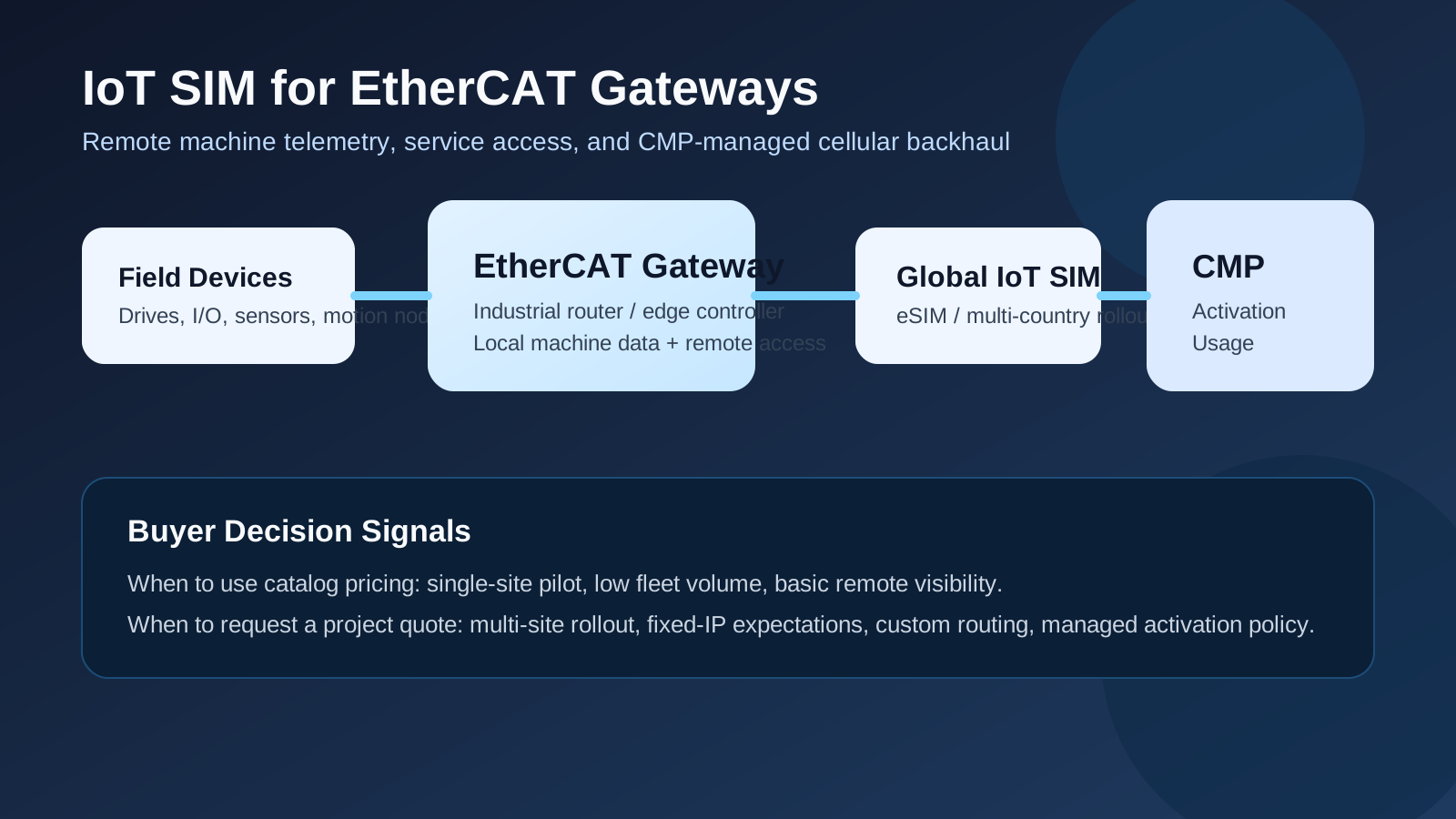
EtherCAT is an industrial Ethernet technology used in motion control, machine control, robotics, packaging, and other real-time automation systems. The EtherCAT Technology Group explains that the protocol processes data on the fly and enables line or bus structures with many nodes without the switching overhead typical in standard Ethernet topologies. That makes EtherCAT very strong for deterministic local control, but it also means remote access is usually introduced through a separate industrial router, IPC, or edge gateway rather than directly through every field node.
Why It Matters
From a B2B procurement angle, the key decision is not whether EtherCAT is fast enough inside the machine, but how remote operations should reach the machine once it is installed across plants, customer sites, or countries. OEMs and integrators often need a controlled path for machine health data, service logs, firmware logistics, or remote engineering support. If the gateway backhaul is chosen too casually, the project later struggles with rollout consistency, SIM management, and commercial alignment between pilot and scale.
That is where a Global IoT SIM model becomes relevant. The cellular layer can stay outside the EtherCAT control loop while still carrying telemetry, exception events, and service traffic between the machine gateway and remote operations. Buyers then need to judge whether the project is still simple enough for catalog pricing or already complex enough to justify quote-based handling.
Typical Applications
- Packaging, assembly, and robotics OEM equipment deployed to customer plants in multiple countries.
- Industrial gateways that collect EtherCAT-connected machine data for centralized dashboards or service teams.
- Retrofit projects where local machine networks stay unchanged, but remote telemetry is added through an edge controller.
- Factory support models that require mobile fallback connectivity for installed machines or demonstration lines.
For adjacent deployment logic, see IoT SIM for industrial routers, RTU, and DTU devices, IoT SIM for OPC UA gateways and industrial data hubs, and IoT SIM for PROFINET edge gateways and remote machine support.
Selection Notes
Start with the device role. EtherCAT terminals, drives, and sensors are usually not the SIM-bearing endpoint. The practical SIM endpoint is more often a gateway, industrial PC, or router that exports machine data upward. That means the buyer should size the connectivity plan around remote monitoring frequency, engineering access windows, site count, and expected fleet operations rather than around the fieldbus itself.
Then review rollout structure. A single test bench or a few machines in one region may fit a standard Global IoT SIM pricing path. A distributed OEM program, however, usually benefits from CMP-based SIM lifecycle control so operations teams can track activations, suspend unused units, monitor usage, and keep a cleaner support inventory. If the design requires remote provisioning flexibility, an eSIM-capable hardware path can also be worth evaluating.
A project quote is generally the better route when the buyer needs multi-country rollout planning, larger batch deployment, fixed-IP style expectations, staged factory activation, or custom handling for gateway fleets managed by OEMs and end customers together. The commercial decision is part of the engineering decision, not a separate afterthought.
How This Maps to Quanqiu IoT
- Global IoT SIM: suitable for EtherCAT gateway backhaul across pilots and international machine deployments.
- eSIM: useful when installed hardware is hard to service physically or future profile changes may matter.
- CMP: relevant for activation, usage review, suspension, and lifecycle control across installed gateway fleets.
- Project quote workflow: recommended when the project expands into multi-site OEM support, custom routing, or larger coordinated rollouts.
If the machine project crosses into broader industrial operations or OT cybersecurity review, also see ISA/IEC 62443 zoned industrial gateways and secure OT backhaul and industrial and energy IoT SIM.
FAQ
Does EtherCAT itself require a SIM card?
Usually no. The SIM is typically used by the gateway, router, or IPC that connects the local EtherCAT machine network to remote services, service teams, or cloud platforms.
When should an EtherCAT project use a project quote instead of a catalog plan?
Use a project quote when the deployment includes multiple countries, coordinated OEM rollout, private or special routing needs, or a larger fleet that needs managed activation and lifecycle support.
Why is CMP useful for machine telemetry projects?
CMP helps teams control activations, view usage, manage inactive units, and keep remote machine connectivity aligned with service operations over time.
Who is this page most useful for?
Procurement managers, hardware integrators, OEM program teams, and industrial service teams planning remote connectivity for machines that use EtherCAT locally.