Soil Moisture and Irrigation IoT SIM: Connectivity for Commercial Agriculture Monitoring
By jietion, Business Development (BD) at Quanqiu IoT · Published · Updated
Definition: In soil moisture and irrigation monitoring, the IoT SIM connects field probes, gateways and pump controllers to the farm platform, so readings arrive and irrigation commands reach the field without wired networks.
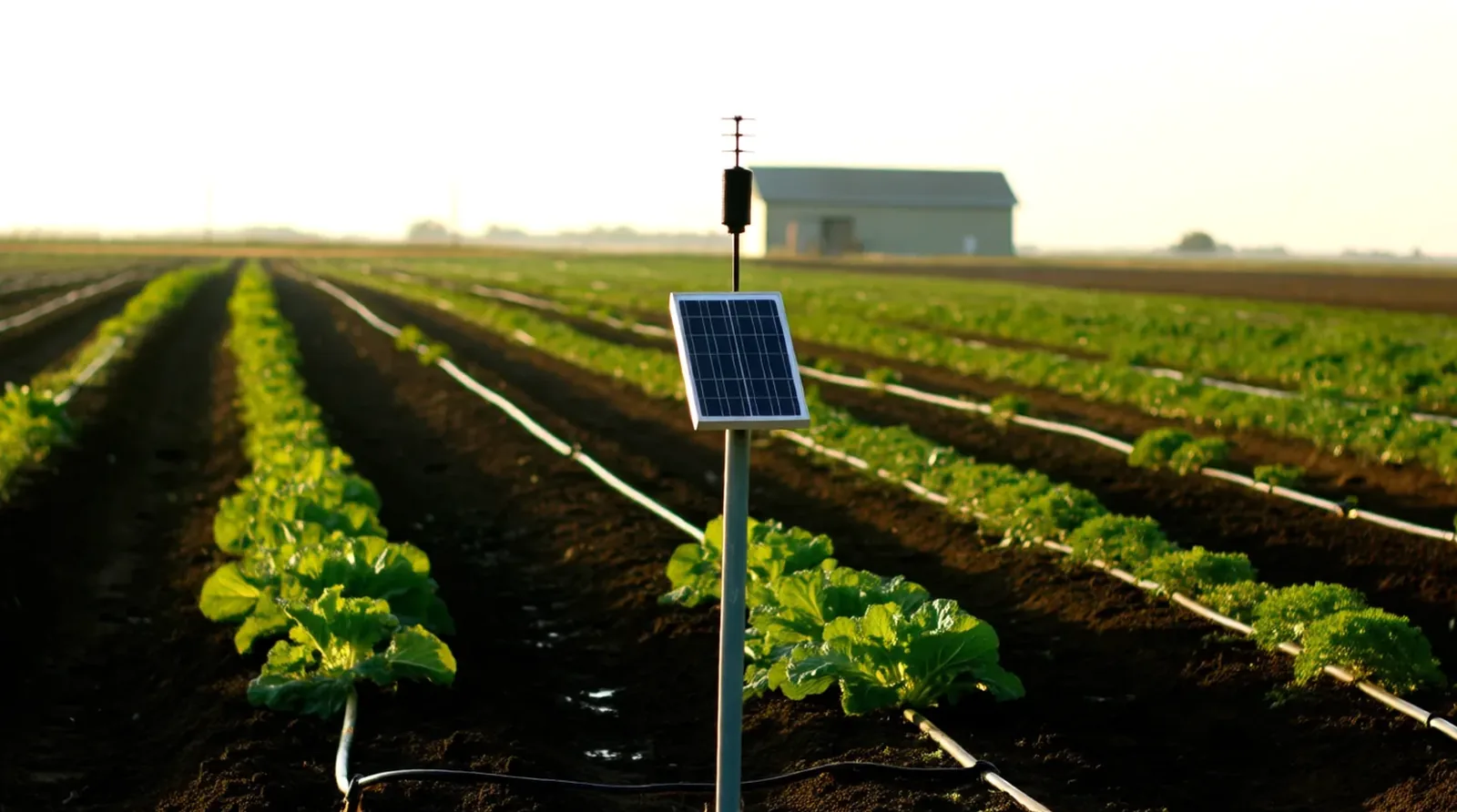
The practical answer: soil moisture data is tiny, so the connectivity decision is about reach, power and reliability, not data volume. Battery probes spread across open fields usually suit NB-IoT or LTE-M, or a local LoRa network with one cellular gateway. Pump and valve controllers that act on commands need a link that answers in seconds, usually LTE-M or LTE Cat 1, often on mains or solar power. Before buying at scale, measure signal at probe height in the actual fields, decide which devices report directly and which go through a gateway, and plan how a dead link affects irrigation.
What a moisture and irrigation network sends
A typical commercial setup has three kinds of device. Soil probes measure moisture, often at several depths, with temperature and sometimes salinity or conductivity. Weather or field stations add air temperature, humidity, rainfall and light. Irrigation controllers open valves, start pumps and report flow and pressure. A study of integrated water-and-fertiliser systems in Hebei describes this mix: sensors for moisture, salinity and pH at different soil depths, fertiliser dosed into the irrigation water through pipes, and alerts sent to an app when moisture or nutrients drift out of balance, with field data carried over GPRS (Yi, 2026).
Readings are small and infrequent. A seed-park monitoring system with 80 sensor nodes, one per 50 mu grid and sampling every 10 minutes, generated about 2.8 GB of raw data a day because it included multispectral images, yet its edge gateways uploaded only about 35 KB per node daily, under 2.8 MB for the whole system (Min, 2026). That ratio is the key planning fact: process near the field and send results, and the cellular data budget becomes a minor cost.
Direct cellular probes or a field gateway
| Design | How it works | Strengths | Watch out for |
|---|---|---|---|
| Cellular probe (NB-IoT or LTE-M) | Each probe has its own module and SIM | No local network to build; each probe independent | Signal at ground level; one SIM per probe; battery drain in weak coverage |
| LoRa sensors with cellular gateway | Probes send to a gateway over LoRa; gateway uses one SIM | Few SIMs; long sensor battery life | Gateway placement, power and mast height; gateway is a single point of failure |
| Wired sensors to a controller with LTE | RS-485 Modbus sensors wired to a controller at the pump house or greenhouse | Mains power; reliable sampling | Cabling across fields; damage from machinery and animals |
| Irrigation controller on LTE-M or Cat 1 | Controller receives schedules and commands, reports flow and pressure | Fast response to commands; can run local schedules | Needs a fallback schedule if the link drops |
Local radio networks reach further than many buyers expect but have limits. A solar-powered soil temperature network for a large irrigation district used LoRa in a star layout; it lost no packets within 650 m, packet loss began at 700 m, and a 12 V, 3000 mAh battery lasted about 10 days without solar charging (Zhang et al., 2026a). Greenhouses with mains power often go wired instead: one crop-diagnosis system read soil, air and nutrient sensors over RS-485 Modbus every 50 seconds and uploaded through a 4G module (Zhang et al., 2026b). The guide to IoT SIMs for irrigation and environmental sensors compares device types in more detail.
Coverage and battery life in open fields
Rural coverage is the main risk. Mobile networks are planned for people and roads, and a probe 30 cm above the soil in a crop canopy sees a much weaker signal than a phone held at head height. NB-IoT’s deep-coverage target is a maximum coupling loss of 164 dB, and battery lives of about 10 years are possible, but only with light traffic and coverage that stays under control; in weak spots retransmissions quickly eat into the margin (Han, 2026). Survey the actual fields, at probe height, during the growing season when the canopy is full.
Where one network is weak, two help. A SIM that can attach to more than one operator in the country, or an eSIM that can switch profile, gives each field a second chance. Where no network reaches, a LoRa gateway on a mast at the field edge can bridge the gap with one cellular connection. Low-power technologies also have a speed trade-off: NB-IoT suits long battery life in remote areas, while video and high-rate data need broadband (Chen, 2026).
Reporting rules matter as much as the radio. Report on change rather than on a fixed clock where you can: sensors can check slow-changing values such as moisture or level locally and send only when readings leave a set range (Han, 2026). One water-and-fertiliser design switched to real-time reporting during critical crop stages and back to scheduled reports during dormancy to save energy (Yi, 2026).
Pumps, valves and what happens when the link drops
Monitoring tolerates delay; control does not. A remote pump command must arrive, execute and confirm within seconds. A wireless level-control prototype uploaded level data every 10 seconds over MQTT and switched its fill and drain pumps in under 1 second when levels crossed the set limits (Liu et al., 2026). Over a cellular link, design the same closed loop: command, confirmation, execution, feedback, and a timeout that leaves the pump in a safe state.
Plan for loss of connection explicitly. An irrigation controller should keep a local schedule and safe limits, such as maximum run time and low-pressure shutdown, so a dropped link does not leave a pump running all night or a crop without water. Keep a redundant sensor at critical points: one integrated system placed primary and backup sensors at each monitoring point and switched automatically when readings looked wrong (Yi, 2026). Protect the control path too. The same study used AES-128 encryption on terminals, TLS on the transmission channel and token authentication on the platform; never leave pump commands open to unauthenticated SMS.
Rolling out across farms and countries
Agritech vendors that sell probes internationally face the same questions as any device maker: which networks and technologies exist in each target country, whether SIMs may stay on foreign networks long term, and how SIMs are activated when growers install probes themselves. Seasonal use adds one more. Many probes are pulled before harvest and reinstalled in spring, so suspend SIMs off-season instead of paying for idle lines. The guide to multi-country device operations covers permanent roaming, and the comparison of eSIM and physical SIM for IoT covers switching operator without a field visit. FAO’s water-management work is a useful reference for why irrigation data matters beyond the farm.
Quanqiu IoT supplies Global IoT SIM cards for soil probes, gateways and irrigation controllers, with SIM suspension and usage alerts in a CMP; NB-IoT, LTE-M and LTE availability per country is confirmed in the quote. Field layouts and device counts can be sent through the quote process.
FAQ
How much data does a soil moisture probe use?
Very little: a few KB a day for readings every 10 to 60 minutes. Gateways that bundle many probes still send only tens of KB per node daily when processing happens at the edge.
NB-IoT, LTE-M or LoRa for soil sensors?
NB-IoT for battery probes in good coverage, LTE-M where commands or mobility matter, and LoRa with a cellular gateway where many sensors sit in an area with weak mobile signal.
Why do probes lose connection in summer?
A full crop canopy and wet soil weaken the signal at probe height. Survey coverage in the growing season and raise antennas where possible.
Can irrigation pumps be controlled over an IoT SIM?
Yes, with LTE-M or LTE, a confirmed command loop and a local fallback schedule so a lost link never leaves a pump running.
Should SIMs stay active over winter?
Not if probes are removed. Suspend them in the connectivity platform and reactivate before reinstallation.
Official References
- FAO: Water management
- GSMA: Mobile IoT (LPWA)
- 3GPP Release 13, which introduced LTE Cat-M1 and NB-IoT for machine-type devices
- Yi Weiwei (2026). Research on the Application of Integrated Water and Fertilizer Technology in the Agricultural Internet of Things Environment (in Chinese). 农业开发与装备, (10), 178-180.
- Min Xiaocui (2026). Design of an IoT-Based Early Warning System for Pests and Diseases in Seed Industry Ecological Parks (in Chinese). 物联网技术, (19), 139-141.
- Zhang Qin et al. (2026). Design and Experiment of a Solar-Powered Soil Temperature Monitoring System (in Chinese). 农机化研究.
- Zhang Yuezheng et al. (2026). Online Diagnosis and Decision-making System for Crop Growth Based on Internet of Things and Large Language Models (in Chinese). 农业机械学报, 57(19), 325-335.
- Han Baohua (2026). Optimization of Low-Power Wide-Area Network Communication Technology for the Internet of Things (in Chinese). 中国宽带, 22(10), 49-51.
- Liu Haiyan, Li Senyu, Li Junmin (2026). Design and Implementation of an Automatic Liquid Level Control System Based on Wireless Communication (in Chinese). 机械工程与自动化, 55(5), 180-183. doi:10.3969/j.issn.1672-6413.2026.05.055
- Chen Zhi (2026). Exploration of Remote Monitoring and Management Applications for Agricultural Machinery Safety Based on IoT Technology (in Chinese). 农机水肥, (27), 81-83. DOI: 10.3969/j.issn.1003-1650.2026.27.027