Satellite NTN and eSIM for IoT Beyond Terrestrial Coverage: What Buyers Should Plan
By jietion, Business Development (BD) at Quanqiu IoT · Published · Updated
Definition: Satellite NTN for IoT extends cellular-standard connectivity through satellites or high-altitude platforms where towers do not reach; the eSIM holds the subscription profiles that let one device use terrestrial and satellite networks.
The practical answer: for most IoT fleets, satellite is a fallback for the sites and moments that terrestrial cellular cannot serve, not a replacement for it. Plan the device around a terrestrial IoT SIM or eSIM profile for everyday traffic, decide which messages truly need a satellite path, and budget for a separate satellite service agreement, a module that supports it, and the regulatory checks in each country. The eSIM matters because it lets one device hold more than one operator profile and change them remotely.
How 3GPP defines non-terrestrial networks and why orbit choice matters to a buyer
3GPP describes non-terrestrial networks as networks, or segments of them, that use satellites or uncrewed aircraft systems flying at roughly 8 to 50 km to carry either a relay node or a base station. The orbit sets much of the device experience. Low Earth orbit sits at about 500 to 2,000 km, with lower delay and a better link budget but many satellites needed for coverage. Medium Earth orbit sits at about 8,000 to 20,000 km, and geostationary satellites hold position 35,786 km above the equator.
The payload type matters too. A transparent, or bent-pipe, payload simply shifts frequency, filters and amplifies the signal, behaving like an analogue repeater. A regenerative payload adds on-board demodulation, decoding and routing, which effectively puts base-station functions in orbit. For buyers, the consequence is that “NTN support” on a datasheet says little on its own: ask which orbit, which payload mode, which 3GPP release and which operator network the module was tested against.
Where satellite backhaul earns its cost: disaster sites, open sea and remote assets
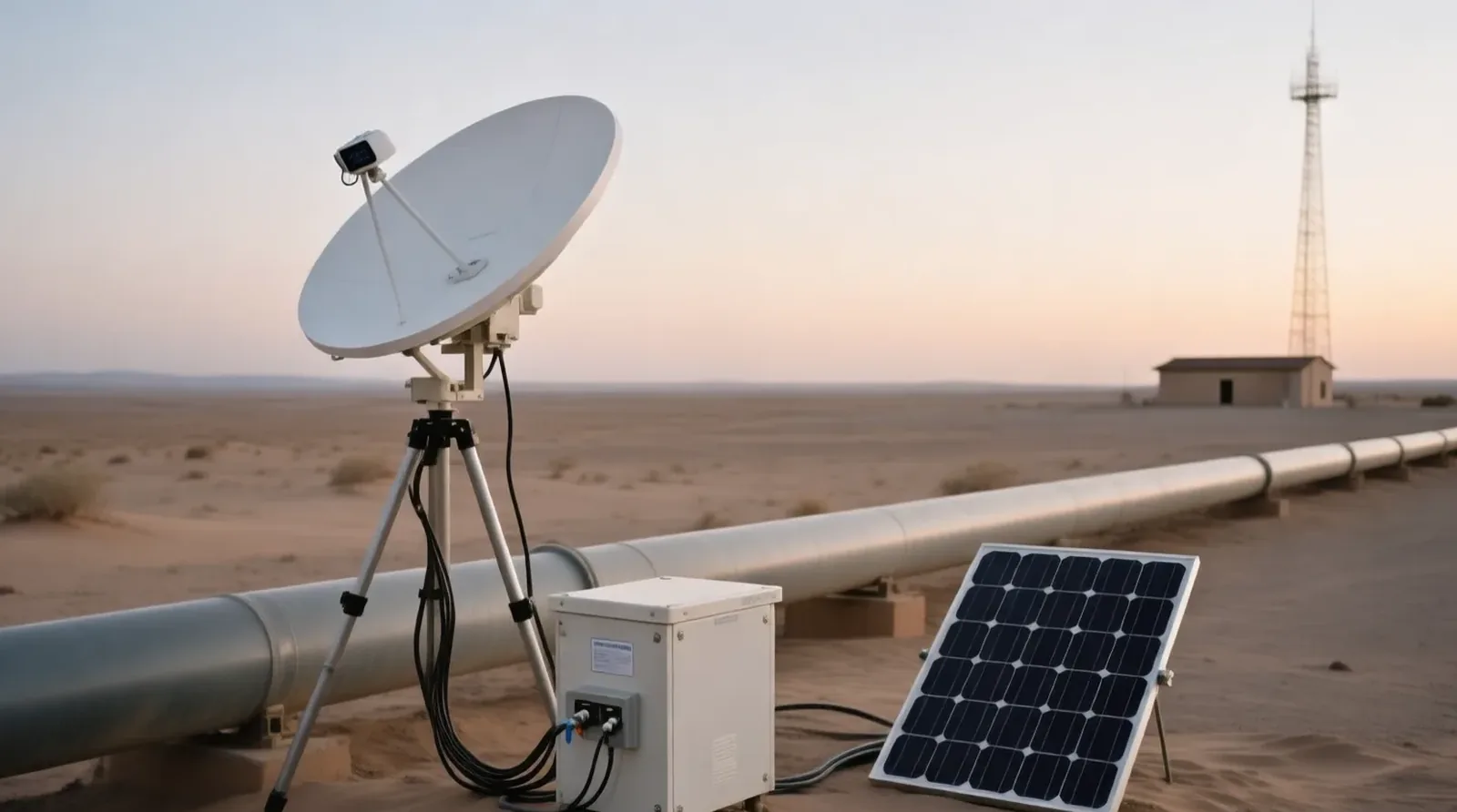
The strongest case is the site that loses everything at once. A Beijing test of emergency broadcasting under a so-called three-disruption scenario, with public networks, mains power and roads all cut, used two-way C-band satellite IoT links with terminal antennas under 25 cm (Xu, 2026). With ground networks deliberately disabled, commands reached terminals in about 2 s, two-way voice ran with roughly 1.5 s latency, and the narrowband uplink returned data at about 47 kbps. A 57.72 kB image took about 12 s and a 620 kB video clip about 2 minutes. The terminals held eight redundant links, from fiber and 4G/5G to shortwave and satellite, and accepted the first verified copy of a message to arrive.
Two lessons carry over to industrial IoT. First, the satellite path suits short, signed messages and small images, so the device should queue bulky data until a cheaper link returns. Second, power planning is part of the connectivity design: that project buried a 200 Ah battery, five times the 40 Ah typical of such terminals. Remote pipelines, offshore buoys, livestock water points and cross-border containers follow the same logic at smaller scale.
What the eSIM does and does not solve in a terrestrial-plus-satellite design
GSMA published SGP.31 (architecture and requirements) and SGP.32 (technical specification, July 2023) so that devices without a screen or a user can receive and switch operator profiles over the air. GSMA’s reasoning is that physical SIM swaps are impractical for devices spread across many hard-to-reach locations. In a hybrid design, the eSIM can carry a terrestrial roaming profile and, where a satellite operator issues cellular-standard profiles, a satellite profile alongside it. See our comparison of eSIM versus physical SIM for IoT and how bootstrap profiles support global onboarding.
The eSIM does not provide satellite coverage by itself. The module must support the satellite frequency bands and NTN timing, the antenna must suit them, and the satellite operator must agree commercial terms. Hardware grade still matters: in-vehicle eSIM guidance calls for full operation from -40 to 85 °C and AEC-Q100 qualification for automotive ICs, with suppliers running the tests and buyers reviewing the reports (Chang et al., 2024). Remote assets in deserts or at sea face similar temperature ranges.
Spectrum and regulatory checks before devices move across borders
Satellite terminals on moving platforms fall under specific radio rules. In ITU terms, earth stations in motion are a special application within the fixed-satellite service, using directional antennas in C, Ku or Ka bands; mobile-satellite terminals use omnidirectional antennas in lower bands such as L and S (Liu et al., 2024). WRC-23 added footnote 5.517B and Resolution 123, allowing non-geostationary earth stations in motion in specified Ka-band frequencies under technical limits, with remote control of frequency, power and transmit enable through a network control center. Maritime terminals must stay at least 70 km from a coastal state’s low-water line under those rules. Most low-rate IoT terminals are not Ka-band earth stations, but the point stands: what a satellite terminal may transmit depends on the band, the platform and the country, and that review happens before shipment.
Planning table: terrestrial IoT SIM, eSIM and satellite NTN
| Question | Terrestrial IoT SIM or eSIM | Satellite NTN path |
|---|---|---|
| Typical role | Everyday telemetry, configuration, firmware | Fallback for alarms and short status messages |
| Orbit and delay | Not applicable | LEO 500-2,000 km; GEO 35,786 km; delay per system: To be confirmed during project validation |
| Uplink capacity | Depends on the local network technology | Narrowband; about 47 kbps in one tested C-band system (Xu, 2026) |
| Hardware | Standard cellular module and antenna | Module with NTN support, suitable antenna, power reserve |
| Profile management | Remote via SGP.32 eSIM where the device supports it | Satellite profile availability per operator: To be confirmed during project validation |
| Regulation | Country network technologies confirmed in the quote | Band, platform and landing rights per country |
| Commercial terms | Catalog plans or project quote | Separate satellite operator agreement |
How to split the work between Quanqiu IoT and a satellite partner
Quanqiu IoT supplies Global IoT SIM cards, eSIM profiles and a CMP across countries, and our SIMs also support satellite communication in 16 countries: Oman, Malaysia, Saudi Arabia, Morocco, Kenya, Brazil, Peru, Argentina, Kazakhstan, Bangladesh, Algeria, Pakistan, Chile, Colombia, Thailand and Singapore. The satellite technology, compatible modules, data rates and pricing are confirmed in a project quote, together with the networks the SIM uses on each part of your route. Outside those countries, a hybrid design pairs our terrestrial connectivity with a satellite service contracted separately. For mixed-route fleets, our multi-country fleet procurement guide covers the terrestrial part in more detail.
A sensible procurement order is: list the sites and the share of time each spends outside terrestrial coverage; define the few messages that must get through anyway; choose a module and satellite service that fit those messages; then size the terrestrial plan for everything else. Pilot a few devices on the real route before committing the fleet.
FAQ
Can my existing cellular IoT device switch to satellite with a new eSIM profile?
Only if its module and antenna already support the satellite bands and NTN operation. A profile alone cannot add radio capability the hardware lacks.
Does Quanqiu IoT provide satellite connectivity?
Yes, in 16 countries: our SIMs support satellite communication in Oman, Malaysia, Saudi Arabia, Morocco, Kenya, Brazil, Peru, Argentina, Kazakhstan, Bangladesh, Algeria, Pakistan, Chile, Colombia, Thailand and Singapore. Satellite technology, compatible devices and pricing are confirmed in the project quote. Elsewhere we provide terrestrial Global IoT SIM, eSIM and CMP services alongside the satellite service you choose.
What kind of data suits a satellite IoT link?
Short alarms, positions and status messages. In one tested system a 620 kB video clip took about 2 minutes, so larger files should wait for a terrestrial connection.
Which orbit is best for IoT?
Low Earth orbit offers lower delay and a better link budget but needs many satellites; geostationary systems cover wide areas from a fixed position. The right choice depends on the service actually available on your route.
Are there regulatory limits on satellite terminals that cross borders?
Yes. Permitted bands, power and operation depend on the terminal type, the platform and each country’s rules, including ITU provisions agreed at WRC-23. Check them before shipping devices.
Official References
- 3GPP: Non-Terrestrial Networks (NTN) overview
- GSMA: IoT RSP, Enabling the growth of Massive IoT (SGP.31/SGP.32)
- Xu Xianghui (2026). Research and Practice of Highly Reliable Transmission and Scheduling Technology for Emergency Broadcasting in the Three-Disruption Scenario (in Chinese). 广播电视网络, (9), 79-83.
- Liu Quan, Wang Lichong, Zhao Weisong (2024). Evolution of Radio Regulations for NGSO Satellite Earth Stations in Motion and Analysis of Their Impact (in Chinese). 卫星应用, (6), 37-42.
- Chang Jun, Ye Dan, Chen Xing (2024). The Application of eSIM in the Internet of Vehicles (IoV) (in Chinese). 汽车电器, (5), 33-34.