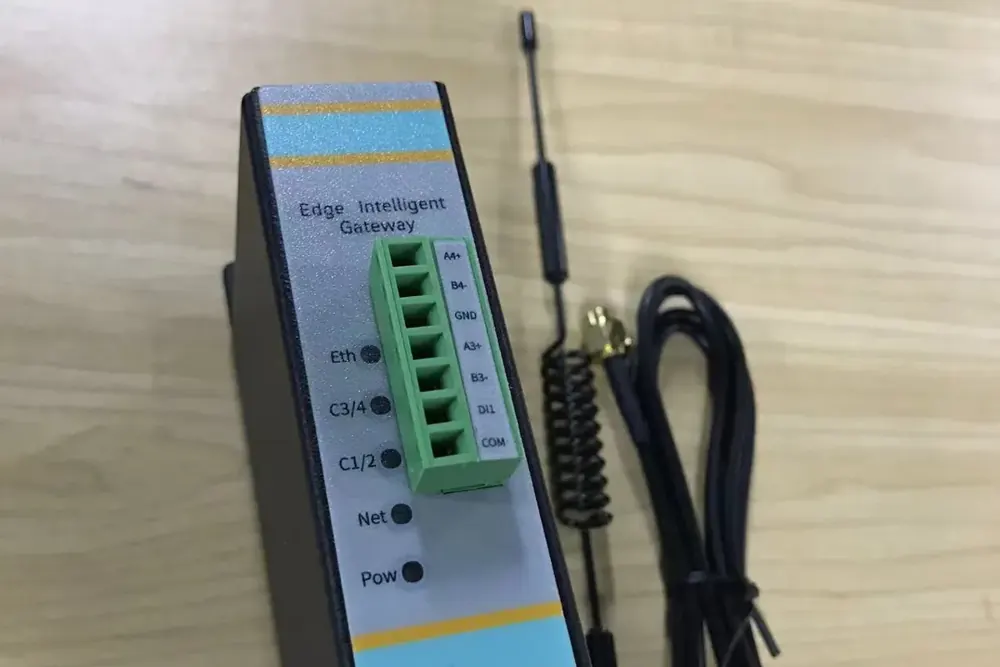
IoT SIM for Wireless Tank and Liquid-Level Control Systems: Telemetry, Alarms and Control Loops
By jietion, Business Development (BD) at Quanqiu IoT · Published · Updated
Definition: An IoT SIM in a tank or liquid-level control system carries level readings, pump states and alarms from the field controller to a remote platform over cellular, so operators can supervise tanks without visiting.
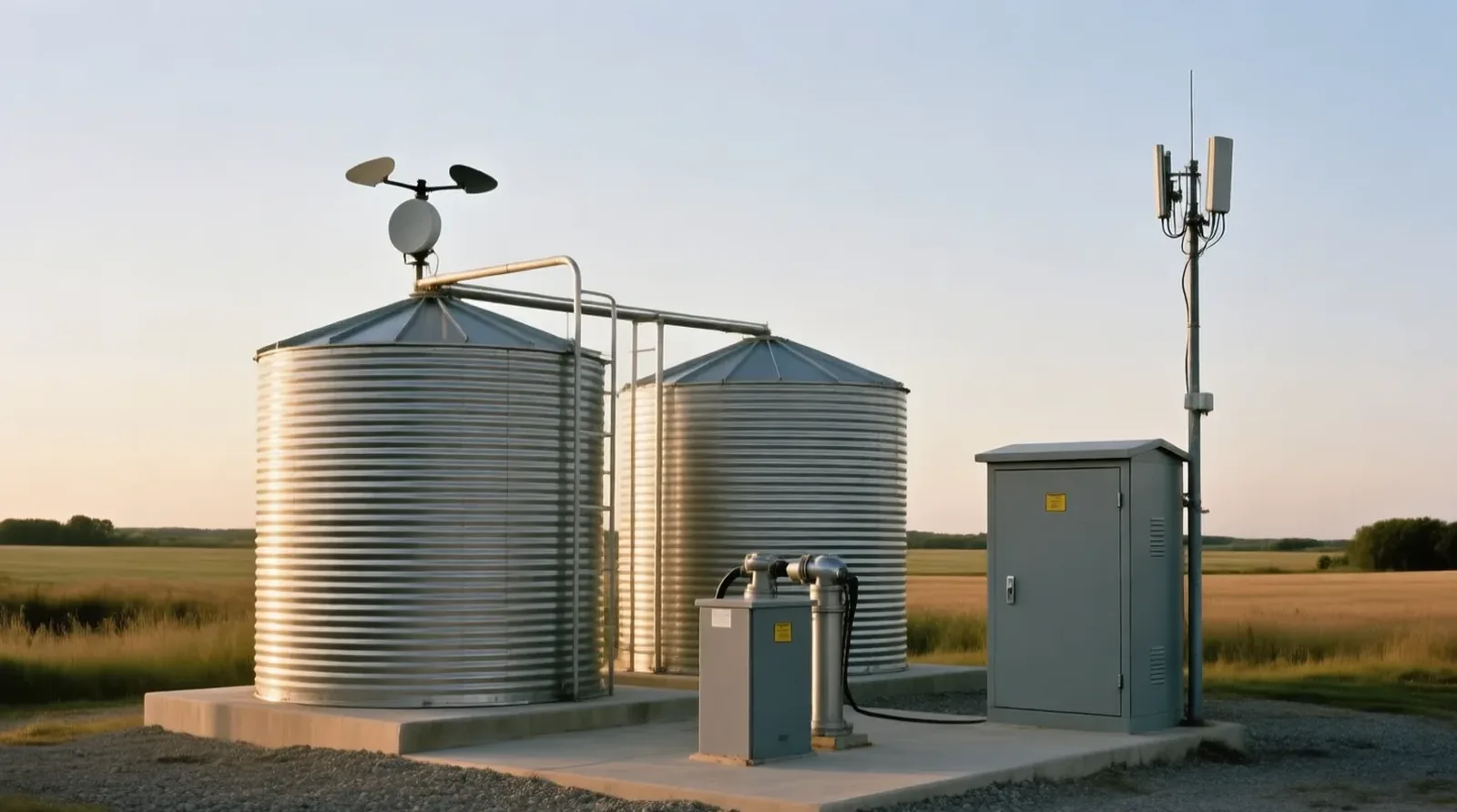
The short answer: keep the control loop local and use the cellular link for telemetry, alarms and setpoint changes. The level transmitter, controller and pump relays should hold the tank within its band even when the modem is offline. The IoT SIM then decides how quickly an operator hears about a high-level condition, how reliably a new threshold reaches the site, and how much the monthly data bill grows as you add tanks. Get that split right and most connectivity choices become straightforward.
What the link carries in a level-control loop and what it must never carry
A compact reference design shows the layers clearly. In a laboratory build, a 0.2-class differential-pressure transmitter with a 0 to 1 m range fed an STM32F103 controller, relays switched the fill and drain pumps, and an ESP8266 Wi-Fi module published data over MQTT to a cloud platform where a phone app could read levels and change thresholds; pumps responded in under 1 s (Liu et al., 2026). That sub-second response came from the local relay logic, not from the network. Swapping Wi-Fi for a cellular module changes the backhaul, and it should not change where the on/off decision is made.
A wastewater station design makes the same point at plant scale. A Siemens S7-200 SMART PLC ran the logic: keep the pump running while the level stays in range, stop it below the minimum, and raise an alarm above the maximum, with SMS and email alerts to maintenance staff (Xu et al., 2026). The gateway in that project supported wired, Wi-Fi and 4G, and the authors chose the wired path for reliability and security. For remote tanks with no cable route, a cellular gateway takes that role, and the same discipline applies: the PLC protects the tank, and the link reports what happened.
Field patterns: wellsite pits, lift stations and remote storage tanks
Drilling mud pits are the classic case where a missed level alarm has safety consequences. A wellsite monitor built around an STC15 microcontroller read a non-contact radar level sensor through a 4-20 mA loop, added temperature and satellite positioning, and pushed data to a control center over GPRS every 40 seconds (Bai, 2015). The author ties the motivation to blowout risk: between 1949 and 1988, China recorded 230 uncontrolled blowout wells, 78 of which caught fire. The same design switched to battery on mains loss, sent a power-failure alarm, and kept running for roughly a week before a low-battery warning.
Pump stations show how redundancy at the sensor end reduces dependence on the link. A retrofit of a 14-year-old sewage lift station in Shenzhen used two ultrasonic level meters on separate brackets and cables, fused in the PLC, and ran every remote command through a four-step cycle of command, confirmation, execution and feedback (Li, n.d.). Over a six-month trial, annual equipment failures fell from 9 to 3 and average handling time dropped from 4.5 h to 1.2 h. Those gains came from the station design as a whole; the cellular link is one part of it.
Smaller deployments look similar with fewer points: a diesel day tank at a telecom shelter, a chemical dosing tank at a booster station, a rainwater cistern on a farm. Each has one or two level inputs, a pump or valve output, and an alarm list that matters far more than the trend data.
Sizing data and choosing the plan for alarm-driven tank telemetry
Message count drives the budget more than payload size. A 40-second reporting interval, as in the wellsite design, produces 2,160 reports per day and about 64,800 in a 30-day month per site. Moving to report-by-exception cuts that sharply. OPC UA, for example, defines subscriptions that report only when a monitored value changes according to client criteria, plus events for important conditions. MQTT publishing on change gives a similar effect on a lighter stack. A level that sits inside its band for hours then costs almost nothing, and the budget is spent on alarms, pump starts and the occasional configuration push.
Protocol overhead is the second factor. TLS sessions, keep-alive packets and reconnections after a weak-signal drop can exceed the application payload on low-rate links, so measure a pilot device for a full week before fixing the plan. A pooled plan across a tank fleet absorbs the outlier sites that alarm often. Per-site volumes and pool terms belong in the project quote, not in a guess from a spreadsheet.
Decision table for cellular tank-level projects
| Design question | Lower-risk choice | What to confirm |
|---|---|---|
| Where the pump on/off logic runs | Local PLC or controller with fixed low and high limits | Behaviour of outputs when the modem or platform is offline |
| Reporting mode | Report-by-exception plus a periodic heartbeat | Heartbeat interval and alarm deadband: To be confirmed during project validation |
| Alarm path | Data message to the platform, SMS as a second path | SMS enablement per project; message format on the receiving side |
| Level sensing | Non-contact radar or ultrasonic; two sensors where overflow is costly | Sensor fusion rule in the PLC |
| Power | Battery backup with a power-loss alarm sent before shutdown | Backup duration at the chosen reporting rate |
| Field protocol | Modbus RTU behind a gateway that encrypts the uplink | TLS support and certificate handling on the gateway |
| Monthly data per site | Measured on a pilot, then pooled | To be confirmed during project validation |
Security of remote setpoints and pump commands
A remote threshold change is a control action, so it deserves more care than a dashboard read. Legacy field protocols such as Modbus and Profinet have no built-in encryption or authentication, which is why reviews of gateway-to-cloud links recommend OPC UA, MQTT over TLS or CoAP over DTLS on the uplink, together with certificate-based device identity and role-based access (Wang et al., 2026). The same review lists firmware-update flaws as a route for malicious code, so signed updates should be on the requirements list. NIST SP 800-213 gives a buyer-side framework for this: decide which cybersecurity capabilities you expect from the device and its manufacturer before you buy, rather than discovering gaps after installation.
On the SIM side, a private APN or a fixed set of permitted destinations reduces exposure of the gateway to the open internet. Whether a given project gets a private APN, static addressing or traffic restrictions is settled during the quote, because it depends on the countries and networks involved.
When a tank fleet needs a project quote instead of catalog SIMs
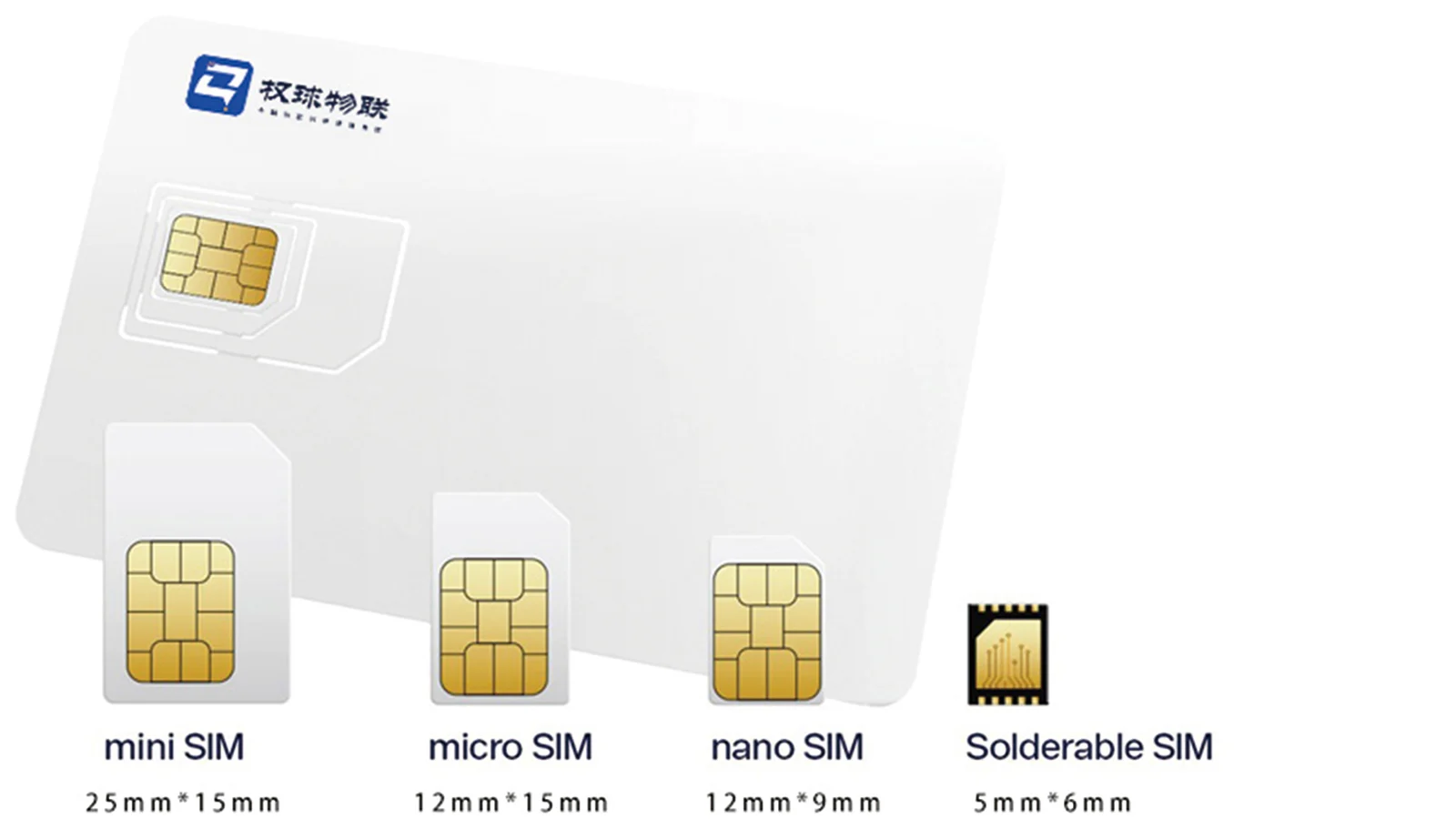
A handful of tanks in one country can usually start on catalog Global IoT SIM cards: insert the SIM, set the APN printed on the delivery sheet, and measure traffic on the pilot. Ask for a project quote when sites span several countries, when tanks sit at the edge of coverage and you need to know which networks are available there, when you want pooled data across hundreds of sites, when SMS alarms must be enabled, or when the gateways will be sealed and an eSIM with remote profile management is preferable to a plastic card. Fleet-wide visibility of usage and session status through the CMP also becomes worth discussing once the site count grows.
For related designs, see how IO-Link Wireless gateways in machine cells separate local control from cellular backhaul, and how alarm panels and emergency devices treat the alarm path as the part that must not fail.
Limits of what cellular connectivity can promise for level control
Coverage at a specific tank, latency on a specific network and the availability of LTE-M or 2G in a given country are confirmed per project; none of them can be assumed from a map. The research designs above are single-site or laboratory builds, and their response times and failure reductions describe those systems only. Treat the cellular link as a reporting channel with occasional gaps, design the site to stay safe through those gaps, and judge the connectivity contract on how alarms and commands behave during the pilot.
FAQ
Can a pump be controlled directly over the cellular link?
It can receive start, stop and setpoint commands, but the protective limits should stay in the local controller. Use a confirm-execute-feedback sequence so the platform knows the command actually took effect.
How much data does a tank-level site use per month?
It depends mostly on the reporting mode. Fixed 40-second reporting means about 64,800 messages a month; report-by-exception with a heartbeat can be far lower. Measure a pilot site for a week and size the pool from that.
Should alarms go by SMS or by data?
Data messages to the platform are the main path; SMS is a useful second path when the platform or the data session is down. SMS is enabled per project after confirmation.
Is Wi-Fi enough instead of cellular?
Where a site has dependable Wi-Fi, yes. Remote tanks, pits and lift stations usually have no wired network, which is where a cellular IoT SIM or eSIM in the gateway takes over.
Which network technologies will the SIM use at my sites?
The SIM uses the technologies offered in each country, such as 2G, 4G LTE or LTE-M where the local network supports them. The exact list for your countries is confirmed in the quote.
Official References
- OPC Foundation: OPC Unified Architecture
- NIST SP 800-213: IoT Device Cybersecurity Guidance for the Federal Government
- Liu Haiyan, Li Senyu, Li Junmin (2026). Design and Implementation of an Automatic Liquid Level Control System Based on Wireless Communication (in Chinese). 机械工程与自动化, 55(5), 180-183. DOI: 10.3969/j.issn.1672-6413.2026.05.055
- Xu Junpeng, Gao Shuaipeng, Xu Yaochang, Wang Yu, Wang Yilin (2026). Design of an IoT-Based Equipment Operation and Maintenance Alarm System for Wastewater Treatment Stations (in Chinese). 平顶山学院学报, 41(2), 21-27.
- Bai Changkai (2015). Design of an Automatic Monitoring System for Mud Pit Liquid Level at Drilling Wellsites (in Chinese). 自动化技术与应用, 34(4), 35-39. https://doi.org/10.20033/j.1003-7241.2015.04.009
- Wang Hao, Yao Meiling, Xu Chi (2026). Data Transmission Security Protection Between IoT Industrial Gateways and Computer Cloud Systems (in Chinese). 中国宽带, (2), 61-63.
- Li Guangchao. Design and Optimization of a PLC-Based Centralized Remote Monitoring System for Pump Stations (in Chinese), 181-183.