IO-Link Data over Cellular: Masters, JSON/REST and MQTT Gateways, IODD and Sensor Replacement
By jietion, Business Development (BD) at Quanqiu IoT · Published · Updated
Definition: IO-Link connects sensors and actuators to a master; an IoT SIM in the master’s gateway sends that data upstream over JSON/REST or MQTT from sites without a local network.
The practical answer: the protocol itself is a short point-to-point link inside the machine, and it never touches the mobile network. What crosses the cellular link is the data the master collects: process values, device status, events and parameters. The amount is small, so even a low-cost LTE-M or LTE Cat 1 connection is usually enough. The work is in choosing how the master exposes data (REST or MQTT), keeping device descriptions consistent, and making sensor replacement work without an engineer on site.
How IO-Link works and where the gateway sits
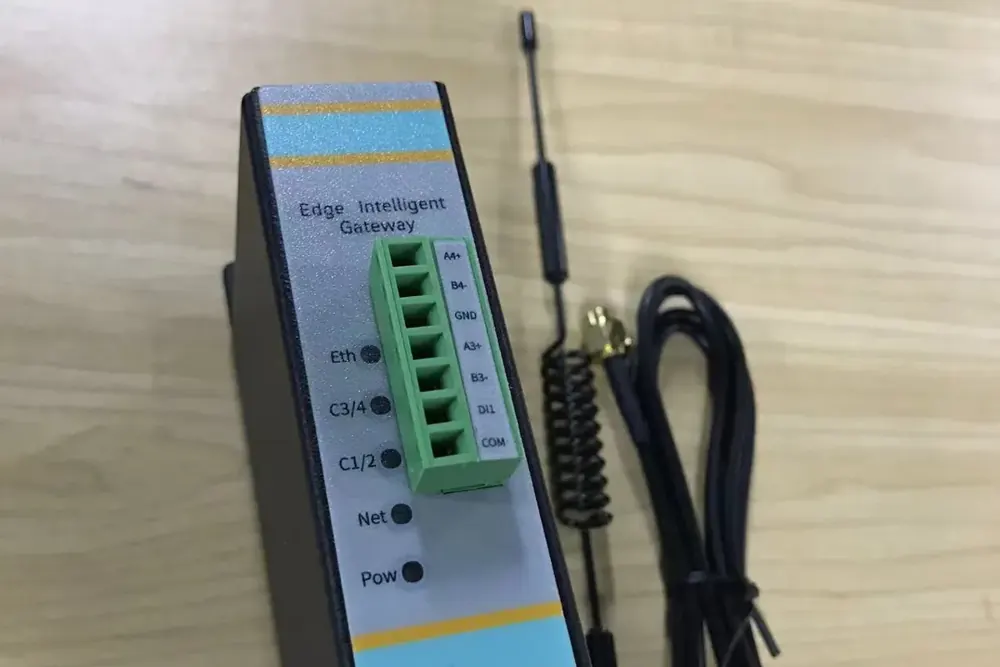
The protocol is standardised as IEC 61131-9. A device connects to one port of a master over an unshielded three-wire cable of up to 20 metres. Three transmission rates are defined: COM1 at 4.8 kbit/s, COM2 at 38.4 kbit/s and COM3 at 230.4 kbit/s. Each device exchanges cyclic process data with the master, plus acyclic parameters and events. The master then passes this data to a fieldbus controller, to an IT system, or to both. For remote assets, a cellular gateway, built into the master or attached to it, carries the IT side.
JSON/REST or MQTT: choosing the upstream interface
The IO-Link Community publishes a JSON integration specification that gives masters a REST API: a client can read process data, device identification and parameters over HTTP. Many masters also publish data over MQTT. The two patterns behave differently on a mobile link.
| Interface | Who starts the exchange | Behaviour on cellular | Good for |
|---|---|---|---|
| JSON/REST on the master | Remote client polls the master | Needs a reachable master address (private APN or VPN); polling adds overhead | On-demand diagnostics, parameter reads, engineering tools |
| MQTT publish from master or gateway | Gateway, outbound | Works behind carrier NAT; long-lived connection; message size controlled at the edge | Continuous monitoring, fleets of remote assets |
| Fieldbus to PLC, PLC to cloud | PLC or edge device | IO-Link data mixed with machine data; depends on PLC gateway | Machines with an existing controller and remote service router |
For MQTT, map message priority to QoS rather than sending everything with the highest guarantee. A 2026 study of an embedded Linux gateway used QoS 2 for control data, QoS 1 for monitoring and QoS 0 for ordinary data; with compression kept only when it saved at least 30 percent, compression ratios settled at 38 to 43 percent (Luo, 2026). Those results came from one gateway on a 100 Mbit/s test network, so treat them as a design pattern rather than a figure for a mobile link.
Sizing the data plan for an IO-Link master
Process data per device is small, often a few bytes. An eight-port master with sensors reporting every minute, sent as compact MQTT messages, can stay within a few megabytes a month once protocol overhead is counted. Data grows when every value is sent as verbose JSON every second, when the gateway reconnects often (each TLS handshake costs kilobytes), or when firmware and parameter sets are downloaded. Choose the reporting interval by the decision it supports: a level sensor on a remote tank does not need one-second updates; a vibration alarm does need to arrive immediately.
IODD files and remote parameter governance
Each IO-Link device is described by an IODD file, an XML description with its parameters, process data layout and identification. The IODDfinder portal provides a central source for these files. Remote tools use the IODD to turn raw bytes into named values and units, so the master, the gateway and the cloud application must all use the same IODD version. Keep a library of the IODDs in use, linked to vendor ID and device ID, and update it on purpose rather than letting each site download whatever version is current.
Parameter changes made remotely should be recorded with who changed what, when and from which value. A remote write that changes a sensor’s switching point can stop a line as surely as a wiring fault.
Sensor replacement with Data Storage and device profiles
Version 1.1 of the specification introduced Data Storage. The master keeps a copy of a device’s parameters; when an identical replacement is plugged in, the master writes the parameters back. For remote sites this is the main labour saver: a local technician swaps the sensor, and nobody has to reconfigure it. It works only when the replacement is compatible and Data Storage is enabled on the port, so verify both during commissioning. Standard device profiles, such as the Smart Sensor Profile, help further: devices from different vendors that implement the same profile present process data in the same way, which keeps cloud dashboards stable after a replacement.
IO-Link Safety and IO-Link Wireless
The safety extension, IO-Link Safety, adds a layer for functional-safety devices. As with other safety protocols, the safety function stays local; cellular access is for diagnostics and reading status only, and safety parameters are changed on site with the tools the safety concept specifies. The wireless variant replaces the cable with a 2.4 GHz radio link between master and devices for moving or rotating machine parts. Neither changes the upstream picture: the master or gateway still decides what leaves the machine.
Related reading: MQTT Sparkplug B on Cat-M1 and NB-IoT, Modbus over cellular for remote sites and ISA/IEC 62443 for cellular conduits.
Quanqiu IoT supplies Global IoT SIM cards for IO-Link masters and edge gateways, with SMS enabled per project and each country’s network technologies, including LTE-M where offered, confirmed in the quote. Request a project quote through the contact page.
FAQ
Does IO-Link need a fast cellular connection?
No. Device data is small. LTE-M or LTE Cat 1 is usually enough for monitoring; plan for more only when firmware or large parameter sets are transferred often.
Should I use the REST API or MQTT over cellular?
MQTT published outbound from the gateway works behind carrier NAT and suits continuous monitoring. REST needs a reachable master address and suits on-demand access.
What is an IODD and why does its version matter?
It is the device description file that tools use to interpret data and parameters. Different versions across the master, gateway and cloud can produce wrong values or failed writes.
Can a sensor be replaced without remote reconfiguration?
Yes, when the master’s Data Storage is enabled and the replacement is compatible; the master restores the parameters automatically.
Can IO-Link Safety parameters be changed over the cellular link?
Treat safety configuration as an on-site task. Use the remote link for status and diagnostics only.
Official References
- IO-Link Community: IO-Link technology, JSON integration and specifications
- IODDfinder: central database of IO-Link device descriptions
- Luo Haibin (2026). Communication Protocol Optimization for Industrial IoT Gateways Based on Embedded Linux (in Chinese). 无线互联科技, (15).