IoT SIM for Smart Meter Rollouts and Utility Procurement-Stage Connectivity Planning
By jietion, Business Development (BD) at Quanqiu IoT · Published · Updated
Definition: Connectivity planning for a smart meter rollout fixes, in the tender, how meters reach the head-end system, which radio technology and SIM they use, and who manages SIMs for 15 years or more.
The short answer: settle connectivity in the tender, not after the meters are chosen. A meter stays on the wall for 15 years or more, so the radio technology, the SIM form factor and the right to change operator must last that long. Write into the specification whether meters connect directly over cellular or through concentrators, which technologies are acceptable, and how SIMs are owned and switched. Then run a pilot in the hardest locations, cellars and meter cupboards, before the volume order.
Direct cellular or concentrator
There are two basic architectures. In the first, every meter has its own cellular module and SIM and talks straight to the head-end system. In the second, meters use power-line communication or a local radio mesh to reach a data concentrator, which uses a single cellular link for the whole group. Many rollouts mix both: concentrators in dense areas, direct cellular for scattered rural meters and for gas and water meters that have no mains power.
| Factor | Direct cellular per meter | Concentrator with cellular backhaul |
|---|---|---|
| SIMs to manage | One per meter, often millions | One per concentrator, often hundreds of meters each |
| Coverage risk | Every meter location must have signal | Only the concentrator site needs good signal |
| Local network to maintain | None | PLC or radio mesh, with its own faults |
| Fits battery meters | Yes with NB-IoT or LTE-M | Depends on the mesh technology |
| Single point of failure | No | Concentrator outage silences a whole group |
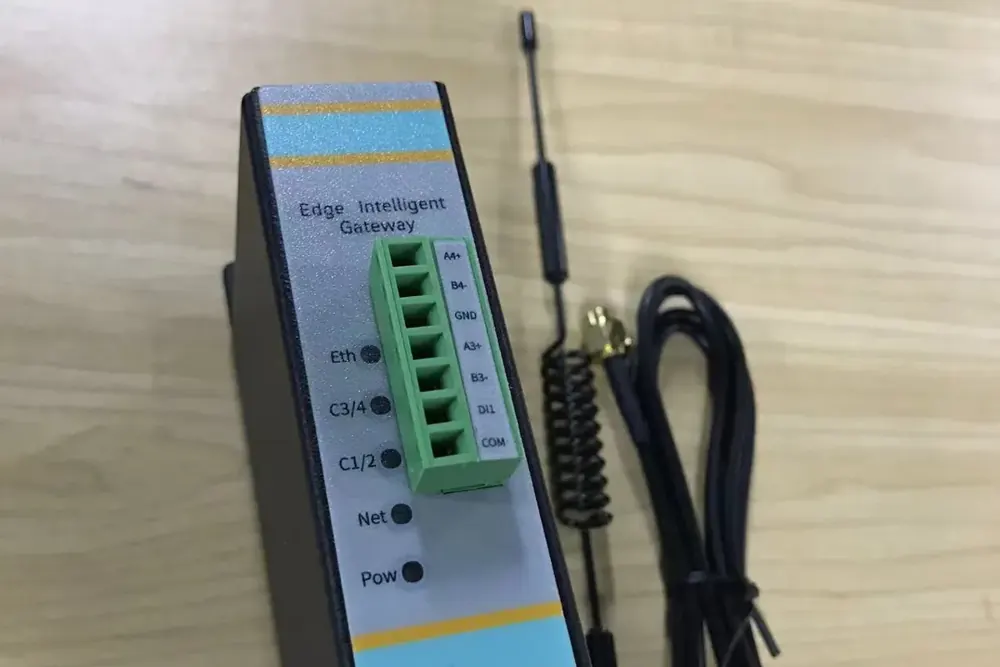
Concentrators are sizeable devices in their own right. One research gateway combined PLC, LoRa and an LTE Cat 4 module, rated for -40 to 70 °C (Xiao et al., 2020). Treat concentrator SIMs as critical infrastructure, with a second network where possible.
Radio technology and data volume
Water and gas meters are battery powered and expected to run for about 10 years; electricity meters have mains power. Published figures for one market put typical traffic at about 200 bytes a day uplink for a water meter, under 100 bytes a day for gas, and 25 to 40 KB a day for an electricity meter (Xie et al., 2018). The same work notes that NB-IoT suits static, low-rate devices that need deep coverage and long standby, while GPRS meters drained batteries too quickly.
- NB-IoT: best indoor reach and lowest power, for water and gas meters with small daily readings.
- LTE-M: more throughput and lower latency than NB-IoT, useful where firmware updates or on-demand reads are frequent.
- LTE Cat 1 or Cat 1 bis: for electricity meters and concentrators that send interval data and receive larger updates.
NB-IoT and LTE-M came from 3GPP Release 13. Check that the networks in your territory support the chosen technology, including power-saving features, and that roaming on NB-IoT is available if meters use a SIM from another country. Do not specify 2G or 3G for new meters; several operators have switched them off. For power budgets, see the guide to battery-powered sensors and LPWAN choice.
SIM form factor and the right to change operator
A meter that outlives its connectivity contract needs a way to change operator without a site visit, which would cost more than the meter. An eUICC, usually soldered as MFF2, lets a new operator profile be downloaded remotely. Write into the tender which remote provisioning architecture the meters must support (SGP.02 for existing platforms, SGP.32 for new headless devices), who runs the profile management platform, and that the utility, not only the meter vendor, can order a switch. The article on profile download for smart electricity meters covers the device side.
Security and data protocols
Most meters use DLMS/COSEM for data exchange with the head-end system, with its own authentication and encryption suites. Protect the cellular path as well. A private APN with private addressing keeps meters off the public internet, and an IPsec link carries the traffic to the head-end. Disable SMS commands unless they are authenticated, lock SIMs to the meter’s IMEI, and set usage alerts so a faulty meter that keeps reconnecting is found quickly.
Procurement-stage checklist
- Architecture per area: direct cellular, concentrator, or both.
- Accepted radio technologies per meter type, with network support confirmed per region.
- SIM ownership: utility, meter vendor or managed-service provider, and how SIMs transfer at contract end.
- eUICC and remote provisioning requirements, including who may trigger an operator switch.
- Private APN, addressing plan and head-end connection.
- SIM states for meters in storage, so millions of SIMs are not billed before installation.
- A pilot of 100 to 500 meters in the worst locations, measured over at least 30 days.
The overview of SIMs for smart meters covers device-level choices, and industrial and energy IoT SIM lists related use cases.
When to ask for a project quote
- Your tender needs connectivity terms for 15 years or more.
- You need a private APN and IPsec to the head-end system.
- Meters or concentrators need eSIM profiles with a right to switch operator.
- You plan a pilot in difficult indoor locations.
Quanqiu IoT supplies Global IoT SIM and eSIM connectivity for meters and concentrators, with private APN options and a CMP for lifecycle states; NB-IoT, LTE-M and LTE availability per country is confirmed in the quote. Tender requirements can be sent through the contact page.
FAQ
How much data does a smart meter use?
Water and gas meters send a few hundred bytes a day; electricity meters with interval data can send tens of KB a day.
NB-IoT or LTE-M for meters?
NB-IoT for battery meters with small daily readings and deep indoor locations; LTE-M where updates and on-demand reads are more frequent.
Should every meter have its own SIM?
Not always. Concentrators reduce the number of SIMs but add a local network and a single point of failure.
How can meters change operator without a site visit?
With an eUICC that accepts remote profile downloads, and a contract that lets the utility order the switch.
When should SIMs be activated?
At installation. Keep SIMs in an inventory state while meters are in storage.
Official References
- DLMS User Association: DLMS/COSEM specifications
- 3GPP Release 13, which introduced LTE Cat-M1 and NB-IoT for machine-type devices
- GSMA: IoT RSP, enabling the growth of Massive IoT (SGP.31/SGP.32)
- Xie Donghai, Yang Yang, Xi Chenchen (2018). Application of NB-IoT Technology in the Metering Industry (in Chinese). 数字技术与应用, 36(08), 45-46.
- Xiao Yong et al. (2020). Research on Intelligent Multi-mode Converged Gateway Device Based on AMI (in Chinese). 计算机科学, 47(6A), 290-294.