Why Video Intercoms Go Offline: SIM, Network and Firmware Causes and Fixes
By jietion, Business Development (BD) at Quanqiu IoT · Published · Updated
Definition: In video intercom and entry systems, an IoT SIM gives each door station or gate panel its own cellular link to the call service, so residents can answer and open the door without the building’s internet line.
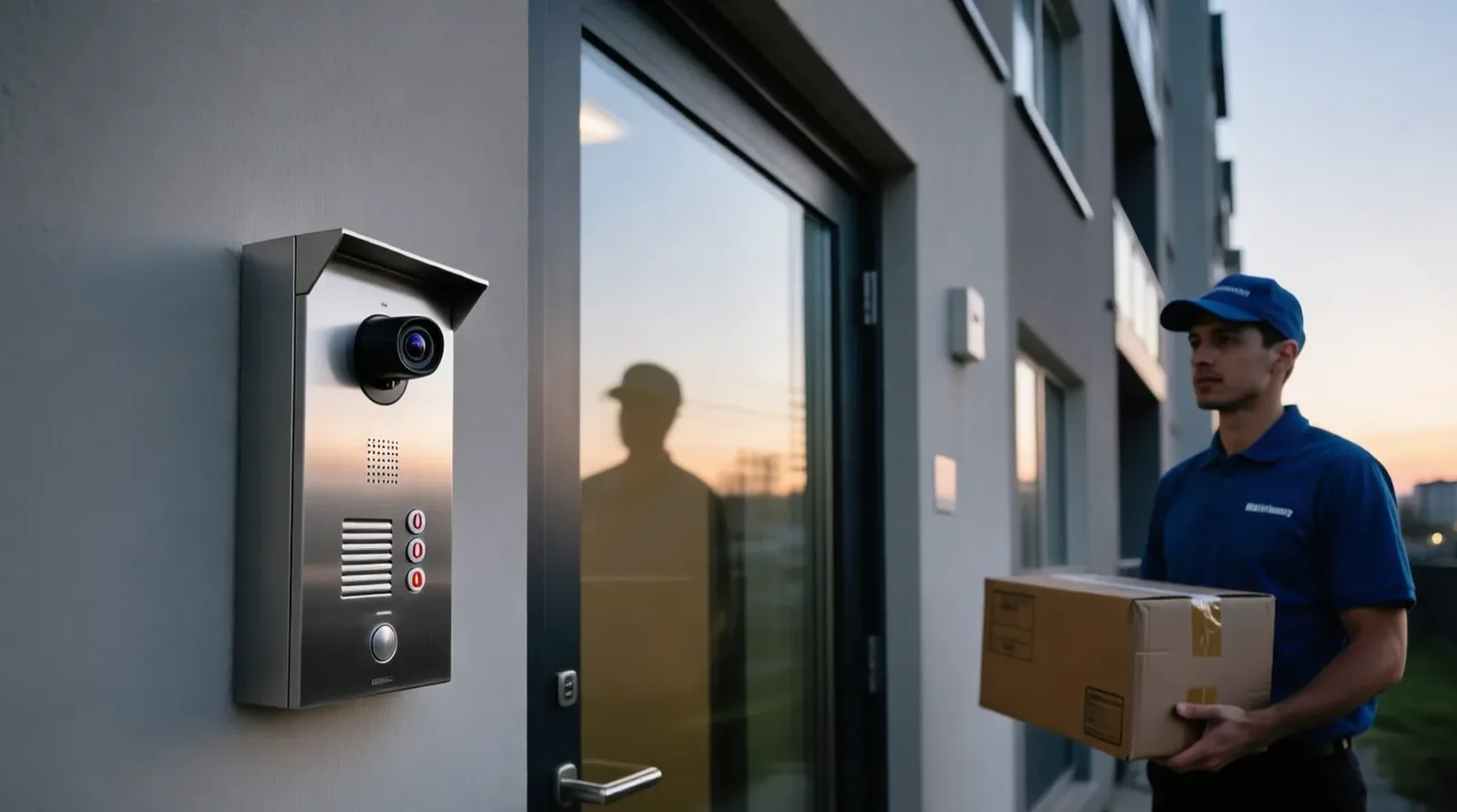
When a cellular intercom shows offline, the SIM is rarely broken. In most field cases the panel is still attached to a mobile network but cannot keep its call registration alive, has run out of data, is locked to a network that the operator has retired, or sits behind a steel door frame with too little signal. Each of these has a different fix, and the fastest way to tell them apart is to compare three timestamps: the last network attach recorded for the SIM, the last data session, and the last successful registration with the intercom cloud. If the SIM attached recently but the cloud has not heard from the panel, the problem is above the SIM. If the SIM has not attached for days, look at coverage, power and the plan status first.
What makes a door station harder to keep online than a camera
A security camera that drops its link for ten minutes loses some footage. An entry panel that drops its link means a courier waiting at a locked gate, a resident who cannot let a visitor in, or a lift that will not call. Buyers who manage hundreds of entry points across apartment blocks, gated communities or office parks feel this as service tickets, not as a statistic. A second difference is traffic shape. Intercoms sit idle most of the day and then need a live video call within a few seconds of a button press. That idle-then-urgent pattern is exactly where cellular sessions and carrier NAT timers cause trouble, because the panel must keep a path open from the cloud to itself while sending almost nothing.
Security pressure adds a third layer. Video-capable devices are attractive targets. The 2016 attack that disrupted the US DNS provider Dyn came largely from compromised webcams and digital video recorders (郭茂文, 2019). An intercom that gets locked down by an operator for abnormal traffic, or reset by its owner after a compromise, also shows up as offline. For the camera side of the same buildings, see our guide to IoT SIM for CCTV cameras and remote security systems.
Offline symptoms, likely causes and the check that separates them
The table below is the triage sequence we suggest for field teams. Work from the top: the first rows are the most common and the cheapest to check remotely.
| Symptom | Likely cause | Remote check | Fix |
|---|---|---|---|
| SIM attached in the last hour, panel offline in the intercom app | Call registration expired behind carrier NAT; keepalive interval too long | Compare last data session with last cloud registration | Shorten the panel’s registration or keepalive interval; confirm the operator’s NAT idle timer during the pilot |
| Panel worked for weeks, then stopped on the same day as others in one country | Data allowance exhausted or SIM suspended by plan rules | SIM state and usage in the CMP | Raise the pool size or set usage alerts before the limit |
| Older panels fail after an operator announcement, newer ones keep working | Module supports only 2G or 3G and the network was switched off | Module model and supported radio technologies | Replace the module or the panel; specify LTE Cat 1 or newer for new orders |
| Panel never attaches after install, works on the bench | Weak signal in a metal frame, basement or gatehouse | Signal quality reported by the module at the installed position | External antenna, different mounting, or a second operator profile |
| New panels in a new country attach, then drop after some weeks | Roaming restrictions on long-term foreign SIMs | Operator and country rules for permanent roaming | Local profile through eSIM, or a project quote for that country |
| Panel online, but door release fails when the internet is down | Door-release credentials checked only by the cloud server | Authentication design of the access controller | Keep an offline credential path on the device |
The last row is not strictly a connectivity failure, but it is reported as one. IoT authentication can run offline, with credentials stored on the device, or online, where a cloud server must confirm every request (郭茂文, 2019). An entry system that relies only on the online mode turns every cellular outage into a locked door. Ask the intercom vendor which mode applies to resident cards, PIN codes and app-based door release.
Firmware and configuration settings that prevent most tickets
Three settings decide whether a cellular intercom recovers on its own or waits for a technician. The first is the APN. Panels shipped with one operator’s APN hard-coded will fail silently when the buyer swaps to another SIM; choose firmware that reads the APN from configuration and can receive it remotely. The second is the modem watchdog. A panel that only reboots its application, not its cellular module, can stay stuck with a dead data session for days. The firmware should detect a missing data path, reset the module, and re-register. The third is the keepalive behaviour already mentioned: for SIP or cloud signalling behind carrier NAT, an interval that works on one network can be too long on the next, so make it configurable per deployment instead of fixed at the factory.
Firmware updates themselves should be planned around data plans. A full image pushed to thousands of panels in one night can exhaust a small pooled allowance. Stage updates by building or region and size the plan with the update in mind.
Vehicle trackers run into the same operator NAT idle timers; GPS Tracker Reporting Intervals and Keep-Alive Timers: How Firmware Settings Drive Monthly Usage explains how GSMA TS.34 suggests setting keep-alive intervals.
Choosing SIM format and network fallback for multi-country rollouts
For a single-country project with one operator, a plastic industrial SIM in a Global IoT SIM country plan is usually the simplest choice. Rollouts across several countries are where SIM format starts to matter. A conventional SIM is written once, either offline in a card writer or over the air through operator SMS to a preset number (Li et al.). eSIM separates the operator subscription from the hardware, so the profile can be stored electronically and downloaded to the device over the network (Li et al.). GSMA published four versions of its eUICC specification between 2011 and 2016 with industrial IoT as the first target, and released the consumer-oriented Remote SIM Provisioning standard in 2016 (Li et al.). For an intercom buyer the practical point is narrower: confirm which eSIM architecture the panel’s module supports before ordering, because a profile type the module cannot load is worth nothing. Our comparison of eSIM vs physical SIM for IoT covers that decision in more detail.
Network fallback is a separate question from SIM format. A multi-network profile can move a panel to a second operator when the first is unavailable, but only if the module and the plan both allow it. Lower-power technologies help status messages, not video. In an energy IoT study, NB-IoT in standalone mode reached a downlink power spectral density 17 dB higher than LTE (Wang et al., 2022), which explains why it reaches meter rooms that LTE does not; it still cannot carry an intercom video call. Use it, if at all, for door-state and alarm messages from deep-indoor controllers.
For multi-network SIMs for EV charger 4G or wi-fi, see our guide to EV Charger 4G or Wi-Fi: Multi-Network SIMs and Dead-Zone Fixes for Charging Hubs.
Security baseline that keeps panels from being shut down
Many offline reports trace back to a device that was isolated after misbehaving. NIST SP 800-213 asks organisations to define device cybersecurity requirements before acquisition, and ETSI’s consumer IoT work, including EN 303 645, sets baseline expectations such as no universal default passwords and a way to update software. CISA’s Secure by Design guidance puts the burden on manufacturers to ship devices that are secure out of the box. On the connectivity side, a private APN or a restricted set of reachable addresses stops random internet traffic from reaching the panel at all. Research on IoT identity proposes using the SIM or eSIM as the secure element for device authentication (郭茂文, 2019), and certificate-based identity is already the basis of eSIM provisioning (Li et al.). Our checklist of cybersecurity questions before buying a Global IoT SIM turns this into procurement questions.
Where Quanqiu IoT fits and when to ask for a project quote
A pilot of a few panels in one country can start from a catalog Global IoT SIM plan. Ask for a project quote when panels go to several countries, when you need eSIM profiles or a second operator per site, when you want SIM status, usage alerts and suspension control in a CMP, or when the panels must sit on a private APN. Send the panel and module models, the expected call minutes and video resolution, the number of sites per country, and how door release is authenticated. Coverage at each building, operator choice and permanent-roaming limits are confirmed during project validation; we do not promise coverage for an entry point we have not tested.
The boundary is clear. A SIM does not fix a panel whose firmware never resets its modem, a door-release design that needs the cloud for every door, or an installation inside a steel enclosure without an external antenna. Those belong in the device specification, and they are cheaper to fix there than in the field.
FAQ
How much data does a cellular video intercom use?
It depends on call minutes, video resolution and how often firmware is updated. Idle signalling is small; calls and updates dominate. Measure a pilot panel for a full month, including one firmware update, before choosing a pool size.
Why does the SIM show online while the intercom app shows offline?
The SIM is attached and may even have a data session, but the panel’s registration with the call server has expired. This usually points to a keepalive interval longer than the operator’s NAT idle timer, or to an application that stopped without resetting the modem.
Should new intercom projects avoid 2G and 3G modules?
Yes. Operators in many countries have already switched these networks off or announced dates. Specify LTE Cat 1 or newer and check the module’s band list against the target countries.
Is eSIM necessary for intercoms?
Not for a single-country project. It becomes useful when panels ship to several countries or when you want to change operator later without visiting each entrance. Check module support first.
Can residents still open the door if the cellular link is down?
Only if the access controller keeps credentials locally. Cards and PIN codes often work offline; app-based door release usually needs the cloud. Ask the vendor for each method.
Official References
- NIST SP 800-213: IoT Device Cybersecurity Guidance for the Federal Government
- ETSI: Consumer IoT security and cybersecurity standards
- CISA: Secure by Design
- 郭茂文 (2019). Discussion of IoT Identity Authentication Solutions (in Chinese). 广东通信技术, (02), 24-28,35. https://doi.org/10.3969/j.issn.1006-6403.2019.02.007
- Li Hongping, Meng Yuming, Zhang Lixing, Zhang Aosi, Du Linmei. Research on the Application of PKI Digital Certificates in eSIM Security (in Chinese). 研究与开发, 34-39.
- Wang Yanfeng, Shen Yongpeng, Tang Yaohua, Zhong Jianying, Zhang Youpeng (2022). Framework and Key Technologies for NB-IoT Energy Internet of Things to Achieve Carbon Peak and Neutrality Goals (in Chinese). 电力系统保护与控制, 50(8), 179-185.