IoT SIM Backhaul for Reservoir and Dam Safety Monitoring: Gate, Spillway and Sensor Data
By jietion, Business Development (BD) at Quanqiu IoT · Published · Updated
Definition: In reservoir and dam safety monitoring, an IoT SIM gives each gate controller, spillway station and sensor RTU a managed cellular link that carries readings, alarms and remote commands from remote embankments to the operator’s monitoring platform.
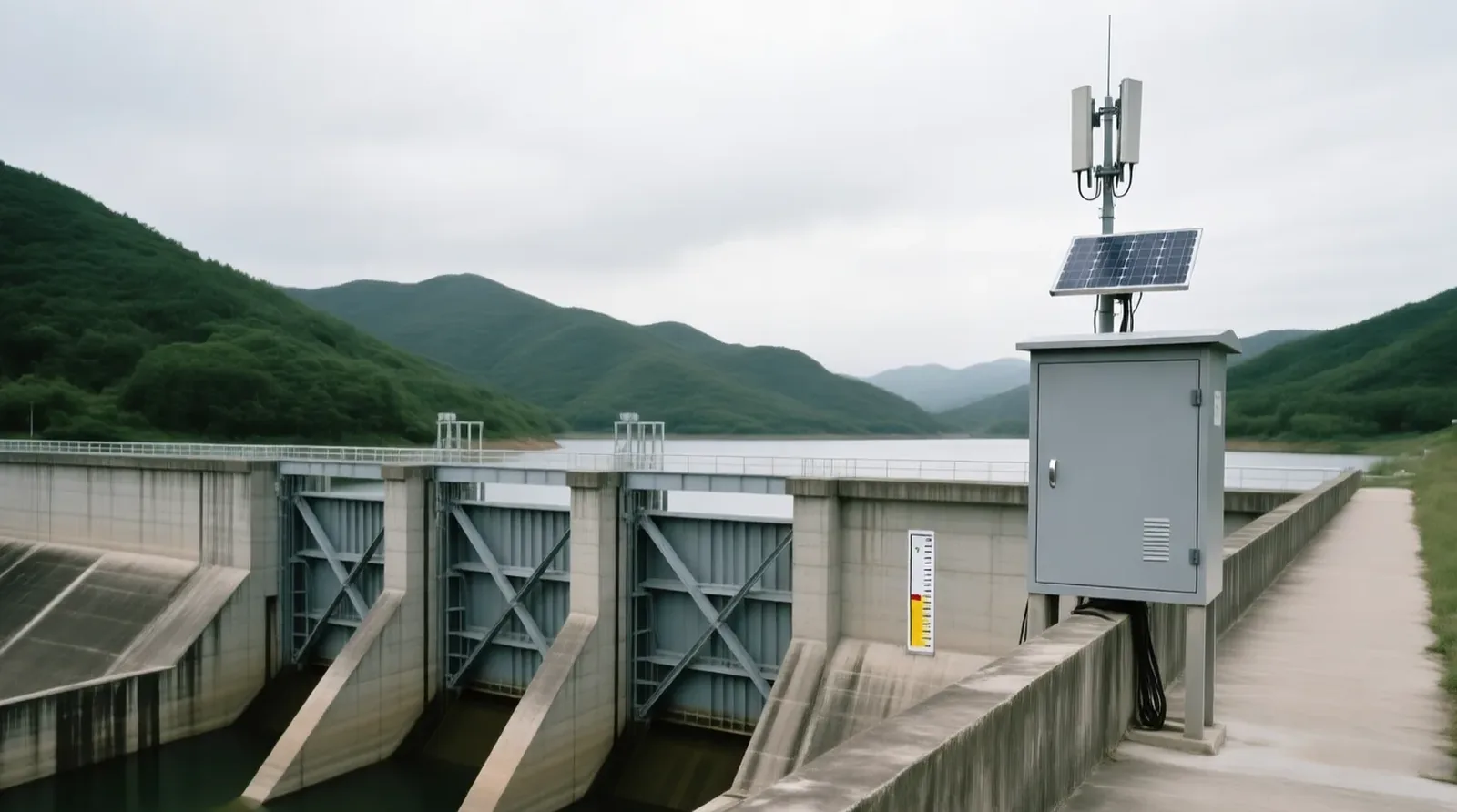
For most small and medium reservoirs, the workable design has three parts. Sensors and gate controllers stay on a local Modbus RTU or 4-20 mA loop into one RTU or PLC per site. That controller reaches the monitoring platform through a cellular router with a Global IoT SIM. Flood and gate alarms get a second, independent path, because the hours when a dam operator most needs data are the hours when power, cables and local networks are most likely to fail. Monthly data volume is rarely the hard part. The hard part is keeping an unbroken, time-stamped record that a condition-assessment model can use, and getting an alarm out when the primary link is down.
Why a reservoir link is judged during the worst week of the year
A fleet tracker that misses an hour of positions costs some convenience. A spillway station that goes quiet during a flood peak leaves the duty engineer guessing about gate position and upstream level at the moment those numbers drive decisions. That changes how a buyer should evaluate connectivity: average uptime matters less than behaviour under storm conditions, at the bottom of a valley, on a site that may be an hour’s drive from the nearest technician.
The number of sites also makes manual reading impractical. Shandong province alone has more than 6,400 reservoirs, over 9,400 pumping stations and about 32,000 km of dikes (Gao et al., 2026). Most of these are small structures without permanent staff. ICOLD’s World Register of Dams lists more than 55,000 large dams worldwide, and small reservoirs below the large-dam threshold are not in that count at all. Many of them store water for irrigation, which FAO identifies as the main driver of agriculture’s 72 percent share of global freshwater withdrawals. Their owners need monitoring that a small operations team can run.
What a gate, spillway and embankment site actually sends
Before choosing a plan or router, list the data classes per site. They differ in urgency, size and local interface, and that list is what a connectivity supplier needs to size a plan honestly. Process controllers at water facilities typically collect sensor data over RS-485 serial Modbus and forward it over Ethernet TCP/IP to a gateway (Xu et al., 2026). Analog instruments such as PT100 temperature probes and 4-20 mA transmitters connect directly to PLC input modules (Li).
| Data class | Typical source | Local interface | Urgency | Reporting interval |
|---|---|---|---|---|
| Upstream and tailwater level | Radar or pressure level transmitter | 4-20 mA or Modbus RTU | High during floods | To be confirmed during project validation |
| Gate position and gate state | Gate PLC, limit switches, encoders | Modbus RTU / Ethernet | High: confirms commands executed | Event-driven plus periodic heartbeat |
| Gate structural condition | Coating thickness, plate thickness, strength tests | Inspection records, uploaded in batches | Low urgency, high value for models | Per inspection campaign |
| Pump, motor and bearing status | PT100 sensors, current and voltage meters | Analog input modules | Medium | To be confirmed during project validation |
| Alarms (level thresholds, gate faults, power loss) | RTU logic or edge gateway | Generated on site | Highest | Immediately, with retry |
Two lines in this table cause most sizing mistakes. Alarms are tiny but must arrive within minutes, so they are a reliability question, not a data-plan question. Structural condition data are infrequent, but they feed the long-term record that safety assessments depend on, so losing them is expensive even though they consume almost no bandwidth.
Condition models are only as good as the data record behind them
Research on small-reservoir spillway gates shows why complete records matter more than raw speed. A study of three metal gates at a class IV reservoir with 5.633 million m3 of storage used 1,800 monitoring records collected in 2014 and 2020 to train a model that classifies gates into four structural states (Huang, 2024). With coating thickness alone the model reached 92.3% accuracy. Adding structural thickness raised it to 94.4%, and adding structural strength took it to about 98%, ahead of BP neural network, SVM and plain Transformer baselines on the same data (Huang, 2024). The author stresses that monitoring data at small reservoirs are scarce and hard to collect, and that more data categories would improve the result.
The practical lesson for connectivity: every missing upload is a missing training example, and small reservoirs cannot afford to lose many. Specify RTUs that buffer readings locally with their own timestamps and resend after an outage, rather than devices that only stream live values. Make sure the platform accepts late data in order. When you compare suppliers, ask how the SIM and router report a session that dropped and re-attached, because that event log is what explains a gap in the record later.
Choosing the backhaul path: cellular primary, cellular backup, or a second technology
Cellular is not automatically the first choice. At wastewater stations where fixed lines exist, one design team selected a gateway that supports wired, Wi-Fi and 4G connections and deliberately used the wired link for reliability and security (Xu et al., 2026). At a reservoir in Zibo, Shandong, monitoring was designed with two independent paths, Beidou short messaging plus a 5G and fibre link, so that one failure does not silence the site (Gao et al., 2026). At the measurement edge, survey teams already use short-range licence-free radio: a wireless depth-sounding float sends Modbus RTU data at 915 MHz to a shore station up to 2 km away in line of sight (Wu, 2021). Local radio collects across the water, and a cellular gateway on the bank carries it onward.
| Site profile | Primary path | Alarm or backup path | What to confirm |
|---|---|---|---|
| Staffed dam with fibre to the control room | Fibre or wired WAN | Cellular router with IoT SIM | Backup router tested monthly, SIM active and not suspended for inactivity |
| Unstaffed small reservoir, good signal at the dam crest | Cellular IoT SIM | Second operator profile (multi-network SIM or eSIM) or satellite messaging | Signal at the actual cabinet location, not at the car park |
| Valley site with weak or single-operator coverage | Cellular with external high-gain antenna | Satellite messaging for alarms | Site survey result; coverage cannot be assumed from public maps |
| Cascade of reservoirs across several districts or countries | Cellular, centrally managed in a CMP | Per site, as above | Project quote: country list, operators, private APN, number of sites |
Link redundancy only helps if the instruments are redundant too. A sewage lift pump station in Shenzhen was retrofitted with redundant PLC I/O, dual communication interfaces and two level meters, and its annual equipment failures fell by 66.7% after the upgrade (Li). That is a single station and a six-month trial, but the design principle carries over: a dual-SIM router does not help if the one level transmitter has drifted.
Alarm routing, warning levels and remote gate commands
Decide who receives which alarm before you choose SIM features. The Shandong programme pushes four warning levels, blue, yellow, orange and red, to operation, asset and safety staff at provincial, municipal and county level (Gao et al., 2026). The wastewater design sends SMS or email alarms from the host computer (Xu et al., 2026). If your RTU sends SMS directly, the SIM plan must include SMS. Check that this works in the deployment country, because SMS on IoT SIMs is not always enabled by default.
Remote gate commands deserve the strictest treatment. Keep control traffic off the public internet: use a private APN with an IPsec tunnel to the control centre, restrict which addresses may reach the gate PLC, and require local confirmation for gate movements where your dam-safety procedures demand it. Our guide to private APN and IPsec VPN for distributed water-utility RTUs covers the network side. For maintenance windows and alarm backhaul on Modbus RTUs, see IoT SIM for Modbus water-utility RTUs.
Catalog plan or project quote for a reservoir programme
A single reservoir in one country, with a cellular router and a modest monthly data allowance, can start from a Global IoT SIM country plan in the catalog. Pilot it on the real site for a full wet season if you can. Move to a project quote when any of these apply: sites in several countries or several operator footprints; a requirement for private APN, static IP or VPN; eSIM profiles so you can change operator without visiting the dam; central SIM management and usage alerts in a CMP across dozens of sites; or a backup path that must be designed with the primary. Share the site list with coordinates, the RTU and router models, expected data per site and the alarm design. Coverage at each structure, operator choice and any roaming limits are confirmed during project validation. We do not quote coverage for a dam site from a map.
Where an IoT SIM stops being the answer
An IoT SIM moves data. It does not make a sensor accurate, keep a cabinet powered through a three-day outage, protect equipment from lightning, or satisfy the dam-safety regulations that apply to your structure. Plan solar or battery autonomy for the router as well as the RTU. Earth the antenna mast. Keep inspection-based data, such as the coating and thickness measurements used in gate condition models, flowing through a documented upload procedure even when it is done by hand. ICOLD’s bulletins on dam performance monitoring data quality and on spillway surveillance are useful reading for the owner-side process this connectivity serves. For irrigation sensors downstream of the reservoir, our article on IoT SIM for smart irrigation and environmental sensors covers that part of the system.
FAQ
How much data does a small reservoir monitoring site use?
It depends on the sensor list and reporting interval, and on whether cameras are installed. Telemetry and alarms alone are usually small. Cameras dominate any budget they are added to. Size the plan from your RTU’s actual logs during a pilot rather than from a vendor estimate.
Should the alarm path use a different technology from the data path?
For unstaffed sites, yes where budget allows. A second operator on the same tower can fail together with the first in a regional power cut, so satellite messaging or a wired link gives more independence. Published reservoir designs use Beidou short messaging alongside 5G and fibre for this reason.
Can we control spillway gates over a cellular IoT SIM?
Technically yes, but treat it as a safety function. Use a private APN and VPN, restrict access to the gate PLC, log every command, and follow your dam-safety procedure on local confirmation. Many operators allow remote reading but restrict remote movement.
Is eSIM worth it for reservoirs?
It is worth considering where sites are remote and a later change of operator would otherwise need a site visit. Confirm that the router or RTU supports the eSIM type you plan to use before ordering.
What do you need from us to prepare a project quote?
The site list with coordinates and countries, router and RTU models, expected data per site, alarm design, whether you need private APN or static IP, and how many sites you plan to add over the next two years.
Official References
- International Commission on Large Dams (ICOLD): World Register of Dams and Bulletins 209 (dam performance monitoring data) and 212 (surveillance of spillways)
- FAO: Agricultural water management
- Huang Mingchao (2024). Research on a Structural State Recognition Model for Spillway Gates of Small Reservoirs (in Chinese). 水利技术监督, (12), 294-297.
- Gao Xiuxiu, Ren Guochang (2026). Practice of Refined Management and Value Enhancement of State-owned Water Conservancy Assets in Shandong Province Based on Digital Twin and IoT (in Chinese). 水资源开发与管理, 13-17.
- Wu Pinghui (2021). Development of a Depth Sounder and Locator Based on Wireless Digital Signal Control (in Chinese). 湖南水利水电, (2), 58-59.
- Xu Junpeng, Gao Shuaipeng, Xu Yaochang, Wang Yu, Wang Yilin (2026). Design of an IoT-Based Equipment Operation and Maintenance Alarm System for Wastewater Treatment Stations (in Chinese). 平顶山学院学报, 41(2), 21-27.
- Li Guangchao. Design and Optimization of a PLC-Based Centralized Remote Monitoring System for Pump Stations (in Chinese). 181-183.