IoT SIM for Safety over EtherCAT Gateways and Remote Maintenance Access
By jietion, Business Development (BD) at Quanqiu IoT · Published · Updated
Definition: Official Safety over EtherCAT guidance is used to plan Global IoT SIM, eSIM, CMP, and project-quote workflows for safe machine support, remote diagnostics, and governed gateway connectivity.
Safety over EtherCAT projects should keep machine safety logic local while giving service teams a controlled remote path for diagnostics, alarms, and lifecycle operations. That makes the gateway connectivity layer a procurement decision: buyers can start with Global IoT SIM for pilot units, use eSIM where hardware replacement is difficult, manage fleet operations through CMP, and move to a project quote when safety-governed machine fleets need larger rollout coordination or custom support handling.
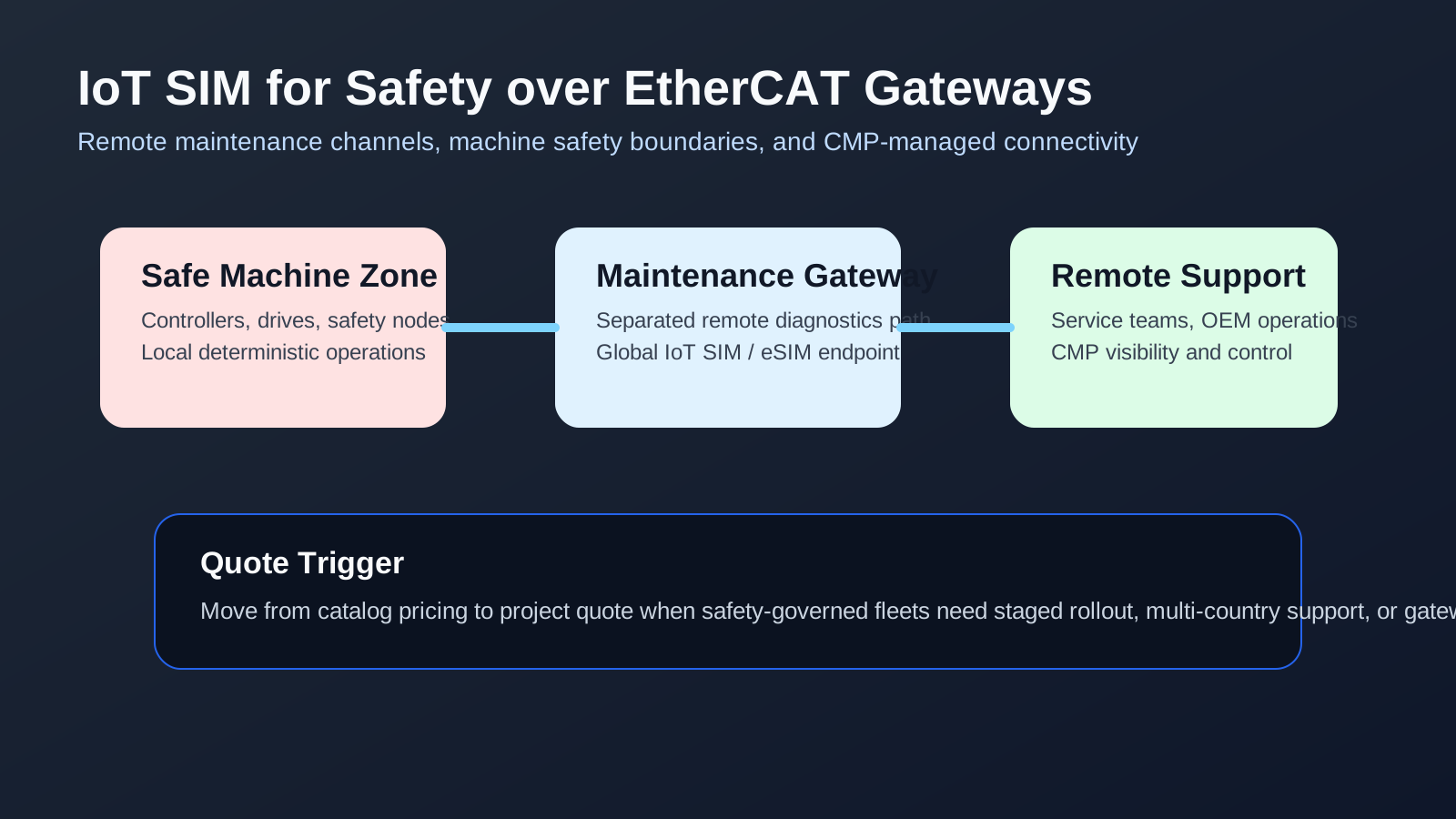
Safety over EtherCAT, often referred to as FSoE, is designed for machine and personnel safety in EtherCAT environments. The EtherCAT Technology Group explains that Safety over EtherCAT enables flexible architectures while preserving safety communication requirements inside the machine network. In practice, however, OEMs and plant operators still need a separate remote support path for maintenance teams, performance review, and incident response. That remote path is where IoT SIM planning matters.
Why It Matters
In machine programs with safety-governed operations, remote connectivity should not blur the line between local safety control and external service access. Buyers need to separate what stays within the machine safety environment from what the gateway exports upward for support, visibility, or managed operations. If that distinction is missing, projects become harder to scale across customers, regions, and service teams.
A managed cellular gateway gives OEMs and integrators a way to keep remote maintenance traffic outside the direct control fabric while still supporting diagnostics, alarm forwarding, and support workflows. The business value is not only technical reach. It is also the ability to standardize procurement and lifecycle handling across fleets of installed machines.
Typical Applications
- OEM machinery using Safety over EtherCAT locally while exposing alarms and service telemetry through an industrial gateway.
- Packaging, robotics, and motion systems that need a governed remote maintenance channel after installation.
- Multi-site factory programs where support teams need visibility into machine health without redesigning the local safety network.
- International equipment rollouts where service operations need one repeatable connectivity model for installed fleets.
For adjacent topics, see IoT SIM for EtherCAT master gateways and remote machine telemetry, IoT SIM for industrial routers, RTU, and DTU devices, and IoT SIM for PROFINET edge gateways and remote machine support.
Selection Notes
The first step is to identify the actual remote endpoint. In most cases, the SIM is not tied to the safety node itself. It sits in a router, IPC, or service gateway that separates field-level operations from remote support functions. Buyers should size connectivity around telemetry intervals, service windows, fleet volume, and regional rollout plans rather than around the safety bus.
The second step is to decide whether the project remains a catalog-buy scenario. A few machines in one region may fit standard Global IoT SIM pricing. But multi-country OEM programs often need CMP visibility for activation control, usage review, suspension, and fleet governance. If the installed base will be hard to service physically, eSIM can also reduce future provisioning friction.
A project quote is usually more appropriate when the machine fleet spans many countries, involves staged activation by distributor or integrator, or requires custom handling for remote service operations. In that scenario, procurement is closely tied to support architecture.
How This Maps to Quanqiu IoT
- Global IoT SIM: supports a repeatable remote maintenance path for installed machine fleets.
- eSIM: helps when hardware is difficult to access after installation or future profile changes may be needed.
- CMP: gives teams operational control over SIM activation, usage, and fleet visibility.
- Project quote workflow: fits larger, safety-governed machine programs with more rollout and support complexity.
For broader industrial planning, review industrial and energy IoT SIM and support.
FAQ
Does Safety over EtherCAT itself use the IoT SIM?
No. The IoT SIM is generally used by the gateway or router that supports remote telemetry and maintenance functions outside the local safety communication path.
When should buyers move from catalog pricing to a project quote?
Move to a project quote when the deployment grows into multi-country installed fleets, staged OEM rollout, custom routing expectations, or more formal support-governance requirements.
Why is CMP important for remote machine support?
CMP helps operations teams see which gateways are active, how usage is changing, and which units should be suspended or reactivated across larger fleets.
Who is this guide intended for?
OEM program teams, procurement managers, system integrators, and service organizations planning safe and repeatable remote support for EtherCAT-based machine fleets.