Remote Irrigation Pump Stations: Data Budgets, Reporting Intervals and IoT Plan Sizing
By jietion, Business Development (BD) at Quanqiu IoT · Published · Updated
Definition: An IoT SIM in a remote irrigation pump station gives the pump controller or RTU a cellular data link, so status and fault alarms reach the control room and start or stop commands reach the pump.
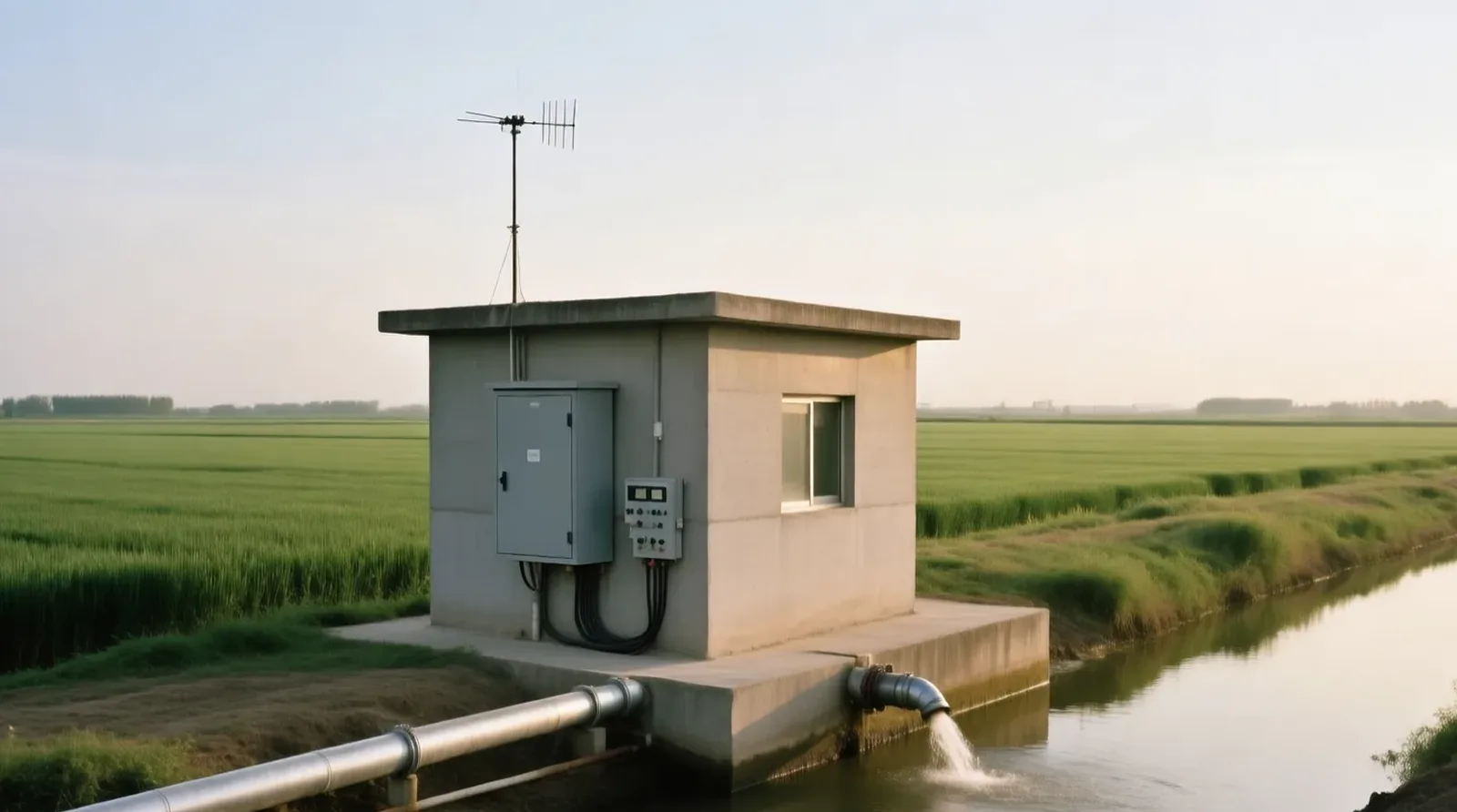
Cellular pump control needs very little data when the controller keeps one connection open and reports on change. A station that sends a 150-byte status message every five minutes uses about 3 MB a month. The same station can use more than ten times that if it opens a new encrypted session for every report. Size the plan from four numbers: message size, reporting interval, how the connection is kept alive, and how often engineers connect remotely.
What a pump station actually sends
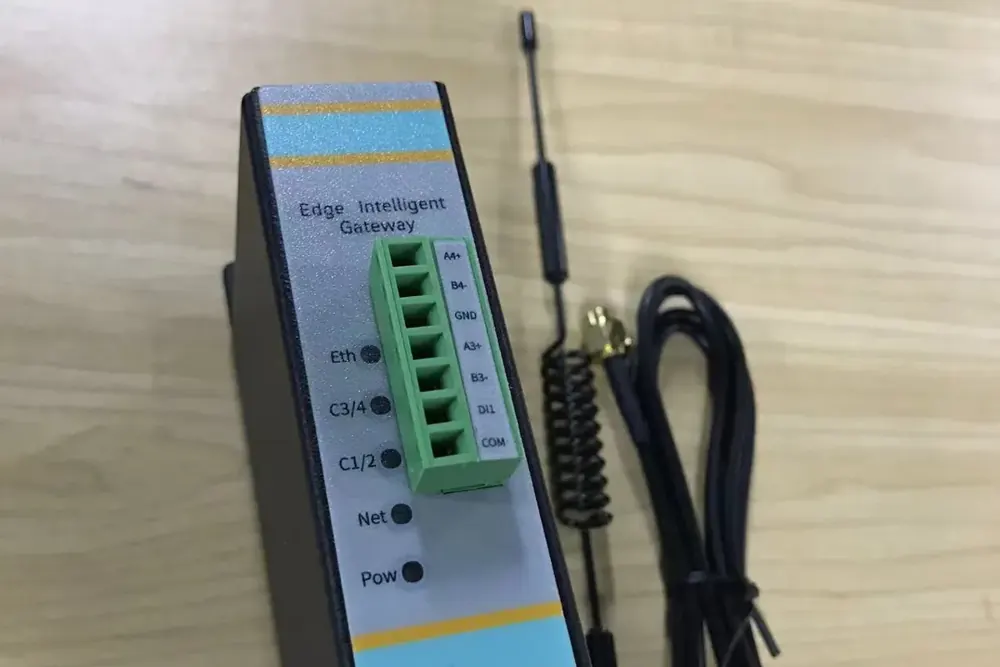
The signal list is short. A published design for unattended wastewater stations, whose pumps and PLCs resemble those of an irrigation lift station, wires each pump to three digital inputs: local or remote mode, running, and fault. Analog inputs carry water level, voltage and current. Sensors talk to the PLC over RS-485 Modbus, the PLC talks to an industrial gateway over Ethernet, the gateway does first-level fault diagnosis, and the host computer raises alarms by SMS or email (Xu et al., 2026). That gateway could connect by cable, Wi-Fi or 4G. The authors chose cable for their site. A pump house at the end of a canal rarely has that choice.
Field sensors around the station add little. In a soil temperature network built for large irrigation districts, each node answers a Modbus read of two holding registers once an hour and passes it over LoRa to a collector (Zhang et al., 2026). On the RS-485 side that reply is 9 bytes. The collector, or the pump RTU, is the only device that needs a SIM.
A worked data budget
The table uses one set of assumptions: MQTT over TCP, a 150-byte payload, about 340 bytes on the air per report once TCP/IP headers and acknowledgements are counted, and a 30-day month. Replace the payload with your own and the arithmetic stays the same.
| Traffic item | Assumption | Data per month |
|---|---|---|
| Status report every 15 minutes | 96 reports a day | about 1 MB |
| Status report every 5 minutes | 288 reports a day | about 3 MB |
| Status report every minute | 1,440 reports a day | about 15 MB |
| Status report every 10 seconds | 8,640 reports a day | about 88 MB |
| MQTT keep-alive at 60 seconds on an idle link | about 124 bytes a minute | about 5 MB |
| New TLS session for every 5-minute report | about 5 KB per handshake | about 43 MB |
| Controller firmware or PLC program download | 2 MB file, once | 2 MB plus retries |
| Remote engineering session over VPN | Depends on the tool | To be confirmed during project validation |
Two rows surprise people. The keep-alive on a quiet link costs more than a 5-minute status report, so set it as long as the operator’s idle timeout allows. And reconnecting for every report costs more than everything else together. A controller that sleeps between reports should resume its TLS session, or stay connected.
Choosing the reporting interval
A fixed short interval is the easy setting and the wasteful one. Pump states change a few times a day. Report by exception: send at once when a digital input changes or when an analog value moves past a deadband, and send a full status at a long interval, such as 15 minutes, so the control room knows the station is alive. Keep the short interval for the minutes after a start command, when the operator wants to watch pressure build.
The same thinking applies to field sensors. The irrigation-district network above samples once per hour, and that interval is what let each node run about 10 days on its battery without sun (Zhang et al., 2026). Soil and water values that move slowly do not earn a faster rate.
Network technology at the station
Match the technology to the command path. Starting and stopping a pump from a control room needs a reply within a second or two, which LTE Cat 1 or Cat 4 gives. LTE-M is workable where it is available. NB-IoT suits meters and level sensors that only report, because its delay is long and uneven for interactive control.
Coverage decides the rest. The irrigation-district study compares its own LoRa network with cellular and notes that a cellular node depends entirely on the operator’s signal at that spot, which is the weak point in hills and remote blocks. Its LoRa links lost no packets up to 650 m and 0.4% to 0.8% at 700 m, in open line of sight (Zhang et al., 2026). A common layout follows from this: LoRa or RS-485 between field sensors and the pump house, and one cellular gateway at the pump house with a high-gain antenna on the roof. For sensor-side design see IoT SIM for smart irrigation and environmental sensors.
Maintenance windows and remote access
Telemetry is predictable. Remote engineering is where budgets break: a technician who opens the PLC programming tool over a VPN, or leaves a web HMI page refreshing, can use in an hour what telemetry uses in a month. Three rules keep this under control. Schedule remote sessions in a maintenance window and close them afterwards. Measure one session in the SIM platform before fixing the plan. Set a usage alert on each station SIM so a forgotten session shows up the same day. Access rules for vendor engineers are covered in patch management windows and remote support separation, and alarm paths for water RTUs in Modbus water utility RTU maintenance windows and alarm backhaul.
Faults that the data plan will not prevent
Most lost stations are lost to power and radio. A pump house loses grid power in the same storm that makes the alarm matter, so the gateway needs its own battery, sized for the reporting interval. Motor starts produce electrical noise and voltage dips, so power the modem from a filtered supply. Antennas inside a steel cabinet lose most of their signal. In a field test of the soil network, the suburban site with strong electromagnetic interference had the lowest communication success, 96.4%, against 99.5% at the quiet reference site (Zhang et al., 2026).
Plan for the day the data path is down. The controller should hold the last safe state and stop the pump on its own low-level or dry-run input without waiting for a command. An SMS alarm sent by the gateway is a useful second path when the IP session cannot be set up.
Quanqiu IoT supplies Global IoT SIM cards for RTUs and gateways, with pooled data from a minimum quantity and SMS enabled per project. In its past projects, telemetry terminals have run on plans from 30 MB to 2 GB a month. Network availability at each station is confirmed in the project quote; send the controller model and locations through the quote process.
FAQ
How much data does a cellular pump controller use per month?
With a 150-byte status message on an open connection, about 1 MB at a 15-minute interval, 3 MB at 5 minutes and 15 MB at one minute. Reconnecting with a new TLS session for every report can add more than 40 MB.
Should a pump station use NB-IoT, LTE-M or LTE Cat 1?
Use LTE Cat 1 or Cat 4 where operators start and stop pumps remotely and expect a quick reply. NB-IoT fits sensors that only report. Confirm which technologies are in service at the site before choosing the modem.
Does every sensor in the field need its own SIM?
No. Sensors can reach the pump house over RS-485 or LoRa, and one cellular gateway there carries the traffic for all of them.
Why did my station use far more data than the estimate?
The usual causes are a short keep-alive, a new encrypted session for every report, a remote engineering session left open, or a firmware download that kept retrying on a weak signal. The per-SIM usage record shows which day it happened.
What happens to the pump if the connection drops?
That depends on the controller logic. It should keep running on local level and pressure inputs, stop on dry-run protection, and report the missed events when the link returns.
Official References
- FAO: Water management
- European Commission: Digitalisation of agriculture
- GSMA: Mobile IoT (LTE-M and NB-IoT)
- Xu Junpeng, Gao Shuaipeng, Xu Yaochang, Wang Yu, Wang Yilin (2026). Design of an IoT-Based Equipment Operation and Maintenance Alarm System for Wastewater Treatment Stations (in Chinese). 平顶山学院学报, 41(2), 21-27.
- Zhang Qin, Ming Jiaqi, Gao Chengming, Wen Bo, Li Jinshan, Yu Houwen, et al. (2026). Design and Experiment of a Solar-Powered Soil Temperature Monitoring System (in Chinese). 农机化研究.