IoT SIM for Grain Storage and Warehouse Condition Monitoring
作者:jietion,商务拓展(BD),Quanqiu IoT · 发布于
Definition: An IoT SIM for grain storage provides the cellular backhaul between warehouse gateways and remote platforms that supervise temperature, humidity, gas, security and equipment alarms across distributed depots.
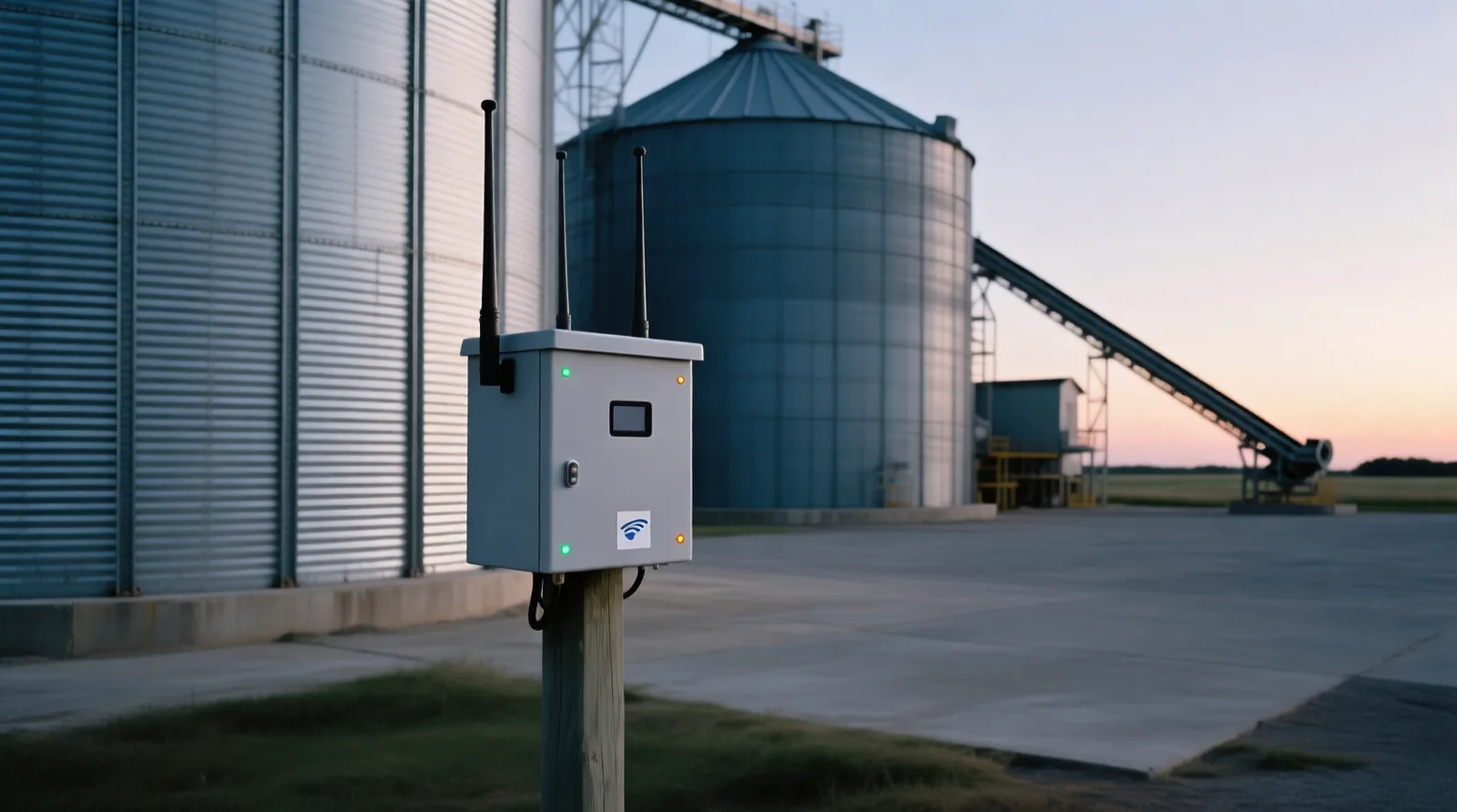
The right design normally connects local sensors to an edge gateway first, then uses cellular service for platform synchronization, alarms and remote maintenance. Putting a SIM in every sensor is rarely the starting assumption. Procurement teams should size connectivity from the gateway traffic model, alarm urgency, site power, antenna conditions and the operational cost of losing visibility at a remote depot.
Start with the warehouse data path
A grain-depot monitoring system spans more than the wide-area link. Sensors collect grain temperature, ambient humidity, gas and security states; local networks aggregate those readings; an edge device filters and timestamps them; the cellular gateway sends selected records and alarms to the platform. That layered approach makes it possible to keep local monitoring active when the public network is temporarily unavailable.
A 2026 design study for a planned 50,000-tonne reserve depot in Qixia used perception, network, platform and application layers aligned to the ISO/IEC 30141:2024 reference model. Its plan placed 856 monitoring points across ten flat warehouses and combined local sensing with edge processing and wide-area communications (Zhao, 2026). These figures describe one simulated project, not a universal warehouse template, but they show why the cellular requirement should be derived after the sensor and gateway topology is known.
Separate sensor traffic from cellular traffic
Dense grain-condition sensing can produce many local readings without producing the same number of cellular sessions. In the Qixia design, temperature and humidity sensors were arranged on a 5 m by 5 m grid at the top, middle and bottom grain layers. LoRa was proposed for in-grain nodes, with NB-IoT used for mobile and selected fixed points and edge nodes filtering data locally (Zhao, 2026). A buyer should therefore ask which data crosses the cellular boundary: periodic summaries, threshold exceptions, maintenance logs, images, firmware packages or all raw samples.
Traffic planning should use measured payloads from the actual gateway. Calculate the encoded message size, reporting interval, protocol overhead, acknowledgements, retries, keepalive traffic and remote-management allowance. Add burst cases for alarm storms and backlogged uploads after an outage. Video, high-resolution imagery and bulk firmware distribution belong in separate traffic classes because they can dominate a plan that looks small when only telemetry is counted.
Match the cellular bearer to the operational task
GSMA describes Mobile IoT LPWA networks as licensed-spectrum operator-managed technologies intended for low data rates, long battery life and hard-to-reach devices. That makes LTE-M or NB-IoT candidates for some warehouse endpoints, but availability, bands, mobility behavior and power-saving support vary by market and module. A mains-powered gateway carrying aggregated traffic may instead use LTE or another cellular mode. The device radio, local coverage and application timing decide the fit.
| Traffic or control task | Typical source | Connectivity implication | Procurement evidence |
|---|---|---|---|
| Periodic condition summary | Edge-aggregated temperature and humidity | Small scheduled uplinks; tolerate store-and-forward if operations permit | Measured encoded payload and reporting interval |
| Gas or temperature alarm | Threshold event from local control | Prioritize prompt uplink, acknowledgement and retry visibility | Alarm delivery test under weak signal and reconnect |
| Security event | Door, intrusion or equipment alarm | May create bursts and escalation messages | Event sequence, recipient path and retention policy |
| Remote diagnostics | Gateway logs and health counters | Bidirectional session and controlled maintenance access | APN, addressing, firewall and authentication design |
| Images or firmware | Camera, imager or update service | High-volume exception to the telemetry model | File size, frequency and maintenance window |
| Radio mode, bands and monthly plan | Selected country, module and site survey | To be confirmed during project validation | Pilot measurements from representative depots |
Design for an outage before relying on remote alarms
A cellular outage must not erase the local safety function. Define how long the gateway stores data, how it marks timestamps, how it retries, how duplicate records are handled and what local action continues without the cloud. Alarm escalation should distinguish a process alarm from a communications alarm; otherwise a disconnected gateway can look like a healthy warehouse that simply has no events.
Carrier redundancy can be considered where the consequence of losing the backhaul justifies the extra integration and commercial work. It is not a standard promise attached to every Global IoT SIM. The project must confirm available networks, module behavior, roaming policy and whether a second profile, second modem or alternative path is technically and contractually available. The alarm-panel connectivity guide provides a useful framework for acknowledgement and recovery, while the remote RTU maintenance guide addresses controlled service windows and store-and-forward operations.
Include field service in the connectivity calculation
The cost of a missed message is often smaller than the cost of diagnosing it at a distant depot. A truck roll can involve access authorization, grain-safety procedures, technician travel and coordination with warehouse operations. Remote health data should expose modem registration, signal measurements, SIM state, last successful upload, retry count, local storage usage and gateway power status. Those observations help a support team decide whether the fault sits in the sensor network, gateway, antenna, subscription or platform.
The Qixia study projected efficiency and energy benefits, including automated handling and reduced inspection staffing, but these were simulation and planning results rather than post-deployment measurements (Zhao, 2026). A business case should use local labor rates, travel distances, energy tariffs and failure history. Pilot evidence should replace borrowed savings assumptions before a fleet rollout is approved.
Procurement questions that prevent an underspecified rollout
The RFQ should state the number and type of depots, gateway count per site, countries, module models, antenna placement, power source, reporting intervals, event classes, backfill behavior, expected log and firmware traffic, platform endpoints and security controls. It should also state who owns installation, APN configuration, device certificates, SIM activation, alert routing and first-line fault isolation.
Warehouse structures, metal equipment and below-grade rooms can change radio conditions sharply. A desktop coverage map cannot replace a representative survey and pilot. Procurement should require installation records and a repeatable antenna test method. Network mode and fallback must be proven on the production module rather than inferred from the chipset data sheet.
Catalog benchmark or project quote
A catalog IoT SIM plan is useful for a gateway prototype with known traffic in one market. Request a project quote when the rollout covers multiple depots or countries, needs eSIM, CMP supervision, private APN, fixed IP, inbound routing, multiple network paths, staged activation or coordinated delivery. The quote should be based on the measured traffic distribution, not only an average monthly figure.
Quanqiu IoT can map Global IoT SIM, eSIM and CMP-managed options to the documented gateway architecture. Connectivity availability, radio modes, roaming conditions, APN behavior and management functions are confirmed for the proposed countries and devices. Use the field-sensor platform guide when the depot feeds a wider data platform, and send the final device, country, quantity and traffic assumptions through the project quote process.
FAQ
Does every grain sensor need its own IoT SIM?
Usually not. Many designs aggregate local wired or low-power wireless sensors at an edge gateway and use one cellular connection per gateway. The final topology depends on distance, power, fault isolation and local-network constraints.
How much monthly data does a grain-depot gateway need?
There is no reliable universal figure. Measure the encoded telemetry, reporting interval, retries, keepalives, alarms, diagnostics, images and firmware traffic on the intended gateway, then apply a documented contingency allowance.
Is NB-IoT always the best choice for a warehouse?
No. It may suit small, infrequent messages where supported, while an aggregated gateway or image workload may require LTE or another mode. Country availability, bands, module support and timing requirements require project validation.
What happens if cellular service is interrupted?
The gateway should continue the approved local monitoring function, store time-stamped records and retry according to a controlled policy. Storage duration, alarm escalation and backfill behavior must be tested for the actual application.
When should a buyer request a project quote?
Use a project quote for multiple sites or countries, significant volume, eSIM or CMP requirements, private networking, fixed addressing, special routing, staged deployment or a defined support workflow.
Official References
- European Commission: Digitalisation of agriculture and rural areas
- GSMA Mobile IoT: licensed low-power wide-area technology
- Zhao Peng (2026). IoT Architecture Empowering Intelligent Management and Control of Smart Grain Depots (in Chinese). 物联网技术, (19), 91-93, 104.
- Zhang Yuezheng, Yuan Tangxiao, Xu Junshan, Fang Zhuquan, Liu Linyan (2026). Online Diagnosis and Decision-making System for Crop Growth Based on Internet of Things and Large Language Models (in Chinese). 农业机械学报, 57(19), 325-335.
- Chen Zhi (2026). Exploration of Remote Monitoring and Management Applications for Agricultural Machinery Safety Based on IoT Technology (in Chinese). 农机水肥, (27), 81-83. DOI: 10.3969/j.issn.1003-1650.2026.27.027
- Min Xiaocui (2026). Design of an IoT-Based Early Warning System for Pests and Diseases in Seed Industry Ecological Parks (in Chinese). 物联网技术, (19), 139-141.