IoT SIM for IO-Link Wireless Gateways and Flexible Machine Cells
Por jietion, Desarrollo de Negocio (BD) en Quanqiu IoT · Publicado · Actualizado
Definicion: IoT SIM for IO-Link Wireless Gateways and Flexible Machine Cells
IO-Link Wireless can reduce cable constraints inside flexible machine cells, tooling stations, and moving equipment, but procurement decisions still happen at the gateway layer. Buyers who want remote monitoring, service visibility, and cleaner fleet operations should plan connectivity around the wireless master or gateway: use Global IoT SIM for repeatable rollout, eSIM when service access is limited, CMP for lifecycle control, and a project quote when deployment scale or support governance becomes more complex.
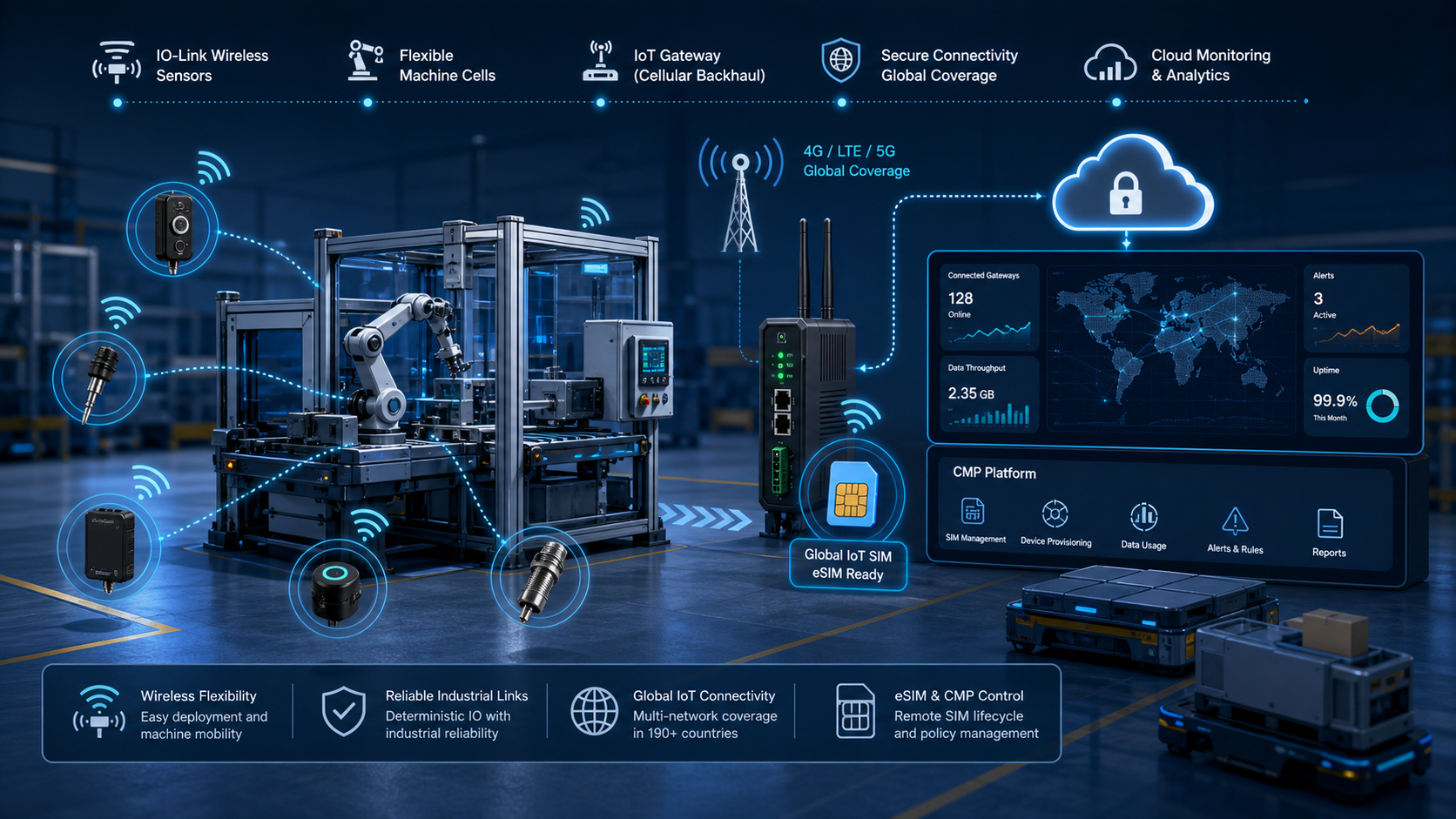
The IO-Link Community describes IO-Link Wireless as a cable-free industrial communication approach for flexible and efficient automation, built on the open 2.4 GHz ISM band. Its technical overview states that the band is divided into 80 channels of 1 MHz, that virtual point-to-point connections use time and frequency division multiplexing, and that five tracks per master are transmitted in parallel with a 5 ms cycle time. For buyers, that makes IO-Link Wireless attractive where mobility, changeover speed, or wiring constraints matter, but it does not remove the need for a governed remote backhaul model.
Why It Matters
Wireless device communication inside a machine cell is only one part of the operating picture. Once diagnostics, uptime data, or maintenance alerts need to reach remote engineering teams, the deployment still depends on a gateway, edge controller, or industrial router that connects the cell to higher-level systems. That is where Global IoT SIM, eSIM, and CMP decisions become operationally important.
The official IO-Link Wireless material also emphasizes reliability and synchronized channel hopping to minimize packet error rate. For procurement teams, that means the local wireless design may be specialized, but the remote support model should still be simple, visible, and scalable.
Typical Applications
- Flexible machine cells where sensors or tooling move and cabling is a maintenance constraint.
- Robotics, packaging, and modular manufacturing equipment that needs fast changeovers and remote service visibility.
- Retrofit cells where wireless field connectivity is easier than rewiring, but remote telemetry still needs a managed uplink.
- OEM deployments that want one repeatable remote support model across many installations.
Related guides include IoT SIM for EtherCAT master gateways and remote machine telemetry, IoT SIM for Zigbee gateways and retrofit device networks, and IoT SIM for Thread border routers and building mesh backhaul.
Selection Notes
Wireless inside the machine does not mean unmanaged outside the machine. Buyers should identify the real SIM-bearing endpoint, which is usually the wireless master gateway, industrial IPC, or router that aggregates cell data and forwards it upward. Connectivity planning should then match support windows, site count, fleet size, and the need for remote changes over time.
A standard Global IoT SIM catalog plan may fit smaller pilots or a limited number of machine cells. A broader rollout usually benefits from CMP-managed operations so teams can activate, suspend, and monitor large numbers of gateway endpoints. If the wireless equipment is hard to access after installation, eSIM may also improve long-term provisioning flexibility.
A project quote is normally the better path when the buyer needs coordinated rollout across many sites, special routing or commercial handling, or a more formal support architecture between OEMs, integrators, and end users.
How This Maps to Quanqiu IoT
- Global IoT SIM: supports repeatable remote connectivity for IO-Link Wireless gateway fleets.
- eSIM: helps when post-installation access is difficult or future profile changes are likely.
- CMP: adds activation visibility, usage tracking, and lifecycle control across many machine-cell gateways.
- Project quote workflow: fits larger or more customized deployments with broader operational coordination.
For broader buying paths, see fleet and logistics IoT SIM, industrial and energy IoT SIM, and contact.
FAQ
Does IO-Link Wireless replace the need for a gateway SIM plan?
No. IO-Link Wireless addresses local device communication. Remote monitoring and support still depend on a gateway or router that needs a managed connectivity model.
Why mention 2.4 GHz, 80 channels, and 5 ms cycle time in a buying guide?
Because those official technical characteristics explain why IO-Link Wireless fits flexible, time-sensitive industrial cells and why remote connectivity should be planned around the gateway rather than the field node.
When should buyers ask for a project quote?
When the rollout expands across many sites, requires special routing or commercial handling, or needs tighter coordination between operations, OEM support, and deployment teams.
Who is this guide intended for?
Procurement managers, OEM teams, system integrators, and industrial service teams evaluating wireless machine-cell deployments with remote support requirements.