IoT SIM for IO-Link Master Gateways and Remote Sensor Diagnostics
Por jietion, Desarrollo de Negocio (BD) en Quanqiu IoT · Publicado · Actualizado
Definicion: IoT SIM for IO-Link Master Gateways and Remote Sensor Diagnostics
IO-Link projects often start at the sensor and actuator level, but large deployments are really decided at the gateway and master level. Buyers who want remote diagnostics, cross-site visibility, and cleaner fleet operations should evaluate IoT SIM options around the IO-Link master or industrial gateway: use Global IoT SIM for rollout consistency, eSIM when field replacement is difficult, CMP for lifecycle control, and a project quote when remote support, multi-country deployment, or custom routing becomes part of the procurement scope.
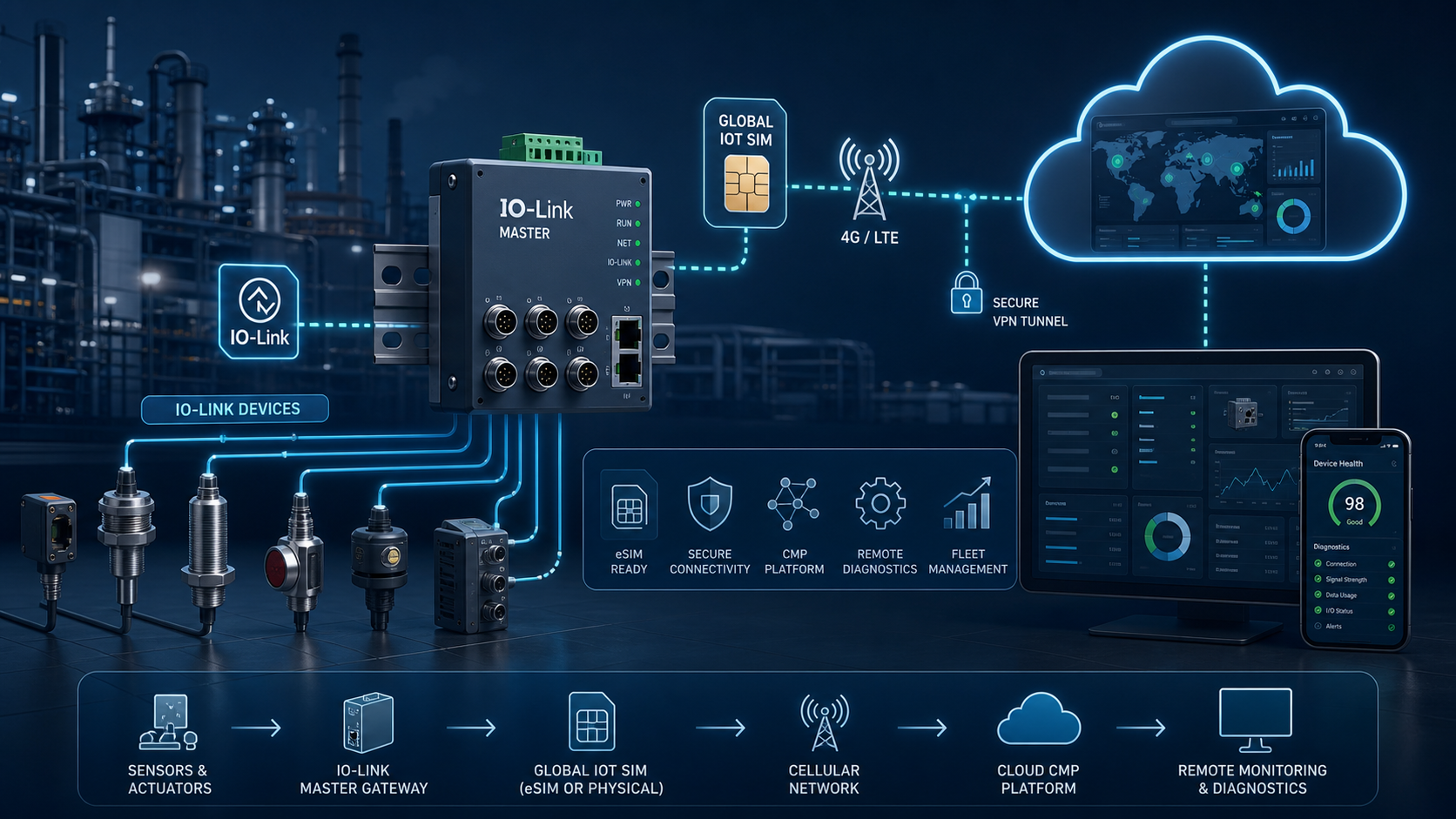
The IO-Link Community describes IO-Link as the first globally standardized I/O technology under IEC 61131-9, enabling point-to-point communication between sensors, actuators, and controllers. It also states that IO-Link enables bidirectional data exchange, remote configuration, and advanced diagnostics. For B2B buyers, that means the real scaling question is not only which device uses IO-Link, but how device data leaves the machine or cabinet and becomes operationally useful across plants, service teams, and cloud or IT layers.
Why It Matters
According to the IO-Link integration guidance, IO-Link masters are responsible for protocol implementation, while the IODD describes the data model of IO-Link devices and supports application-level integration. The same guidance highlights that higher-level integration needs transport and implementation details specified up to the application interface, including measured values, setpoints, parameters, diagnostics, error messages, and IO-Link master configuration.
That is exactly where managed cellular backhaul becomes commercially relevant. Once an OEM, system integrator, or industrial operator wants remote diagnostics outside a local PLC cabinet, the IO-Link master or gateway becomes a natural point for Global IoT SIM, CMP operations, and quote-based rollout planning.
Typical Applications
- Distributed machine fleets where service teams need remote visibility into sensor alarms, device status, and parameter changes.
- Industrial OEM equipment that uses IO-Link locally but reports upward through a gateway or edge controller.
- Cabinet, skid, and production-cell deployments that feed diagnostics into SCADA, MES, cloud, or maintenance platforms.
- Projects that want a lightweight bridge from IO-Link data into IT systems using JSON, REST API, MQTT, or OPC UA paths.
For adjacent deployment logic, see IoT SIM for industrial routers, RTU, and DTU devices, IoT SIM for OPC UA gateways and industrial data hubs, and IoT SIM for MQTT Sparkplug gateways and unified namespace projects.
Selection Notes
The official integration material notes that IO-Link has specifications for integration into systems such as PROFINET, EtherNet/IP, EtherCAT, AS-Interface, CiA, SERCOS, JSON, and OPC UA. It also highlights JSON integration via REST API or MQTT as a lightweight route for IT or cloud solutions. For procurement teams, this means the gateway and master layer may need to serve both operational technology and higher-level business systems at the same time.
A small pilot may still fit a standard Global IoT SIM pricing path. But once the project expands across sites, countries, or service organizations, the buyer usually benefits from CMP-based SIM lifecycle control for activation, suspension, usage review, and fleet visibility. If the installed gateway will be hard to access physically, eSIM can also make long-term provisioning simpler.
A project quote is generally the better route when the deployment includes multi-country operations, larger machine fleets, special addressing expectations, or coordinated rollout between OEMs, integrators, and plant operators.
How This Maps to Quanqiu IoT
- Global IoT SIM: useful for remote IO-Link master gateways across pilots and scaled industrial fleets.
- eSIM: appropriate when field replacement is difficult or profile flexibility matters.
- CMP: valuable for SIM activation, status monitoring, and lifecycle governance across many installed gateways.
- Project quote workflow: recommended when the project involves larger deployments, cross-border rollout, or more formal support architecture.
For broader operational guidance, also review industrial and energy IoT SIM and when to buy from catalog pricing versus request a project quote.
FAQ
Does IO-Link itself require the SIM card?
No. The SIM is generally used by the IO-Link master gateway, industrial router, or edge controller that moves diagnostics and operational data to remote systems.
Why are IO-Link masters important in connectivity planning?
Because the official integration model places protocol handling and upstream data use at the master and gateway layer. That is where remote monitoring and lifecycle management usually connect.
When should buyers move from catalog pricing to a project quote?
When the deployment adds multi-country fleets, coordinated OEM rollout, private or custom routing expectations, or a larger support and activation model.
What makes this topic useful for procurement teams?
It helps buyers connect device-level IO-Link benefits to practical rollout questions such as gateway selection, fleet management, and remote support operations.