IoT SIM for Farm Machinery Telematics and Fertigation Control: Rural Coverage, Data and Device Lifecycle
Por jietion, Desarrollo de Negocio (BD) en Quanqiu IoT · Publicado
Definition: In farm machinery telematics and fertigation control, an IoT SIM connects tractors, harvesters, irrigation controllers and field sensors to a management platform over cellular networks that reach fields where wired or Wi-Fi links do not.
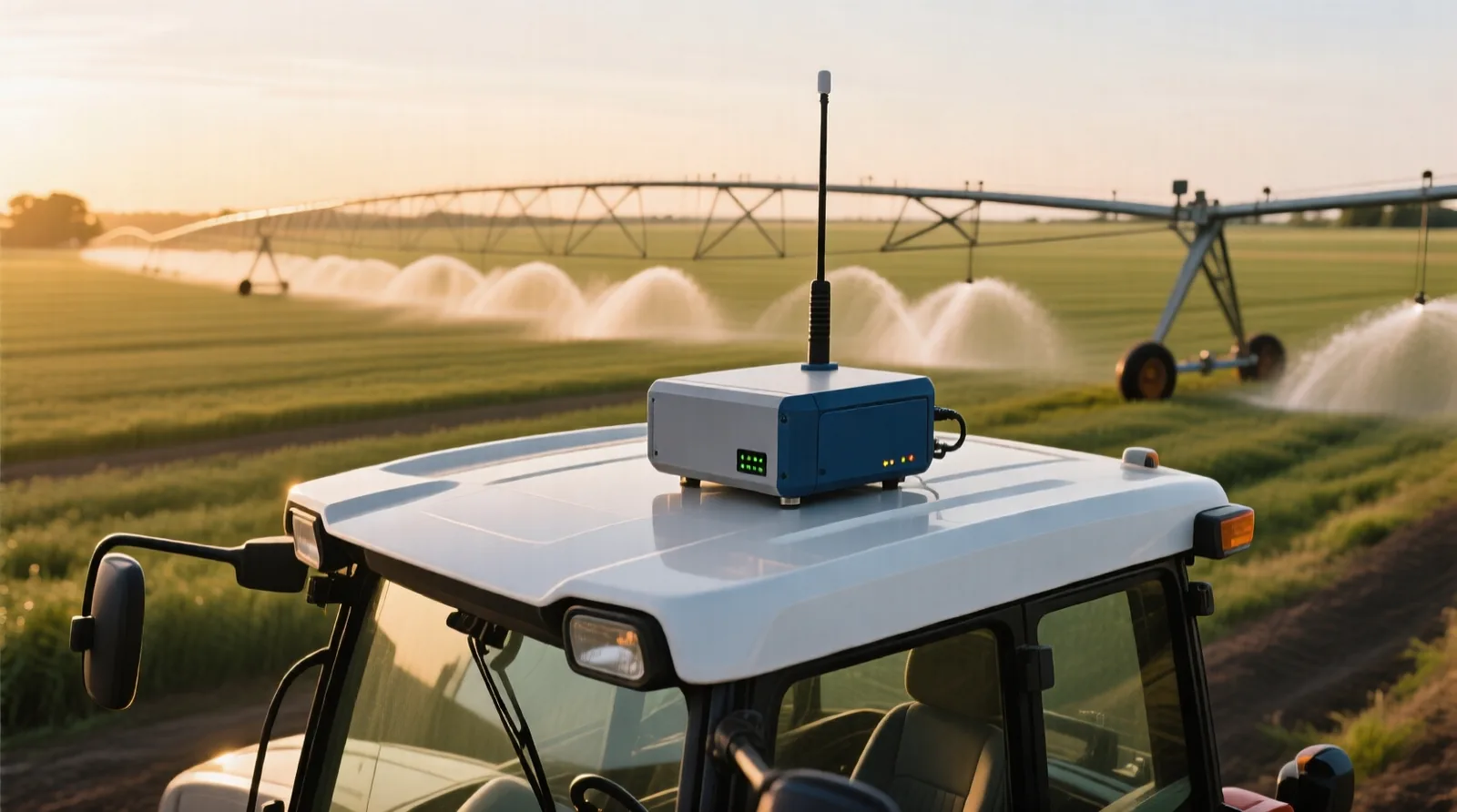
For agritech vendors and machinery OEMs, the connectivity decision is less about raw speed and more about three practical questions: will the device stay connected at the edge of rural coverage, how much data will it actually send once edge processing is in place, and who will manage thousands of SIMs over a ten-year equipment life. Recent field studies of machinery monitoring, fertigation and crop-disease warning systems give useful numbers for each of these questions, and they point to a design pattern that works: process data at the edge, send small event-driven reports over a low-power cellular link, and keep video or bulk uploads for the few cases that need them.
What a connected farm actually sends
Agricultural IoT covers very different devices. Machinery telematics reports position and engine condition from a moving vehicle; fertigation systems read soil moisture, salinity and pH at several depths and drive valves and pumps; greenhouse diagnosis systems combine environmental sensors with crop observations. A machinery-safety platform in Anqing, China, for example, monitors engine water temperature, hydraulic pressure, vibration and position on tractors and combine harvesters, and covers more than 65% of the large machinery in the city (Chen, 2026). A fertigation study in Cangzhou describes sensor networks that track temperature, humidity, light, rainfall, soil moisture, salinity and pH to steer the mix of water and fertiliser delivered through the pipes (Yi, 2026).
The European Commission treats this kind of digitalisation as a cornerstone of a competitive and sustainable farm sector, and points to the gap in connectivity between urban and rural areas as something policy needs to close. FAO’s water-management work makes the same point from the resource side: producing more food with less water depends on knowing what the soil and crop need. Both lead back to the same engineering problem: getting reliable field data out of places that were never designed for connectivity.
Edge processing changes the data budget
The single most useful number for anyone sizing data plans comes from a pest and disease early-warning system in a 200-mu seed park. Its 80 sensing nodes, including multispectral imagers, generate about 2.8 GB of raw data a day, yet after edge gateways extract the indices that matter, the whole system uploads under 2.8 MB a day, roughly 35 KB per node, with processing latency below two seconds (Min, 2026). The same system still produced warnings 26 hours ahead of disease outbreaks on average and located affected grid cells within 11 metres.
Other designs follow the same idea in different ways. The Cangzhou fertigation design switches to real-time reporting during critical crop nutrient stages and back to scheduled reporting during dormancy to save energy (Yi, 2026). A greenhouse diagnosis system in Shouguang samples air and soil parameters every 50 seconds over RS485 and Modbus-RTU and uploads through a 4G module, then turns sensor data and grower descriptions into structured prompts for a language model that recommends temperature, humidity and light settings (Zhang et al., 2026). The lesson for buyers is that the plan size depends far more on where processing happens than on the number of sensors.
| Device type | Typical reporting pattern in the studies | Network fit | Plan sizing note |
|---|---|---|---|
| Field sensor node behind an edge gateway | Edge-extracted indices, about 35 KB per node per day (Min, 2026) | NB-IoT or LTE-M, or LoRa to a cellular gateway | Small pooled plan; size the gateway, not each sensor |
| Fertigation controller | Real-time during critical stages, scheduled during dormancy (Yi, 2026) | LTE-M or Cat-1 where valves are commanded remotely | Seasonal peaks; pooled data helps |
| Greenhouse diagnosis unit | Environmental readings every 50 s via a 4G module (Zhang et al., 2026) | LTE Cat-1 or Cat-4 | Moderate, steady volume per site |
| Machinery telematics unit | Position every 30 s, alarms within 10 s of an abnormal reading (Chen, 2026) | LTE Cat-1 or LTE-M; 4G when video is needed | Estimate from fleet hours; video changes the plan entirely |
| Machinery with live video | HD video over 4G or 5G (Chen, 2026) | LTE Cat-4 or 5G | To be confirmed during project validation |
Machinery telematics on the move
Telematics units on tractors and harvesters behave more like vehicle trackers than like field sensors. The Anqing platform uses GPRS for low-volume data and 4G when HD video is required, keeps transmission latency under 100 ms, and raises an audible and visual alarm within 10 seconds of receiving abnormal data (Chen, 2026). Its installation rules are worth copying into any OEM checklist: the GPS antenna mounted vertically on the cab roof or dashboard with an elevation angle of at least 85 degrees, at least eight satellites during commissioning, and position uploads every 30 seconds with ten consecutive packets received before sign-off. A random-forest model trained on 2021–2023 data from 5,000 machines predicted faults with 92% accuracy and 88% recall, but only because the data kept arriving (Chen, 2026).
The connectivity risk for machinery is movement across coverage: fields far from towers, valleys and border regions. A unit that stops reporting during harvest is a truck roll to a field, often at the busiest time of the year. Buffering on the device, a SIM that can register on more than one network where that is permitted, and a reporting design that tolerates gaps all matter more than peak throughput. For fleet-style deployments see our guide to GPS tracker fleet procurement across countries.
Designing for gaps, damage and long equipment life
Every study plans for interruptions. The seed-park system caches data at the edge during network outages and resends it in timestamp order afterwards, while warnings continue to be computed locally; sensor failures are filled from historical means or spatial interpolation, with an alert if a sensor stays down for more than six hours (Min, 2026). The fertigation design places primary and backup sensors at each monitoring point and switches automatically when readings go out of range (Yi, 2026). Security is layered as well: AES-128 encryption at the terminal, TLS on the link and dynamic token authentication on the platform in one design (Yi, 2026), and AES-256 with CRC-32 checks, keeping tampering below 0.1% and packet loss below 1%, in the machinery platform (Chen, 2026).
Farm equipment also lives for a long time. A SIM that is soldered or industrial-grade survives dust, vibration and temperature swings better than a consumer card, and eSIM lets the operator change profiles without a field visit when coverage or commercial terms change. For irrigation-specific sensor design, our guide to IoT SIM for smart irrigation and environmental sensors covers sensor placement and power, and LoRaWAN gateway backhaul explains when a private LoRa network with a cellular gateway beats a SIM in every sensor.
Choosing network and SIM by deployment
Buyers should start from the device mix and the countries, not from a technology preference. Licensed low-power wide-area cellular, meaning NB-IoT and LTE-M as promoted through the GSMA’s Mobile IoT work, suits battery-powered field nodes; the Anqing study notes NB-IoT battery life of one to two years with wide coverage for remote areas (Chen, 2026). LoRa covers large farmland at low cost when a gateway can be placed centrally (Yi, 2026), and LTE Cat-1 or 4G fits controllers and machinery that need steady two-way traffic. Where a product will be sold in several countries, check whether NB-IoT or LTE-M is actually available in each target market, and whether permanent roaming restrictions or local registration rules apply to devices that stay in-country.
When catalog plans fit and when to request a project quote
Catalog pricing is usually enough for a pilot field, a demonstration greenhouse or a handful of machines in one country with a known data profile. Request a project quote when you are rolling out across many farms or countries, when you need pooled data for seasonal peaks, when units will move across borders, when you want eSIM so that profiles can be changed later, or when you need lifecycle tools through a CMP or API to activate, suspend and monitor thousands of SIMs. Bring the device types and modules, expected units per country, reporting design and any video requirement; our quote process explains the next steps.
Risk boundaries: what the evidence does and does not show
The studies cited here come from Chinese farms and greenhouses: Anqing, Cangzhou, Shouguang and a seed park. Several are design descriptions without field trials or cost data (Chen, 2026; Yi, 2026), and the greenhouse diagnosis work covered three crops over about two months (Zhang et al., 2026). Their data volumes and reporting patterns are useful starting points, not guarantees for your devices. Coverage in a specific field, NB-IoT or LTE-M availability in a given country, and operator authorization for roaming or eSIM profiles require project-specific confirmation, and we do not promise an SLA unless one is agreed for a project.
How this maps to Quanqiu IoT
Quanqiu IoT supplies Global IoT SIM connectivity for agricultural devices in industrial and soldered form factors, eSIM for products that need remote profile changes, and CMP access for activation, usage monitoring and lifecycle control across countries. For agritech projects we start from your device mix, reporting design and target markets, then propose plans, pooling and SIM format in a project quote. Our agriculture and environment IoT SIM page summarises the main deployment types.
FAQ
How much data does a field sensor need per month?
With edge processing, very little: one published seed-park system uploaded about 35 KB per node per day. Without edge processing, raw sensor and image data can be a thousand times larger, so design the processing first.
Should every sensor have its own SIM?
Not necessarily. Battery-powered nodes can use NB-IoT or LTE-M SIMs, but large farms often run LoRa sensors into a cellular gateway, so only the gateway needs a SIM.
What reporting interval should machinery telematics use?
One published platform uploads position every 30 seconds and raises alarms within 10 seconds of an abnormal reading. Faster reporting raises data use; video raises it far more.
How do I keep data when the field loses coverage?
Cache on the device or edge gateway and resend in timestamp order when the link returns, while keeping critical alarms computed locally. Multi-network SIMs help where permitted.
Can one SIM work for machines sold in many countries?
Often, but check local network technology support, permanent roaming restrictions and registration rules for each market. eSIM gives a path to local profiles where roaming is not allowed long-term.
Official References
- European Commission — Digitalisation in agriculture
- FAO — Agricultural water management
- GSMA — Mobile IoT (licensed LPWA: NB-IoT and LTE-M)
- Chen Zhi (2026). Exploration of Remote Monitoring and Management Applications for Agricultural Machinery Safety Based on IoT Technology (in Chinese). 农机水肥, (27), 81-83. DOI: 10.3969/j.issn.1003-1650.2026.27.027
- Yi Weiwei (2026). Research on the Application of Integrated Water and Fertilizer Technology in the Agricultural Internet of Things Environment (in Chinese). 农业开发与装备, (10), 178-180.
- Zhang Yuezheng, Yuan Tangxiao, Xu Junshan, Fang Zhuquan, Liu Linyan (2026). Online Diagnosis and Decision-making System for Crop Growth Based on Internet of Things and Large Language Models (in Chinese). 农业机械学报, 57(19), 325-335.
- Min Xiaocui (2026). Design of an IoT-Based Early Warning System for Pests and Diseases in Seed Industry Ecological Parks (in Chinese). 物联网技术, (19), 139-141.