Industrial IoT eSIM Bootstrap Profiles and Out-of-the-Box Global Onboarding
Por jietion, Desarrollo de Negocio (BD) en Quanqiu IoT · Publicado · Actualizado
Definition: An industrial IoT eSIM is a soldered, remotely provisioned subscriber identity module whose bootstrap (provisioning) profile enables first-time network attachment so operational profiles can be downloaded over the air.
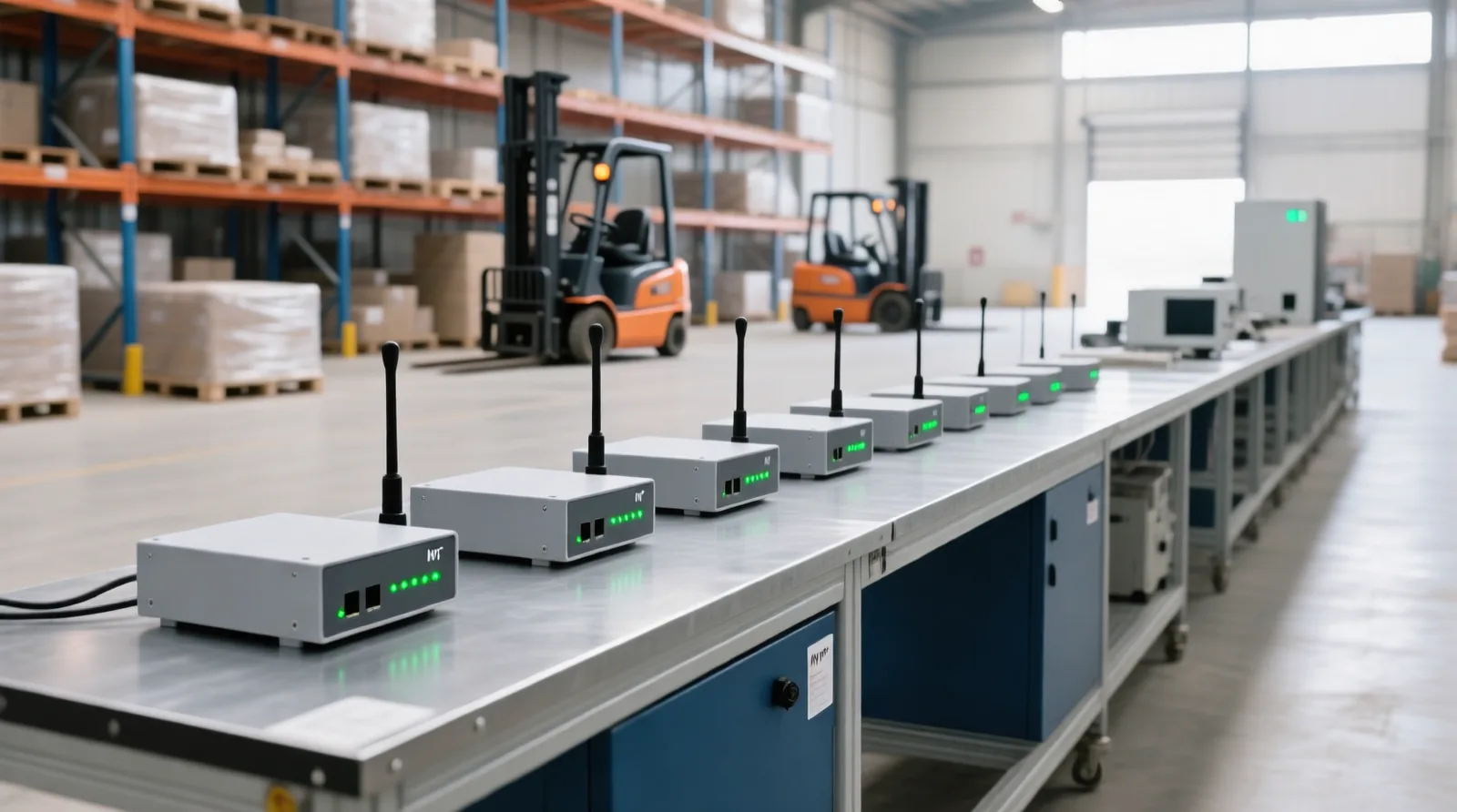
Out-of-the-box global onboarding for industrial IoT devices rests on a simple mechanism defined in GSMA SGP.32: a device ships with a bootstrap profile that lets it reach the network, after which the eSIM IoT Manager (eIM) triggers the download and enablement of a live operational profile without anyone touching the hardware. GSMA published SGP.32 v1.1, the eSIM IoT Technical Specification, on 26 April 2024, built specifically for network- and UI-constrained devices. For procurement teams, the practical question is not whether this works in a lab, but whether a given deployment needs the project workflow — eIM integration, staged activation, profile state management — or whether a standard catalog order is sufficient. This page maps the published specification to that buying decision.
Why It Matters
The case for remote provisioning is a logistics case before it is a technology case. GSMA notes that physical SIM cards require manual installation and physical swapping to change or update MNO profiles, which is impractical for IoT devices deployed at scale across multiple locations or in challenging-to-reach environments. Every profile change on a removable SIM therefore implies a site visit, a technician window, and a recovery or replacement process — costs that scale linearly with fleet size and are difficult to forecast at the bid stage. SGP.32 was developed to remove that dependency by enabling over-the-air Remote SIM Provisioning for devices that cannot support a user interface or a rich network stack. The market context reinforces the urgency: GSMA forecasts cellular IoT connections reaching 3.1 billion by 2025, a nearly five-fold increase since 2018, and analyst forecasts cited by Shan (2020) put M2M eSIM shipments growing at roughly 18% CAGR from 101 million units in 2019 to 232 million in 2024. Embedded form factors also carry reliability arguments in harsh environments; Chang et al. (2024) note that eSIMs in intelligent connected products must operate across a -40 to 85 degrees Celsius working range and that automotive-grade IC reliability is judged against the AEC-Q standard series, with AEC-Q-100 applying to integrated circuits. Those are design inputs, not coverage promises, but they explain why industrial buyers increasingly treat the eSIM as a component decision rather than a connectivity afterthought.
Typical Applications
SGP.32 is aimed at devices that are network- and UI-constrained — the segment where consumer eSIM activation flows do not fit. Typical candidates include industrial routers, RTUs and DTUs, remote telemetry units, environmental and utility monitoring endpoints, asset trackers, and gateways installed in cabinets, pits, poles, or vehicles where a site visit is expensive. The specification defines three profile types that matter for onboarding design: the Provisioning Profile, which supports the initial attachment and bootstrap phase; the Operational Profile, which carries the commercial service; and the Test Profile, used for validation. In a staged activation model, a device leaves the factory with a bootstrap profile, attaches on first power-up, and the eIM then triggers a profile download — the specification’s ProfileDownloadTriggerRequest and ProfileDownloadTriggerResult structures describe exactly this trigger-and-confirm exchange. Once the operational profile is enabled, the eIM continues to manage profile state, so a fleet can be re-pointed or re-provisioned remotely as contracts, regions, or tenants change. Readers comparing form factors should review our analysis of eSIM versus physical SIM for IoT, and teams specifying hardware should read our guidance on IoT SIMs for industrial routers, RTUs and DTUs.
Selection Notes
Selection starts with the specification lineage, because the three GSMA tracks solve different problems. Li (2024) traces the evolution: SGP.01 (2013) placed the operator’s SM-DP+ platform in control of the terminal, managing eUICC activation, binding, and download; SGP.21 (2015) inverted that model for consumer electronics, letting the device and its user drive activation; SGP.31 (2022) then defined an IoT architecture with SM-DP+, eIM, IPA, and SM-DS components. SGP.32 v1.1 is the technical specification that follows SGP.31, and it defines the eUICC architecture components — ECASD, ISD-R, ISD-P — together with profile policy and state management by the eIM, eIM configuration, and the package structures (EuiccPackageRequest, EuiccPackageResult) that carry API-driven lifecycle commands. For a procurement manager, the practical checks are: does the device firmware implement an IPA and support the SGP.32 flows; does the chosen connectivity management platform expose eIM-equivalent profile state management; and does the onboarding sequence use a provisioning profile for bootstrap before an operational profile is enabled. Where any of these is unclear, treat it as a project validation item rather than assuming catalog compatibility. Note also that both removable SIM and eSIM solutions must comply with 3GPP and ETSI standards (Shan, 2020), so the eSIM choice does not exempt a device from the underlying cellular compliance work.
Decision Matrix
The table below separates what a standard catalog purchase can cover from what requires a project workflow. Values marked as requiring validation are not established by the published specification and must be confirmed against the specific device, platform, and commercial terms.
| Decision dimension | Standard catalog purchase | Project workflow |
|---|---|---|
| Profile installation method | Acceptable where physical SIM installation and manual swapping are workable | Required where over-the-air RSP is needed for network- and UI-constrained devices per SGP.32 |
| Deployment footprint | Adequate for simple, single-location deployments without remote profile lifecycle needs | Appropriate for large-scale, multi-location fleets where manual intervention is impractical |
| Lifecycle control | Sufficient when profiles rarely change | Needed when eIM-based profile state management and profile download triggering are required |
| Onboarding model | Pre-loaded single profile | Staged activation using Provisioning and Operational Profiles |
| Platform integration | None beyond device provisioning | SGP.32-compliant eIM integration and CMP-style management APIs |
| Commercial terms, pricing, SLA | To be confirmed during project validation | To be confirmed during project validation |
| Roaming rules and permanent roaming exposure | To be confirmed during project validation | To be confirmed during project validation |
| Multi-network or failover behaviour | To be confirmed during project validation | To be confirmed during project validation |
Project Quote Triggers
A project quote is the right instrument when the deployment’s shape, not its size alone, breaks the catalog model. The clearest triggers are: fleets distributed across many locations where manual SIM installation or swapping is impractical; devices that are network- and UI-constrained and require over-the-air RSP; projects that need SGP.32-compliant eIM integration and profile state management; and rollouts that depend on staged activation with provisioning and operational profiles. Each of these changes the engineering and integration scope, which is why pricing cannot be published as a catalog figure. The boundary between a catalog benchmark and a project quote is drawn by four variables: device mix (chipset, IPA support, firmware maturity), geography (where devices will actually attach), traffic profile (steady telemetry versus bursty or high-volume use), and rollout complexity (who owns integration, testing, and field logistics). A published benchmark can describe the specification and the profile model; only a project review can price the integration, the platform work, and the operational model. Our quote process is structured to capture those four variables before any commitment.
Risk Boundaries
Several things that buyers reasonably ask about are simply not established by the published specification, and should not be promised by any supplier on the strength of it. SGP.32 does not specify commercial pricing, contract terms, or quote workflows. It does not detail specific roaming restrictions, permanent roaming rules, or blacklist exposure. It does not describe multi-network operation, carrier diversity, or failover behaviour — so any multi-network or fallback design must be validated against the actual commercial agreements and platform capabilities for the project, not assumed from the standard. It also does not provide field cost implications such as technician dispatch, field recovery, maintenance travel, or replacement logistics. Those costs are real and often dominant in industrial rollouts, but they must be modelled per project using the deployment’s geography and access conditions. On the device side, Chang et al. (2024) remind us that environmental and reliability requirements — wide temperature operation and AEC-Q verification for automotive-grade ICs — are separate engineering gates that an eSIM selection does not satisfy by itself. Treat every one of these as a project validation item with a named owner.
Once devices are past onboarding, recovery rules decide whether a bad switch becomes a site visit; SGP.32 eIM deployment: multi-carrier fallback and rollback compares SGP.32 rollback, fallback profiles and signal-based switching.
How This Maps to Quanqiu IoT
Quanqiu IoT positions its Global IoT SIM and eSIM portfolio around the SGP.32 model rather than around a generic connectivity claim. The specification’s three profile types map directly to how we structure onboarding: a bootstrap or provisioning profile for first attachment, an operational profile for commercial service, and staged activation so devices can be commissioned before they are billed. The eIM role in SGP.32 — configuration, package structures, and profile state management — maps to centralized device and profile management through our CMP-style platform, where profile download triggering and lifecycle control are handled through API-driven workflows rather than manual intervention. For integrators, that means the same management surface can serve industrial routers, RTUs, DTUs, and gateways across regions. What we will not do is convert a specification into a promise: coverage, roaming behaviour, redundancy design, and service levels are confirmed during project scoping against the actual device mix and geography. Where a deployment is simple and single-location, a standard catalog order remains the efficient path; where it is distributed, constrained, or lifecycle-intensive, the project workflow is the honest answer.
FAQ
What is a bootstrap profile in industrial IoT eSIM onboarding?
In SGP.32 terms, the bootstrap phase is served by a Provisioning Profile, which allows a device to attach to a network so that an operational profile can subsequently be downloaded and enabled. It is the mechanism that makes out-of-the-box onboarding possible without a site visit.
Does SGP.32 guarantee multi-network coverage or failover?
No. The specification does not describe multi-network operation, carrier diversity, or failover behaviour. Any redundancy or fallback design must be validated as part of the project against the commercial agreements and platform capabilities actually available.
When should I request a project quote instead of ordering from the catalog?
Request a quote when devices are network- and UI-constrained and need over-the-air RSP, when the fleet spans many locations where manual SIM swapping is impractical, or when you need eIM-based profile state management and staged activation. Pricing, roaming terms, and service levels are confirmed during that scoping.
Does an eSIM remove the need for device-level environmental qualification?
No. Chang et al. (2024) note that eSIMs in intelligent connected products must operate across a -40 to 85 degrees Celsius range and that automotive-grade IC reliability is assessed through the AEC-Q series, with AEC-Q-100 applying to integrated circuits. Those remain separate engineering gates.
Official References
- GSMA SGP.32 v1.1 — eSIM IoT Technical Specification, 26 April 2024
- GSMA — IoT RSP: Enabling the growth of Massive IoT
- Shan Xiangru (2020). The Value of eSIM Stands Out in the 5G and IoT Era (in Chinese). 基础电子, (8), 11-12.
- Chang Jun, Ye Dan, Chen Xing (2024). The Application of eSIM in the Internet of Vehicles (IoV) (in Chinese). 汽车电器, (5), 33-34.
- Li Jie (2024). New Branches on an Old Tree: An Analysis of the GSMA SGP.31 IoT eSIM Architecture (in Chinese). 通信企业管理, (05), 78-80.