eSIM for Railway Onboard LTE and 5G-R Communication Units: Vibration, Lifecycle and Remote Profile Management
Por jietion, Desarrollo de Negocio (BD) en Quanqiu IoT · Publicado
Definition: In railway onboard radios and train communication units, an eSIM is a soldered SIM chip whose operator profile is downloaded and managed remotely, replacing removable cards that loosen and corrode under constant vibration.
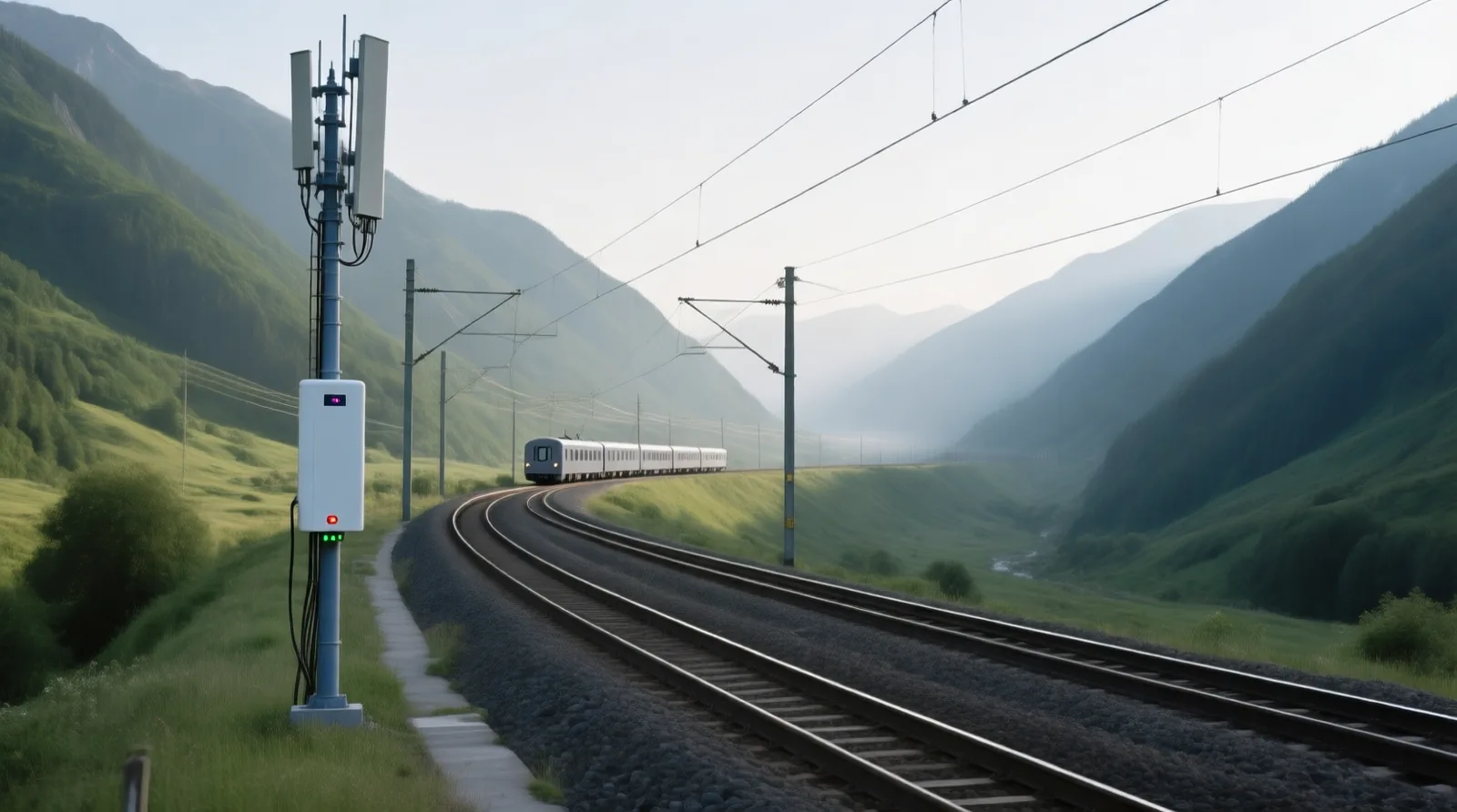
Few environments are harder on a removable SIM card than a locomotive. Vibration never stops, temperatures swing from depot to mountain pass, and the only time anyone can open a cab radio is during a short maintenance window. That is why railway engineers are among the most detailed advocates of eSIM: published work from heavy-haul freight lines and from the 5G-R programme shows both why the card fails and what has to be engineered before an eSIM can replace it. The answer for buyers is that eSIM solves the contact problem, but write endurance, profile management and the operator model need as much attention as the chip itself.
How vibration and cold defeat a SIM socket
The clearest failure analysis comes from LTE equipment on a heavy-haul line in northern China, where 30-tonne-axle-load trains of up to 25,000 tonnes have used TD-LTE since a 2014 trial (He, 2025). Inspecting long-used drawer-type sockets with SEM and EDS, the author found deep scratches, gold plating worn through to the base metal, organic residue and oxides. Vibration causes micro-friction between the socket springs and the card contacts, which drives oxide films and dust into the contact area until the signal is cut; during sharp temperature drops the debris hardens and lifts the springs, so unrecognised-card faults appear in clusters (He, 2025).
Mitigations exist but buy time rather than solve the problem. Cleaning the contacts with alcohol until bare metal shows removes non-conductive debris, and a dry lubricant film of perfluorinated solvent, perfluoropolyether oil and fine PTFE particles reduces wear, though applying it takes a cleaning, preheating, coating and baking routine with vendor guidance (He, 2025). Board design matters too: the same study recommends keeping the SIM socket within about 10 cm of the module and adding filtering capacitors and TVS protection on the SIM lines. The author’s conclusion is that contact faults cannot be eliminated on this equipment, which is why an embedded SIM was proposed.
The operational cost: card production and maintenance windows
The 5G-R research puts numbers on the administrative side. The GSM-R network in China used roughly 400,000 physical SIM cards; centralised card production, from application and review to writing, testing and distribution, takes more than seven days; and replacing a card on site costs 0.5 to 2 hours within limited maintenance windows (Qu et al., 2026). In one communication module of only 3.5 cubic centimetres, the SIM slot alone occupied 17% of the internal space (Qu et al., 2026).
Process rigidity adds to this. Railway SIM data is managed centrally by a card production centre, so introducing a new service means collecting cards, editing data and redistributing them, and when a locomotive moves between railway bureaus, the receiving bureau has to remove the old card and fit its own (Song, 2023). In freight and passenger rolling stock alike, each of these swaps is effectively a truck roll to a depot. A remotely managed profile turns most of them into a platform operation.
How rail eSIM architectures are being designed
The 5G-R work chose the GSMA SGP.31/SGP.32 IoT architecture, noting that the older M2M variant has stalled and consumer deployments have declined (Qu et al., 2026). Because the national railway runs as a single operator without interconnection to other networks, the discovery server was left out of scope; the IoT Profile Assistant runs on the eSIM itself so that terminals do not need software changes; a railway-run certificate authority issues certificates to the provisioning server, card vendors and eSIMs; and an EID-plus-IMEI whitelist restricts which devices may download profiles (Qu et al., 2026). An earlier study of the GSM-R system describes two download modes, one where the terminal connects as an independent network device and one where an accessory downloads through a main terminal, and lists the data a profile request carries, such as EID, owning bureau, terminal type and locomotive number (Song, 2023).
In Europe the same transition is being standardised through FRMCS, the successor to GSM-R. ETSI’s Technical Committee on Rail Telecommunications maintains the GSM-R specifications and develops FRMCS together with UIC and 3GPP, including conformance specifications for FRMCS services over 5G published in 2026 and a specification for interworking with GSM-R. Onboard equipment bought now should therefore be assessed against both today’s network and the migration path.
Write endurance: the question most eSIM tenders forget
A soldered chip removes the socket, but it introduces a new limit: how many times its memory can be rewritten. Consumer-grade SIM chips are rated at about 30,000 write-erase cycles, while automotive-grade AEC-Q100 parts reach around 1,000,000 (Qu et al., 2026). In 5G-R terminals the most frequent write is the location update file, so it largely determines eSIM life. Combining temperature, vibration, humidity and wear-out terms into one decay model, the authors estimated that effective endurance for high-speed onboard equipment falls to about 6.3% of the nominal rating, a theoretical result they say still needs field data to confirm (Qu et al., 2026).
For buyers this turns into concrete tender questions: what chip grade and rated cycle count the eSIM has, which files the modem writes and how often, and what operating temperature range is guaranteed. One example from the heavy-haul study is an eSIM in DFN8 packages rated from -40 to 105 °C with 500,000 read-write cycles, mounted on a small adapter board so that a failed unit can be swapped as a module instead of a whole communication board (He, 2025). Our guide to MFF2 soldered eSIM reliability goes deeper into packages and qualification.
Public networks, multiple operators and cross-border trains
Dedicated rail radio is only part of the picture. Wagon telematics, passenger information systems, onboard video and maintenance gateways usually run on public networks, where coverage along a line can vary by operator. One published method adds an automatic control program and a profile assistant to the device, stores profiles from several operators in the eUICC, averages three signal-strength readings, and switches to another operator’s profile when the signal falls below a per-device threshold and no data transfer is in progress, switching back if the new network is weaker (Min, 2022). It is a design description without field results, but it shows that multi-network failover with eSIM is a software and policy design, not a default behaviour.
Trains that cross borders add roaming restrictions: some countries limit permanent roaming or require local registration for devices that stay in-country, so the profile strategy has to be decided per route. For mixed fleets of routers and gateways, see our guide to IoT SIM for industrial routers, RTUs and DTUs.
Choosing a SIM approach for onboard equipment
| Onboard application | SIM approach | What to confirm first | Commercial path |
|---|---|---|---|
| Retrofit of existing LTE radios with drawer-type sockets | Industrial SIM plus contact maintenance, or eSIM on an adapter board | Socket condition, board space, adapter compatibility | Catalog pricing is usually enough for trials |
| New train-control or cab radio units | Soldered eSIM with remote provisioning | Chip grade and write endurance, temperature range, IPA location, certificate model | Request a project quote |
| Wagon telematics on public networks | Global IoT SIM or multi-profile eSIM | Coverage along the route, failover policy, data volume | Project quote |
| Cross-border freight or passenger services | Country-appropriate profiles | Permanent roaming restrictions, local registration, operator authorization | To be confirmed during project validation |
When to request a project quote, and the limits of the evidence
Request a project quote when equipment will be built into rolling stock in volume, when profiles must be managed centrally through an eIM, CMP or API, when more than one operator or country is involved, or when the railway requires its own certificate authority or device whitelist. Bring the module part numbers, the onboard application list, route countries and expected data per unit; our quote process explains the steps. If you are weighing delivery models for new hardware, eSIM vs physical SIM for OEM manufacturing and field replacement sets out the trade-offs.
Keep the evidence in proportion. The heavy-haul analysis covers one railway’s equipment without controlled experiments or quantified failure rates; the 5G-R lifespan figure is a model that needs field data; and the GSM-R and multi-operator papers are conceptual or procedural (He, 2025; Qu et al., 2026; Song, 2023; Min, 2022). None of them guarantees how a given train, route or operator will behave, and network coverage, operator authorization, failover and any SLA require project-specific confirmation.
How this maps to Quanqiu IoT
Quanqiu IoT supplies Global IoT SIM connectivity and eSIM for rail and transport equipment makers and integrators, with CMP access for activation, usage monitoring and lifecycle control. For onboard projects we review the module, chip grade, onboard applications and route countries first, and then propose the SIM format, profile strategy and management setup in a project quote.
FAQ
Why do SIM cards fail more often on trains than in buildings?
Continuous vibration causes micro-friction that wears the contact plating and pushes oxide and dust between the socket springs and the card, and cold snaps make that debris harder, so faults appear in clusters.
Is a soldered eSIM always more durable than a card?
It removes the contact failure, but memory write endurance becomes the limit. Ask for the chip grade, rated cycles and the expected write frequency of your modem.
Can existing onboard radios be converted to eSIM?
One published approach mounts the eSIM on a small adapter board that plugs into the existing socket and can be swapped quickly; suitability depends on the specific board and is confirmed during project validation.
How does eSIM relate to FRMCS?
FRMCS is the 5G-based successor to GSM-R being specified by ETSI with UIC and 3GPP. Rail eSIM designs aim to make onboard units ready for that migration without manual card changes.
Can a train unit switch operators automatically?
On public networks, a multi-profile eSIM with a switching program can change operator when the signal drops below a threshold, but the policy, coverage and roaming rules must be designed and tested for each route.
Official References
- ETSI — Technical Committee Rail Telecommunications (GSM-R and FRMCS)
- GSMA — IoT RSP: Enabling the growth of Massive IoT (SGP.31 and SGP.32)
- He Qiang (2025). Fault Analysis of SIM Cards in LTE Communication Equipment of Heavy-Haul Combined Trains and Research on ESIM Card Solutions (in Chinese). 电子元器件与信息技术, (5), 221-223, 227.
- Qu Yi, Zhang Weijun (2026). Research on eSIM Technology and Its Operation and Maintenance Scheme of 5G-R System (in Chinese). 铁道通信信号, 62(5), 52-61.
- Song Jing (2023). Discussion on the Application of eSIM in Railway Dedicated Mobile Communication System (in Chinese). 铁路通信信号工程技术, 20(3). https://doi.org/10.3969/j.issn.1673-4440.2023.03.008
- Min Qingxue (2022). Automatic Switching Between Multiple Operators for IoT Device Communication Based on eSIM Technology (in Chinese). 通信管理与技术, (5), 45-49.