eSIM for Power Distribution Automation Terminals: Remote Provisioning, Authentication and Field Reliability
Por jietion, Desarrollo de Negocio (BD) en Quanqiu IoT · Publicado
Definition: In a distribution automation terminal, an eSIM is a SIM chip soldered onto the communication module whose operator profile can be downloaded, switched and corrected remotely instead of during a site visit.
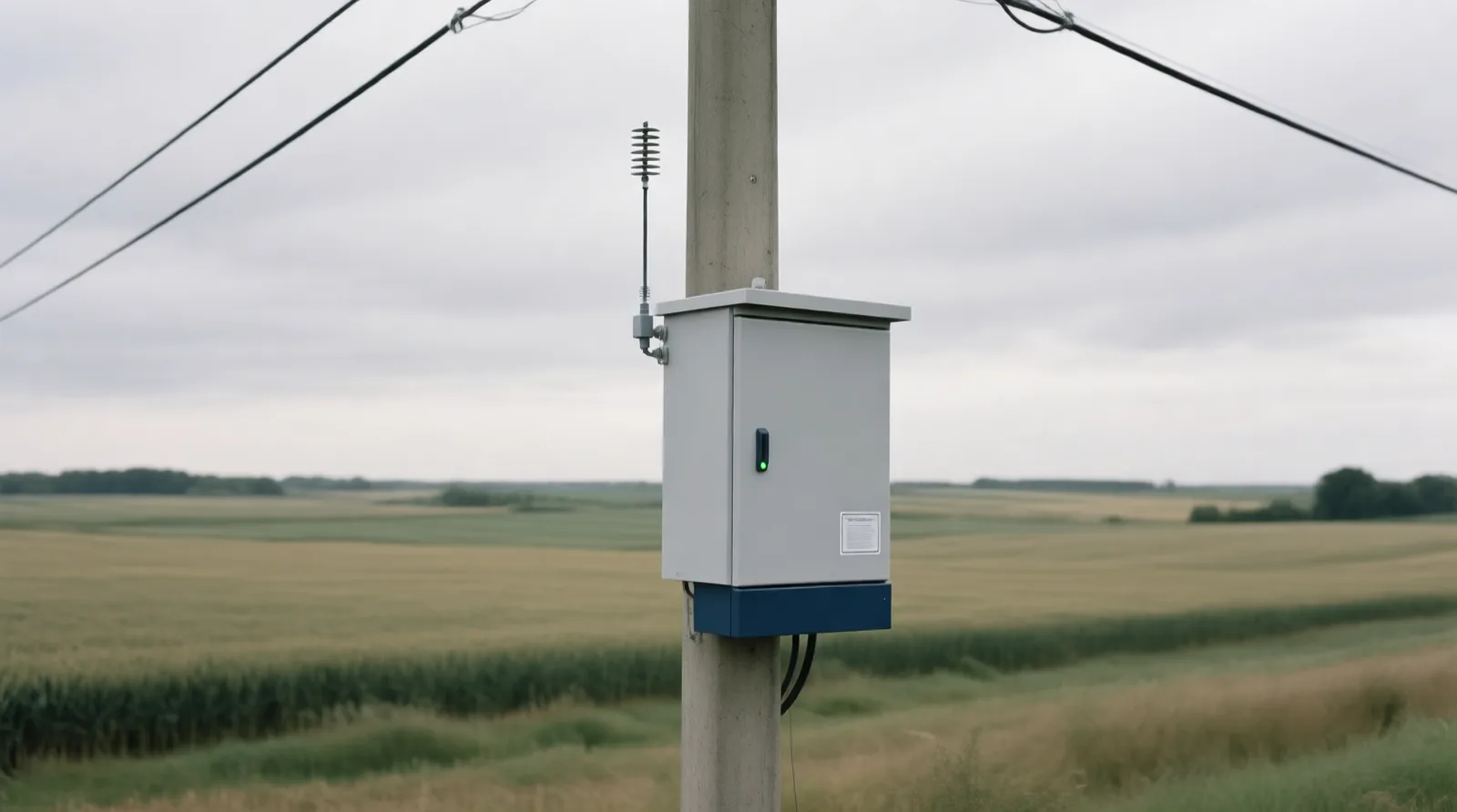
For grid operators and the companies that build feeder terminals, ring-main-unit controllers and data concentrators, eSIM is first a reliability decision and only second a provisioning decision. A removable SIM card is one of the few moving parts in an otherwise sealed terminal, and in field studies of distribution networks it shows up again and again in the list of reasons a terminal drops offline. Replacing it with a soldered eSIM removes the contact problem; the harder engineering questions sit in the communication module, the authentication design and how profiles are managed across thousands of sites.
Why removable SIM cards keep knocking feeder terminals offline
A study of distribution automation terminals in a Chinese provincial network grouped offline events into wireless-module faults, power supply problems, terminal and software faults, parameter mismatches, SIM card problems and master-station issues. Terminal-side abnormalities such as module failure, a loosened SIM card or loss of power accounted for nearly half of all offline events, and SIM-related causes alone, namely loosening, rust, contamination, moisture and wrong parameter settings, were linked to about 18% of them (Liu et al., 2018). A more recent design paper from another provincial grid describes the same pattern: pluggable cards in distribution terminals lose contact, absorb humidity and suffer from vibration, which degrades stability (Chen et al., 2026).
The scale makes the problem expensive. Public-network terminals in power systems have long used the 25 mm by 15 mm mini SIM, and a single prefecture-level city can hold tens of thousands to more than a hundred thousand SIM cards, which is hard to administer and tends to waste number resources (Wang, 2019). Every terminal that goes offline because of a card means a truck roll to a pole-top cabinet, a substation yard or an underground vault. The European Commission estimates that about EUR 584 billion of electricity infrastructure investment is needed between 2020 and 2030, much of it in distribution grids, so the number of connected field devices that need this kind of attention is growing rather than shrinking.
The data side raises the stakes further. Dispatch centres are digitising operating knowledge; one study matched textual fault plans to reported fault phenomena automatically with an F1 score of about 0.93 on a regional dataset (Ji et al., 2022). Tools like that are only as good as the terminal data that reaches them, and a terminal that silently drops off the network is the weakest link.
What a soldered eSIM changes inside the terminal
An eSIM in this setting is an embedded chip soldered to the communication module rather than a card in a socket (Liu et al., 2018). Because there is no slot and no exposed contact, the terminal resists vibration, moisture, heat and electromagnetic interference better, keeps data longer and tolerates more update cycles; it can also be sealed more tightly because no card opening has to be reserved (Liu et al., 2018; Wang, 2019). The eUICC itself can take up around 90% less board space than a physical SIM, and one eUICC can hold several operator profiles, with one active at a time (Wang, 2019).
The operational gain comes from remote management. Communication parameters can be written after the terminal leaves the warehouse, which cuts configuration mistakes made by installation crews, and a wrongly configured terminal can be corrected over the air instead of going offline (Liu et al., 2018). Card administration also collapses: filing, requisition, return and allocation of cards become a single operation, and timely remote deactivation avoids paying for lines that should already have been closed (Liu et al., 2018).
On the standards side, GSMA published SGP.31 (architecture and requirements) and SGP.32 (technical specification) specifically for network- and UI-constrained IoT devices, so that operator profiles can be provisioned over the air without manual card swaps. The trust model is the same family as earlier GSMA remote provisioning: a certificate issuer signs certificates for the provisioning platform and the eUICC from a common root, which lets them authenticate each other (Wang, 2019). For a deeper explanation of the eIM and IoT Profile Assistant roles, see our SGP.32 remote provisioning guide.
5G and RedCap modules: the interface problem that is easy to miss
The 2026 provincial-grid design paper is useful mainly because it documents a hardware constraint that procurement documents rarely mention. Many 5G modules in LGA packages expose at most two ISO 7816 SIM interfaces, which is not enough to switch freely between an eSIM from one operator, an eSIM from another and a physical USIM. RedCap modules on an M.2 interface may offer only one 7816 interface and no SPI port (Chen et al., 2026).
The authors work around this with an external eSIM module and a hardware switch: when a physical USIM is inserted it takes the interface and the external eSIM is disabled; without a USIM, the internal or external eSIM is selected (Chen et al., 2026). The practical lesson for buyers is simple. Before you specify “eSIM with multi-operator capability” for a 5G or RedCap terminal, ask the module vendor how many SIM interfaces the module really exposes, whether the eSIM will be on-module or external, and how switching between operators is triggered. Multi-network operation and failover are design choices that must be engineered and tested; they do not come for free with an eSIM.
Authentication and lifecycle control at grid scale
Utilities tend to add their own security layer on top of the operator’s network authentication. In the scheme described for one Chinese provincial grid, the eSIM chip carries the utility’s own cryptographic service certificates for a secondary authentication step, the platform uses the national SM2, SM3 and SM4 algorithms, and session keys stay inside the chip and the cipher machine, are not exportable, and expire so that terminals must re-authenticate (Chen et al., 2026). The deployment reused existing provincial infrastructure with one application server, one database server and one additional cipher machine, and the platform covers the eSIM lifecycle from application and configuration through activation, maintenance and retirement, with early warnings when signal quality degrades (Chen et al., 2026).
Outside China the algorithms and certificate authorities will differ, but the architecture questions are the same: who issues the device identity, where keys live, how profile operations are authorised, and which system raises an alarm before a terminal goes dark. For substation-side gateways and protocol choices, our guides on IEC 61850 substation gateways and DNP3 RTUs and SCADA links cover the application layer that rides on this connectivity.
Choosing a SIM approach for distribution terminals
Buyers should match the SIM approach to the rollout rather than to the technology trend. The table below summarises the choices we see most often; values that depend on the operator, the module or the utility’s security policy are marked for confirmation.
| Situation | SIM approach | What to confirm first | Commercial path |
|---|---|---|---|
| Pilot of a few dozen terminals on one network | Industrial physical SIM or soldered MFF2 with a single profile | Module socket or MFF2 footprint, APN, data volume | Catalog pricing is usually enough |
| Feeder automation rollout across a city or province | eSIM with remote provisioning and central lifecycle management | eIM or RSP platform ownership, CMP or API integration, card administration process | Request a project quote |
| 5G or RedCap terminals that must reach more than one operator | On-module or external eSIM with a defined switching design | Number of 7816 interfaces, SPI availability, switching trigger, failover test plan | Project quote with engineering review |
| Utility requires its own secondary authentication | eSIM that can host utility certificates | Certificate authority, key storage, algorithm requirements | To be confirmed during project validation |
| Terminals exported for overseas grid projects | Global IoT SIM or eSIM profiles for the target country | Permanent roaming restrictions, local registration rules, operator authorization | Project quote per country |
When a project quote is the right route
Published plans work for evaluation units and small pilots where one network, one APN and a predictable data volume are enough. Move to a project quote when the terminal count reaches fleet scale, when profiles must be managed centrally through an eIM, CMP or API, when 5G or RedCap modules need a multi-operator switching design, when the utility adds its own authentication layer, or when terminals will be installed outside the country where they were built. In the last case, permanent roaming restrictions and local registration requirements decide whether a roaming profile is acceptable at all, and that is a country-by-country question.
A useful quote request lists the terminal types and module part numbers, expected terminal count and phasing, target countries, data profile per terminal, whether eSIM profiles must come from more than one operator, and who will operate the provisioning platform. Our quote process page explains what happens next.
Risk boundaries: what the studies do and do not show
The research cited here is valuable because it comes from people running real distribution networks, but it has limits. The 2018 terminal study is a qualitative comparison without field trials or quantitative reliability metrics; the 2019 review discusses prospects rather than measured results; and the 2026 authentication design reports no field trial or security test results and applies to one provincial grid (Liu et al., 2018; Wang, 2019; Chen et al., 2026). The 18% figure describes one network’s offline causes and does not prove the same share elsewhere.
An eSIM also does not fix every cause of downtime: module failures, power loss and master-station problems remain. Coverage, operator authorization for profiles, failover behaviour and any service levels are not implied by choosing eSIM, do not guarantee uptime, and require project-specific confirmation. We do not offer an SLA unless one is agreed in writing for a specific project.
How this maps to Quanqiu IoT
Quanqiu IoT supplies Global IoT SIM connectivity for industrial terminals in removable and soldered form factors, eSIM for projects that need remote provisioning, and CMP access for lifecycle tasks such as activation, monitoring and deactivation. For grid projects we start from the terminal design: module interfaces, target networks, data volume, rollout phasing and the security model, and then propose the connectivity and management setup in a project quote. If vibration and sealing are your main concerns, our guide to MFF2 soldered eSIM reliability covers form-factor selection, and eSIM vs physical SIM for IoT compares the delivery models.
FAQ
Does an eSIM remove SIM-related truck rolls completely?
It removes the contact, moisture and loosening failures of a removable card and lets many configuration mistakes be fixed over the air. It does not prevent module, power or master-station faults, so some field visits remain.
Can one distribution terminal use profiles from more than one operator?
An eUICC can store several profiles with one active at a time, but whether a 5G or RedCap terminal can switch between them depends on the module’s SIM interfaces and the switching design. Confirm this with the module vendor before writing it into a tender.
Is SGP.32 required for eSIM in grid terminals?
SGP.32 is the GSMA specification built for constrained IoT devices and is the natural choice for new designs, but the platform, operator support and who runs the eIM must be agreed for each project.
How do utilities add their own security on top of eSIM?
One published design stores the utility’s certificates in the eSIM chip for a secondary authentication step and keeps session keys non-exportable. The equivalent outside China depends on the utility’s own PKI and is confirmed during project validation.
When is catalog pricing enough?
For pilots and small batches on one network with a known data volume. Fleet-scale rollouts, multi-operator designs, utility authentication and exported terminals need a project quote.
Official References
- GSMA — IoT RSP: Enabling the growth of Massive IoT (SGP.31 and SGP.32)
- European Commission — Smart grids and meters
- Liu Liang, Chen Feng, Liu Guanke, Xia Yunfeng, Qin Weidong, Su Sheng (2018). Distribution Automation Terminal Based on eSIM Card (in Chinese). 湖北电力, 42(5), 25-28.
- Chen Jinshan, Wu Shiyu, Wang Xinlan, Chen Duanyun, Yu Sihang, Li Zhaoxiang, et al. (2026). Unified Authentication Management Technology and Application for Power 5G Communication Based on eSIM (in Chinese). 电力信息与通信技术, 24(7), 109-116. https://doi.org/10.16543/j.2095-641x.electric.power.ict.2026.07.12
- Wang Wei (2019). The eSIM Technology and Its Application Prospect in the Power Systems (in Chinese). 电气传动自动化, 41(6), 36-39.
- Ji Wenxuan, Cui Jianye, Feng Bin, Gu Wei, Zheng Xiang, Guo Chuangxin (2022). Power Dispatching Fault Plan Matching Based on Visual Character Enhancement (in Chinese). Proceedings of the CSEE, 42(15), 5439-5447. https://doi.org/10.13334/j.0258-8013.pcsee.220273